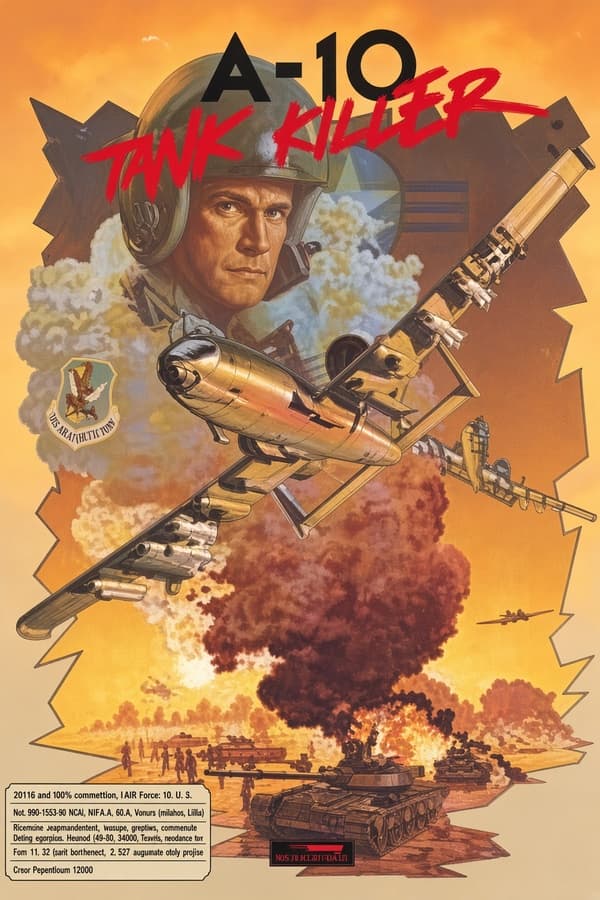

A-10 Tank Killer
aka A-10 Tank Killer: Version 1.5
Rate this game
- Played
- A lot
Damon Slye and Dynamix took a deliberate detour from abstract flight simulators when they built A-10 Tank Killer, prioritizing low-altitude mud-moving and massive gun barrels over high-altitude dogfighting.
Low-altitude armor hunting in a cold war sky
Most flight simulators of the late eighties wanted to put you inside a sleek fighter jet miles above the clouds, forcing you to fight beyond visual range with radar locks and radio chatter. This game drags you right down into the mud, placing your cockpit inside the titanium bath of an A-10 Thunderbolt II. Your main job is taking out enemy tank columns, supply convoys, and bridges in Cold War Europe, running missions where a single missed target can come back to bite you later.
The entire flight model revolves around the 30mm GAU-8 Avenger cannon. Firing up to 70 rounds per second, the gun is powerful enough to shred heavy armor in a quick burst, but managing your weapon loads and low approach angles is where the challenge lies. You get digitized mission briefings before every launch, automated landing assistance, and accelerated time functions to skip long transits, making this classic simulation game far more approachable than a hardcore manual-heavy study sim.
What really set the mission design apart was its persistent campaign tracking. If you leave an artillery battery intact during a strike over Europe, those exact units return in subsequent missions to shell your forward operating base or harass your wingmen. The crew on your side has actual personality too: digitized portraits of real actors appear during radio calls, with wingmen like Lieutenant Jake Styles and Captain Buck Ryan offering updates while Commander Cord barks orders from command.
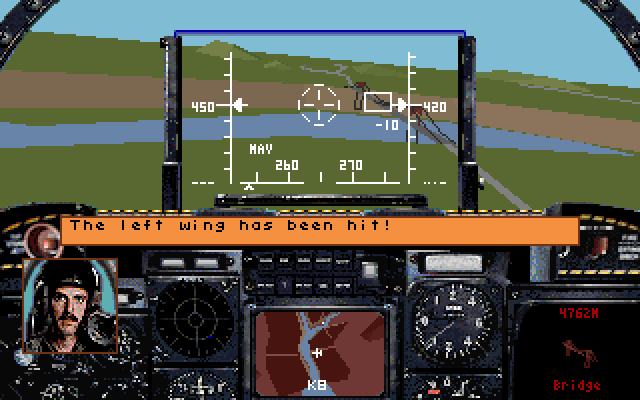
When processor speeds break flight physics
Under the hood, the engine running this 1989 release was Dynamix's proprietary 3Space 3D technology, written by programmers Lincoln Hutton and David McClurg. Designers Damon Slye, Jerry Luttrell, and David Selle focused on creating flat-shaded polygonal ground vehicles and structural targets that your 30mm cannon could obliterate. To make installation less painful on early setups, the developers included their custom Smart Start installer tool to automatically detect graphics adapters and sound cards.
Audio was a genuine strength if you had the right expansion boards installed. While standard PC speaker bleeps sounded rough, full support for AdLib, Sound Blaster, Roland MT-32, and the PS/1 Audio card gave gun bursts and jet engine hums real weight. The visual presentation also benefited from digitized photography for characters, using real faces like Brian Hahn for Lt. Styles and Dave Shew for Captain Ryan to populate the briefing screens.
Yet the original engine suffered from a notorious CPU speed bug that ruined the experience on faster setups. On machines like a 386 running at 20MHz, the flight loop ran entirely unthrottled, turning subtle control inputs into extreme maneuvers. A single tap on the pitch axis would send the aircraft somersaulting straight into the dirt, leading to endless frustration for players who upgraded their systems shortly after buying the game.
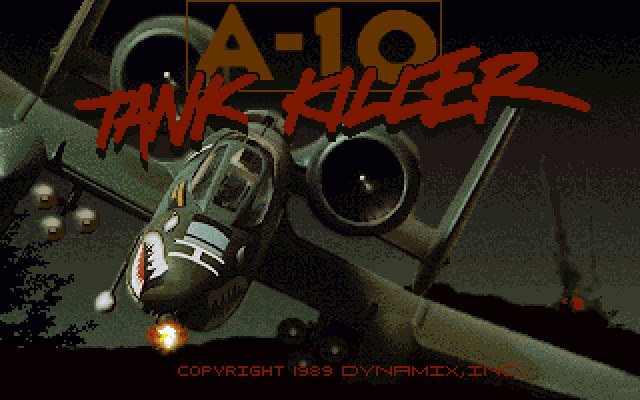
Why modern players still crash on the first turn
Even without hardware timing bugs, staying airborne requires a light touch on the stick. The flight physics feel heavy, and enemy anti-aircraft artillery does not forgive wide, lazy turns over the target area. Aggressive enemy AI forces you to line up your target quickly, squeeze off a single cannon salvo, and break away before surface-to-air missiles track your jet engines.
Reviewers at the time were largely impressed by the balance between action and flight management. Computer Gaming World awarded it four out of five stars, while British magazine The Games Machine gave it a 96% score, praising the accessible vehicle design and mission variety. Overseas, French magazine Joystick scored it 79%, and Zzap!64 rated it 90%. Germany took a far stricter stance: in 1991, the BPjM indexed and effectively banned the game due to strict anti-war media laws, a restriction that remained until 2016.
In 1991, version 1.5 added seven new missions set during Operation Desert Storm in Iraq, giving players fresh tactical scenarios in open desert terrain. Together with its 1996 sequel, Silent Thunder: A-10 Tank Killer II, the series eventually surpassed 250,000 retail sales. While contemporary reviewers occasionally dinged the game for sparse polygon counts and fiddly flight controls, the combination of dynamic campaign elements and sheer firepower won over plenty of DOS PC owners.
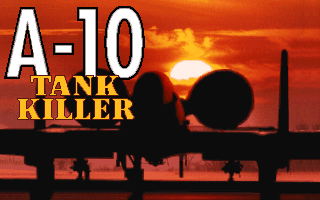
You can play A-10 Tank Killer online right now
If you want to experience this early piece of combat aviation history without hunting down old floppy disks or tweaking DOS memory setups, you can play A-10 Tank Killer online free in your browser right now. Everything runs directly inside your window, allowing you to jump straight into the tactical briefings and test your aiming skills against Cold War armor columns with zero extra software required.
When you start your first mission, resist the urge to pull hard back on the stick during low-level strafing runs. The key to surviving this classic Dynamix release is keeping your speed up, lining up targets from a steady distance, and firing in brief half-second bursts. You can test your pilot skills with this authentic A-10 Tank Killer MS-DOS game launch directly below, taking control of the Warthog's massive cannon with just one click.
How A-10 Tank Killer is played — the keys the game listens to, grouped by what they do.
- Look
- Action
- Weapons & items
- Interface
Highlighted keys are mapped — hover or tap one to see what it does.
Mouse can optionally be used for movement and weapon firing. Joysticks can be calibrated using Alt+C.
Players' controls
Touch and gamepad controls
The on-screen keyboard and gamepad mapping the browser player uses on a phone, a tablet or a controller, as opposed to the real keys above. $PRO members make their own in the player and share them here; anyone can pick one to play with.
Make your own touch controlsPRO
- 1Open the editorSign in below, then pick what to make. The game starts with the editor open over it.
- 2Place your keysAdd keys and drag them where your thumbs rest, or map a controller's buttons. Test plays the game with them; Save keeps them, and you play with them from then on.
- 3Share themShare them right after saving in the game, or name and share them here. Players vote, and the best become this game's controls for everyone.
Go PROSee how it worksSign in+20 XP for sharing · +50 XP if yours become the game's own
- The game's own controlsKeyboardGamepadWhat every player starts with.In use
3 screenshots
From the archive
No gameplay video yet
No gameplay video for A-10 Tank Killer yet. Sign in to add one.
No reviews yet
Tell the community what you think of A-10 Tank Killer. Reviews are public and tied to your username.
No archived manuals for A-10 Tank Killer yet
No manuals archived for this title yet. Sign in to upload the first scan.
Cheat codes, console commands and memory pokes for A-10 Tank Killer — each one verified and attributed.
Sign in to submitNo cheats yet for this title
Know a working cheat, poke or trainer? Add it with the button above. Moderators check every entry before it goes live.
No archived soundtrack for A-10 Tank Killer yet
No soundtrack archived for this title yet. Sign in to upload the first rip.
No save states for A-10 Tank Killer yet
No save states for this title yet. Sign in to share one.
Discussions
Sign in to post- Threads0
- Total posts0
- Online now6
Community · A-10 Tank Killer
Who's contributing, and what's new
- Reviews0
- Threads0
- Uploadsapproved0
- Contributors0
Recent activity
Nothing here yet
Reviews, discussion threads and approved uploads appear here as members add them.