
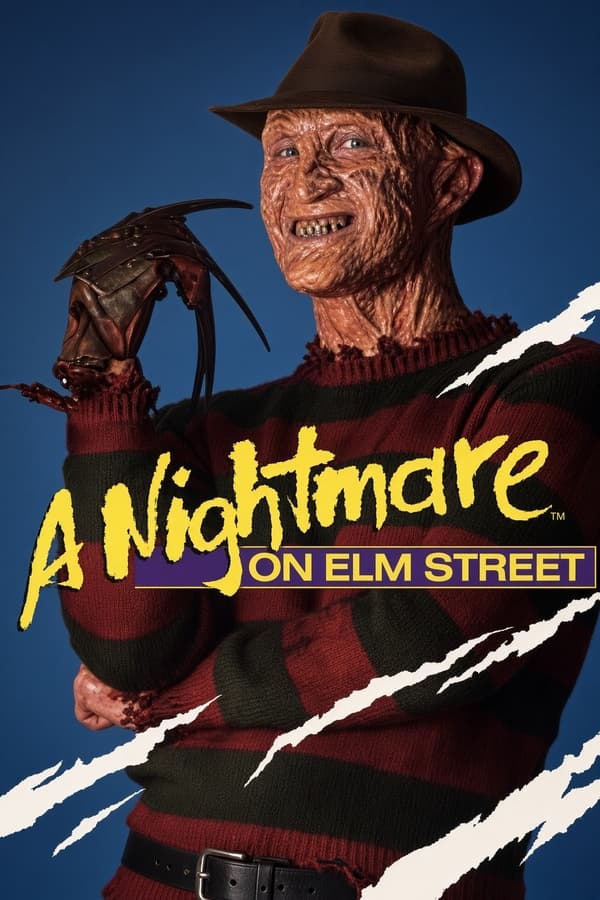

Long before they defined real-time strategy, Westwood Associates turned A Nightmare on Elm Street into a top-down action horror game where idle menu screens punish you for wasting time.
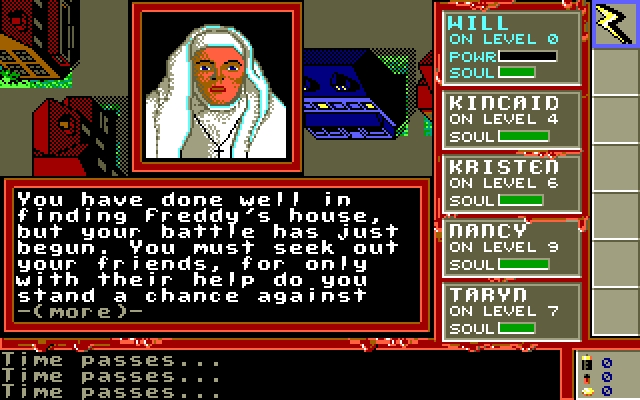
Most movie tie-ins of the late eighties were simple side-scrollers, but this adaptation of the third film takes a different path. You start on the street level of Elm Street, navigating a multi-directional scrolling maze to find keys, batteries, and weapons while avoiding traps and wandering monsters. Your ultimate goal is to break into Freddy Krueger's house, enter the Nightmare World, and rescue your five captured friends before their soul meters empty completely.
The immediate threat comes from the ticking clock. As you explore, your captured friends scream as their health constantly drains in the background. If you take too long searching suburban alleys for gold coins and supplies, they die before you ever reach them. Even the character selection screen has a cruel trick built into it: if you take too long picking your hero, Freddy pops up and kidnaps the available teenagers one by one until you are stuck with whoever remains.
You can choose between five teenagers, each bringing a specific special ability to the fight:
While the game opens with clever survival ideas, sitting down to actually play the 1989 release reveals where it hits a wall. The isometric top-down perspective makes navigating narrow hallways and street corners frustratingly imprecise. It is far too easy to clip into environment geometry, getting stuck in a wall while a giant spectral version of Freddy wanders over to finish you off.
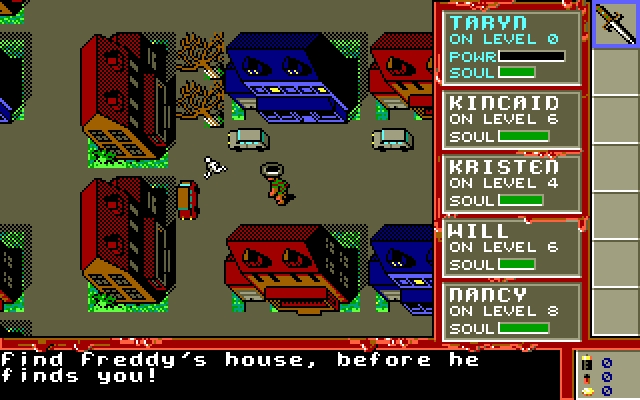
The visuals suffer from an oddly murky palette, looking a bit like an older 8-bit port pushed onto PC displays without much cleanup. Enemy hitboxes can feel arbitrary, meaning your precious ammunition and battery power for special abilities often go to waste. If you run out of health or let your friends perish, the run ends fast, leading many players to hunt down fan-made trainers just to bypass the unforgiving damage spikes.
Looking at the credits reveals where the team started out. Developed by Westwood Associates and published by Monarch Development, this title arrived years before the studio made Dune II and Command & Conquer. You can already see early signs of their interest in multi-directional scrolling and complex map design, even if the underlying mechanics lack the polish of their later work.
It is worth clarifying that this DOS release is completely distinct from the 1990 NES title of the same name developed by Rare. While the console game was a four-player platformer, Westwood's computer version focused heavily on resource management, maze navigation, and atmospheric horror elements. It gives a clear look at how early action games were changing on PC hardware.
For modern players, the game is best approached as a fast-paced, high-stress curiosity rather than a long campaign. An experienced action player who knows the layout of the streets can zip through the main quest quite quickly, but your first few attempts will almost certainly end in sudden death within the maze of tunnels. Managing your Soul meter while hunting for gold coins to buy vital health restoration keeps the tension high throughout the short runtime.
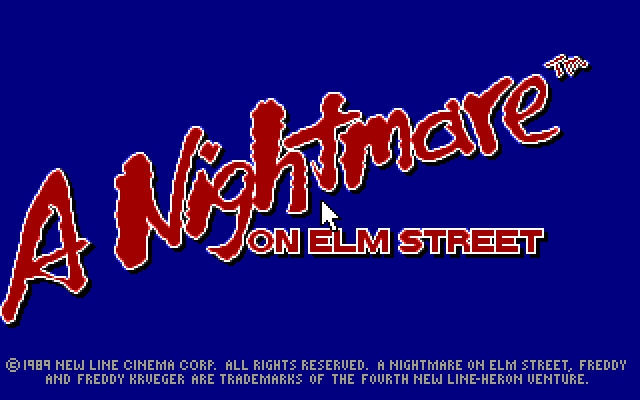
If you want to test your reflexes against Freddy's minions, you can play A Nightmare on Elm Street online today. You can launch the full A Nightmare on Elm Street MS-DOS game free in your browser right here, with no setup required. Just remember to pick your starting character immediately off the title screen, or Freddy will decide your team for you before you even take your first step down Elm Street.
Long before they defined real-time strategy, Westwood Associates turned A Nightmare on Elm Street into a top-down action horror game where idle menu screens punish you for wasting time.
Most movie tie-ins of the late eighties were simple side-scrollers, but this adaptation of the third film takes a different path. You start on the street level of Elm Street, navigating a multi-directional scrolling maze to find keys, batteries, and weapons while avoiding traps and wandering monsters. Your ultimate goal is to break into Freddy Krueger's house, enter the Nightmare World, and rescue your five captured friends before their soul meters empty completely.
The immediate threat comes from the ticking clock. As you explore, your captured friends scream as their health constantly drains in the background. If you take too long searching suburban alleys for gold coins and supplies, they die before you ever reach them. Even the character selection screen has a cruel trick built into it: if you take too long picking your hero, Freddy pops up and kidnaps the available teenagers one by one until you are stuck with whoever remains.
You can choose between five teenagers, each bringing a specific special ability to the fight:
While the game opens with clever survival ideas, sitting down to actually play the 1989 release reveals where it hits a wall. The isometric top-down perspective makes navigating narrow hallways and street corners frustratingly imprecise. It is far too easy to clip into environment geometry, getting stuck in a wall while a giant spectral version of Freddy wanders over to finish you off.
The visuals suffer from an oddly murky palette, looking a bit like an older 8-bit port pushed onto PC displays without much cleanup. Enemy hitboxes can feel arbitrary, meaning your precious ammunition and battery power for special abilities often go to waste. If you run out of health or let your friends perish, the run ends fast, leading many players to hunt down fan-made trainers just to bypass the unforgiving damage spikes.
Looking at the credits reveals where the team started out. Developed by Westwood Associates and published by Monarch Development, this title arrived years before the studio made Dune II and Command & Conquer. You can already see early signs of their interest in multi-directional scrolling and complex map design, even if the underlying mechanics lack the polish of their later work.
It is worth clarifying that this DOS release is completely distinct from the 1990 NES title of the same name developed by Rare. While the console game was a four-player platformer, Westwood's computer version focused heavily on resource management, maze navigation, and atmospheric horror elements. It gives a clear look at how early action games were changing on PC hardware.
For modern players, the game is best approached as a fast-paced, high-stress curiosity rather than a long campaign. An experienced action player who knows the layout of the streets can zip through the main quest quite quickly, but your first few attempts will almost certainly end in sudden death within the maze of tunnels. Managing your Soul meter while hunting for gold coins to buy vital health restoration keeps the tension high throughout the short runtime.
If you want to test your reflexes against Freddy's minions, you can play A Nightmare on Elm Street online today. You can launch the full A Nightmare on Elm Street MS-DOS game free in your browser right here, with no setup required. Just remember to pick your starting character immediately off the title screen, or Freddy will decide your team for you before you even take your first step down Elm Street.
How A Nightmare on Elm Street is played — the keys the game listens to, grouped by what they do.
Highlighted keys are mapped — hover or tap one to see what it does.
Requires mouse driver pre-installed to use mouse movement and selection controls. Contains copy-protection screen where words are selected/identified.
The on-screen keyboard and gamepad mapping the browser player uses on a phone, a tablet or a controller, as opposed to the real keys above. $PRO members make their own in the player and share them here; anyone can pick one to play with.
Cheat codes, console commands and memory pokes for A Nightmare on Elm Street — each one verified and attributed.
Sign in to submitaka Nightmare on Elm Street: Dream Warriors
How A Nightmare on Elm Street is played — the keys the game listens to, grouped by what they do.
Highlighted keys are mapped — hover or tap one to see what it does.
Requires mouse driver pre-installed to use mouse movement and selection controls. Contains copy-protection screen where words are selected/identified.
The on-screen keyboard and gamepad mapping the browser player uses on a phone, a tablet or a controller, as opposed to the real keys above. $PRO members make their own in the player and share them here; anyone can pick one to play with.
Cheat codes, console commands and memory pokes for A Nightmare on Elm Street — each one verified and attributed.
Sign in to submit