
In Abuse, you move inmate Nick Vrenna through a dark, mutagen-infested prison facility using your keyboard while aiming your weapon crosshair independently with the mouse.
Aiming with the mouse changed how 2D action shooters had to feel
Before this game arrived on PC displays, two-dimensional platform shooters locked your fire to whichever direction your character happened to face. Running left meant shooting left, and hitting an enemy flying diagonally above you required jumping into the air and pitching your aim at awkward 45-degree angles. Crack dot Com tore that constraint down completely by splitting movement and crosshair control between two hands.
You use the keyboard to run, jump, and navigate platforms, while your right hand sweeps a mouse reticle across any pixel on the screen. Running backward down a narrow catwalk while laying down fire into a ceiling vent full of descending creatures feels smooth in a way no contemporary console side-scroller could match. The basic Laser Rifle fires steady red pulses that instantly follow your pointer, making short work of small wall-crawlers before they leap onto your head.
As you fight deeper into the complex, you unlock heavier firepower including grenade launchers, flamethrowers, and high-impact explosives. Bouncing a grenade around a corner to clear out a room full of mutated inmates before walking through the door becomes standard practice. Finding speed boots or a jetpack power-up turns Nick Vrenna into a hovering gun platform capable of circling massive mutant bosses while keeping a constant stream of plasma locked onto their weak spots.
Dark corridors, swarming mutants, and the brutal weight of save consoles
The campaign places you inside an underground high-security detention facility set in the then-futuristic year 2009. A genetic outbreak called Abuse has transformed the guards and inmates into aggressive monstrosities, and your goal is to stop the liquid mutagen from reaching the primary water supply before making your escape. The level design moves you through claustrophobic metal shafts and wider alien-infested chambers linked by teleporters, elevators, and destructible walls.
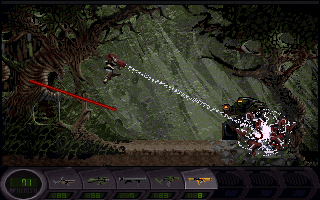
Atmosphere does a lot of the heavy lifting during early levels. Composer Bobby Prince provided a driving soundtrack through MIDI and digital audio hardware that paired nicely with dynamic lighting effects and pitch-black secret pockets hidden behind cracked walls. You spent half your time shooting wall switches to unlock doors and the other half scanning dark ceilings for lurking flyers.
The pacing hits a wall later in the campaign due to two specific design choices that still make modern players grind their teeth:
- Save terminals: You cannot save your progress anywhere on the fly. You must reach designated save consoles, which are often spaced far apart across huge multi-screen levels.
- Difficulty spikes: Late-game areas choke small corridors with massive waves of fast-moving enemies and flying beasts, draining your special ammunition instantly.
- Control learning curve: Coordinating fast keyboard jumps with sudden mouse flicks requires hand-eye coordination that took 1990s PC players hours to master.
Dying near the end of a long level means replaying ten minutes of platforming and switch-hunting just to get another shot at the ambush that killed you. When the game throws dozens of flyers into a narrow corridor alongside automated defense turrets, your health pool evaporates before you can sweep the crosshair across the screen.
Under the hood of Abuse: LISP code, late rewrites, and public domain source
The technical structure behind the project was unusual for an MS-DOS release. Programmer Jonathan Clark built an internal LISP interpreter engine directly into the code, using script files to manage enemy behaviors, object interactions, level triggers, and weapon physics. Dave Taylor produced the title, while Duong Nguyen and Murray McMillan crafted the sprites and metallic wall textures.
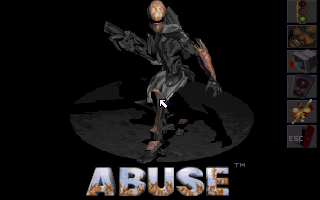
The development team radically changed the story late in the production process. The initial design centered on a special operations agent infiltrating an alien hive to destroy a central cooling system, but the team stripped that context away and replaced it with Nick Vrenna's prison breakout scenario shortly before release. When Electronic Arts, Inc. published the title in North America, its shareware version had already spread across BBS systems and compilation CDs.
In the late 1990s, Crack dot Com released the source code and shareware art assets into the public domain, though Bobby Prince retained rights to his sound effects. That code release allowed porting enthusiasts to bring the engine to Mac OS (handled by Bungie), Linux, and AmigaOS. Command-line enthusiasts could launch the original binary with the -edit flag to enable built-in developer shortcuts, including pressing Shift+Z for god mode when the late-game swarms became unmanageable.
Why you should play Abuse online right now
The dual-stick layout standard on modern controllers owes an obvious debt to the control scheme pioneered here. While the harsh save system and late-level enemy density can feel punishing, the core loop of running, leaping, and aiming across 360 degrees holds up extremely well for anyone who loves action games from 1995. The weight of the movement and the speed of the crosshair make taking down swarms of alien beasts genuinely satisfying once your hands adapt to the scheme.
You can play Abuse online free in your browser right now without downloading floppy disk images or wrestling with DOS emulation settings. If you have never experienced this landmark MS-DOS game before, jump in, grab the mouse, and remember to keep moving backwards while you clear the ceiling vents.