
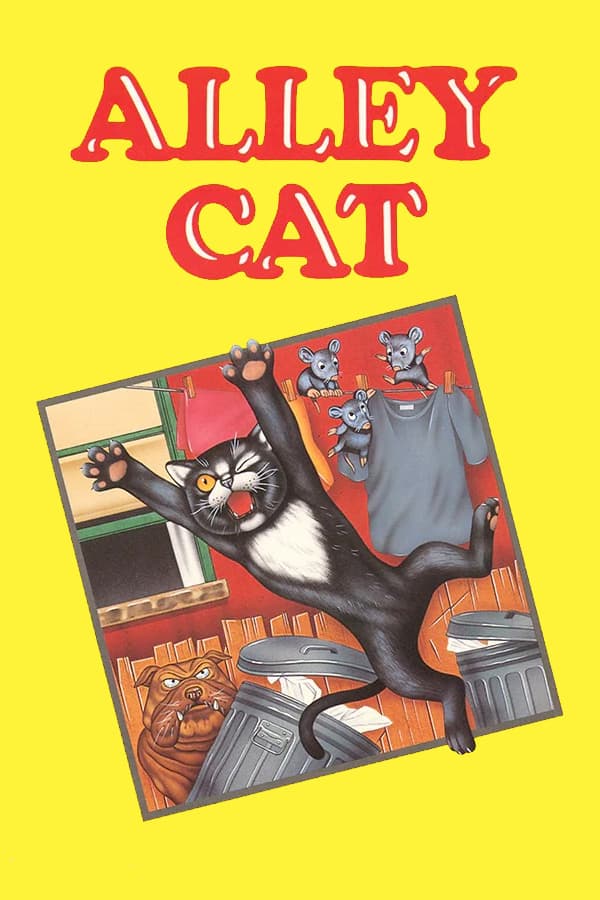

If you played Alley Cat on an early IBM PC, you probably spent hours helping a scrappy black feline jump off trash cans, dodge flying shoes, and leap into fishbowls.
Bill Williams built Alley Cat out of a discarded prototype
Before it became an early standard for home computer platforming, the project began as an unfinished idea. Original designer John Harris created a single-screen prototype for Atari hardware but grew dissatisfied with where it was going and set it aside. Programmer Bill Williams took over the concept at Synapse Software Corporation, expanding the single alley into a full suite of distinct single-room arcade challenges.
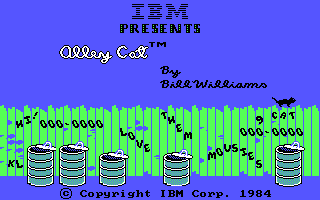
When IBM published the PC port in 1984, the entire program arrived compressed into a single executable named CAT.EXE. Fitting the full package between 32KB and 55KB meant Williams had to assemble the machine code by hand, embedding all graphic tables, sprite animation data, and single-channel PC Speaker music directly into that tiny file. There were no secondary data archives or external audio drivers to load. The machine simply booted the executable and immediately began buzzing out the bouncy main theme through the system's internal beeper.
Surviving the alley before you even reach a window
The screen opens on a dark brick alleyway acting as the central hub. Your goal as Freddy the cat is simple: reach open windows on the side of an apartment building so you can earn points and eventually impress a female cat named Felicia. Reaching those windows requires leaping from garbage cans onto a tall wooden fence, then springing up to hanging clotheslines where mice occasionally run across for extra points. Missing a jump and hitting the pavement leaves you vulnerable to roaming dogs that drag you into a fight screen and wipe out one of your lives.
Controlling Freddy takes practice because of the game's steep parabolic jump trajectory. Once you launch off a trash can lid, you are committed to the arc, and adjusting your landing mid-air takes precise timing. Adding to the chaos, apartment residents regularly lean out of their windows to throw random household items like shoes and telephones straight down at your head. If an object hits you, Freddy tumbles back down to the alley floor, often landing directly in front of an oncoming dog. Mastering this opening hub in the action layout of the Alley Cat MS-DOS game is the only way to earn a shot at the mini-games inside.
Five rooms, a giant spider, and an angry broom
Diving into an open window randomly places you into one of five distinct challenge rooms. Every room presents a completely different task, forcing you to adjust your approach on the fly:
- The Fishbowl Room: Swim inside a giant fishbowl, eat all the orange fish while dodging yellow electric eels, and periodically surface for air so Freddy does not drown.
- The Birdcage Room: Push a heavy cage off a central table so it shatters on the floor, allowing you to catch the bird that flies out.
- The Cheese Room: Navigate inside a massive slice of Swiss cheese, dropping through holes to catch mice as they pop out of random openings.
- The Sleeping Dogs Room: Creep past a row of sleeping dogs to drink milk out of their food dishes without stepping on them or waking them up.
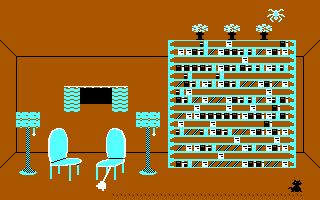
- The Bookshelf Room: Climb a giant bookcase to knock down three flower vases at the top while avoiding a giant spider that drops straight down from above.
According to the original game manual, the bookshelf room belongs to an eccentric character named Nick Cromancer, a rare bit of written humor for a PC release of that era. Every indoor room also features an energetic push broom that constantly tries to sweep Freddy across the floor and knock him right back out the window. If you run back and forth across the floorboards while dodging the broom, you can see small cat paw prints left behind on the carpet.
Romance on the heart platforms brings no mercy
Clearing any mini-game sends Freddy back to the alleyway, but with a crucial reward: a window now displays a female cat calling for a suitor. Jumping through that designated window opens the romance screen, which presents a vertical layout of floating heart platforms. You must climb toward Felicia at the top row while avoiding rival tomcats who knock you down to lower levels.
Cupid also flies across the screen, shooting arrows that turn solid hearts into broken hazards that drop you straight through if touched. If you make it to the top and touch Felicia, the game resets the room progression and immediately cranks up the overall speed. The dogs run faster, the residents throw items with higher accuracy, and the spider drops down the bookshelf with almost no warning delay.
Where this feline platformer leaves you today
The visual presentation relies entirely on four-color CGA graphics, filling the screen with stark cyan, magenta, white, and black shapes. Modern players often struggle with the stiff jumping physics and the unforgiving collision detection, particularly in the bookshelf room where a single pixel of contact with a spider instantly kills you. Yet the sheer variety of mechanics packed into such a tiny memory footprint keeps you coming back for another run.
You can play Alley Cat online for free in your browser right now, without installing anything or setting up custom software. Load up the game, try your hand at sneaking past the sleeping dogs to drink their milk, and see how many difficulty loops you can survive before the broom sweeps you back out into the alley.