
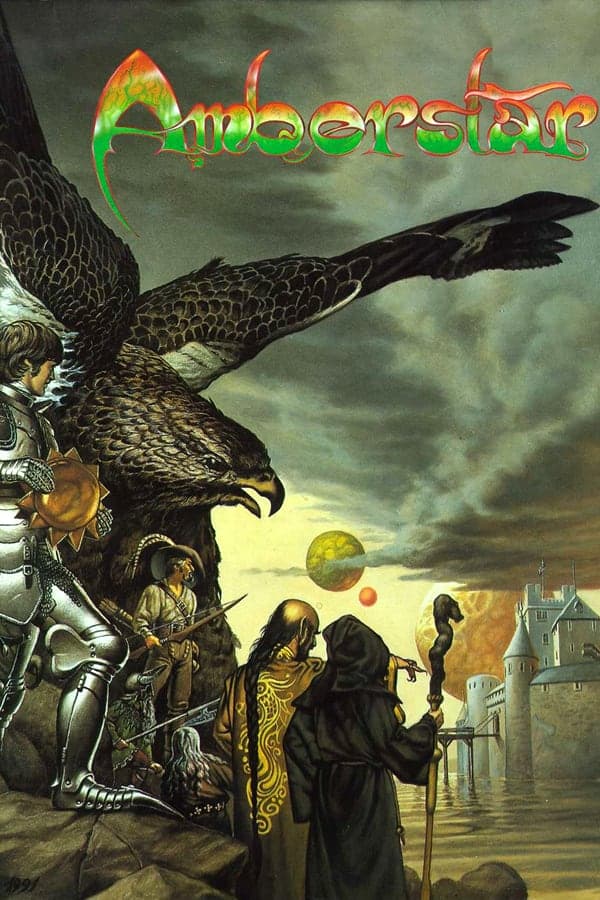

You start with nothing but basic gear beside your parents' graves in Twinlake, tasked with hunting down 13 shards of the Amberstar before an evil deity breaks free. It mixes top-down wilderness exploration with first-person 3D dungeon crawls, handing you a map that fills itself in while throwing tactical grid battles at your six-person party.
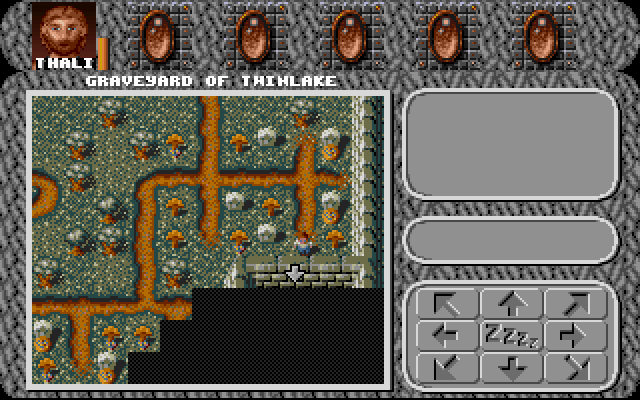
Amberstar hits you with a quiet, demanding opening that sets it apart from typical early nineties RPGs. The wizard Shandra sends you out across the world of Lyramion to stop the dark mage Marmion from releasing Lord Tarbos, but you begin completely alone. Wandering out of Twinlake, the view uses a diagonal 2D top-down perspective that covers towns and overland routes, showing your tiny sprite stepping across tiles, hopping onto rafts, buying horses, or booking passage on ships and giant eagles.
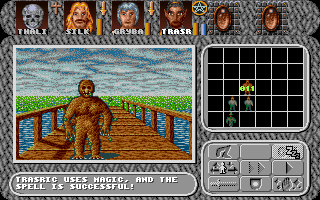
Step inside a sewer grate or dungeon entrance, though, and the engine immediately flips into a 3D first-person perspective. The step-based raycasting engine renders walls, corridors, and locked doors tile by tile. You navigate by checking pressure plates, feeling along suspicious walls, and grabbing keys off floor tiles. In 1992, this dual structure gave the game a sense of scale, even if contemporary players comparing it to Ultima Underworld or Might and Magic: Clouds of Xeen found the dungeon graphics a bit flat.
The team behind the game at Thalion Software GmbH came out of the Atari ST demoscene, originally building a reputation under the handle TEX (The Exceptions). Designers Karsten Köper and Erik Simon worked alongside programmer Jurie Horneman to construct a custom engine split between fast 2D scrolling and grid-based 3D rendering. When Udo Fischer ported the game from the Atari ST to Amiga and PC, the team brought along Jochen Hippel to handle the sound, filling PC speakers and early Sound Blaster cards with distinct chiptune compositions.
That demoscene heritage showed up in the tech, but retail execution was another story. The game shipped with a thick 168-page printed manual, yet thousands of players got stuck in the early hours because the manual stubbornly refused to explain basic starter mechanics, like how class restrictions affected early equipment. You had to learn by trial and error, getting wiped out by early random encounters while figuring out which guild trainer would actually talk to an unclassed orphan.
When combat triggers, the screen shifts to a grid-based turn-based arena. Positioning matters just as much as raw statistics. You can recruit up to six companions into your roster, pulling together a mix of paladins, fighters, mages, and even animals found across different towns. Keeping your squishy spellcasters locked behind heavily armored front-liners is mandatory if you want to survive deep dungeon runs.
Magic is broken down into 90 distinct spells across three classes, ranging from simple light sources and healing charms to screen-clearing offensive blasts. The role-playing systems force you to manage inventory weight, spell points, and party food rations constantly. The automatic mapping feature saved players from having to draw every corridor on real-world graph paper, even if navigating deep catacombs still required careful tracking of hidden buttons and switches.
If you commit to collecting all 13 talisman fragments, prepare yourself for a mammoth campaign. This 1992 release is notoriously long, often taking roughly 50 hours to complete. The mid-game progression hits serious pacing snags, forcing you into long stretches of backtracking across continents to fetch missing keys or talk to distant NPCs before a sealed door will budge.
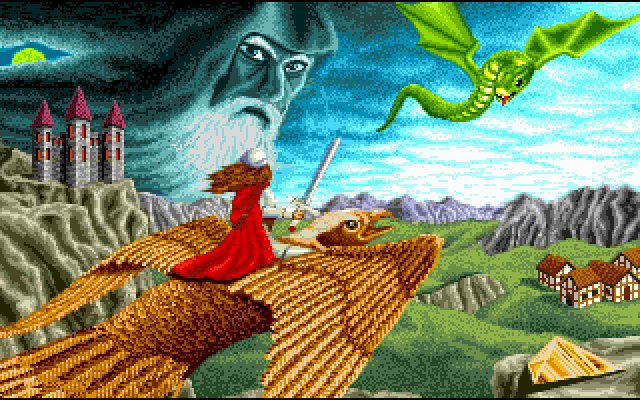
Commercial sales failed to match the critical praise from magazine reviewers of the day, leaving Thalion in financial trouble. They managed to finish a sequel, Ambermoon, in 1993, but the studio closed before completing their intended trilogy. Key members of the development group later migrated to Blue Byte, taking these exact design ideas forward to create Albion in 1995 as a spiritual follow-up.
The core design of this MS-DOS game holds up well if you appreciate methodical, party-based fantasy adventures that refuse to rush you. The combination of tactical grid movement, party building, and satisfying exploration makes it a solid pick if you want a classic computer RPG.
You can play Amberstar online free in your browser right now, jumping straight into the Twinlake graveyard without hunting down old disk images or setting up hardware. Load it up to recruit your first companion, test out the turn-based combat grid, and see how quickly the auto-mapper fills in your first underground maze.
You start with nothing but basic gear beside your parents' graves in Twinlake, tasked with hunting down 13 shards of the Amberstar before an evil deity breaks free. It mixes top-down wilderness exploration with first-person 3D dungeon crawls, handing you a map that fills itself in while throwing tactical grid battles at your six-person party.
Amberstar hits you with a quiet, demanding opening that sets it apart from typical early nineties RPGs. The wizard Shandra sends you out across the world of Lyramion to stop the dark mage Marmion from releasing Lord Tarbos, but you begin completely alone. Wandering out of Twinlake, the view uses a diagonal 2D top-down perspective that covers towns and overland routes, showing your tiny sprite stepping across tiles, hopping onto rafts, buying horses, or booking passage on ships and giant eagles.
Step inside a sewer grate or dungeon entrance, though, and the engine immediately flips into a 3D first-person perspective. The step-based raycasting engine renders walls, corridors, and locked doors tile by tile. You navigate by checking pressure plates, feeling along suspicious walls, and grabbing keys off floor tiles. In 1992, this dual structure gave the game a sense of scale, even if contemporary players comparing it to Ultima Underworld or Might and Magic: Clouds of Xeen found the dungeon graphics a bit flat.

The team behind the game at Thalion Software GmbH came out of the Atari ST demoscene, originally building a reputation under the handle TEX (The Exceptions). Designers Karsten Köper and Erik Simon worked alongside programmer Jurie Horneman to construct a custom engine split between fast 2D scrolling and grid-based 3D rendering. When Udo Fischer ported the game from the Atari ST to Amiga and PC, the team brought along Jochen Hippel to handle the sound, filling PC speakers and early Sound Blaster cards with distinct chiptune compositions.
That demoscene heritage showed up in the tech, but retail execution was another story. The game shipped with a thick 168-page printed manual, yet thousands of players got stuck in the early hours because the manual stubbornly refused to explain basic starter mechanics, like how class restrictions affected early equipment. You had to learn by trial and error, getting wiped out by early random encounters while figuring out which guild trainer would actually talk to an unclassed orphan.
When combat triggers, the screen shifts to a grid-based turn-based arena. Positioning matters just as much as raw statistics. You can recruit up to six companions into your roster, pulling together a mix of paladins, fighters, mages, and even animals found across different towns. Keeping your squishy spellcasters locked behind heavily armored front-liners is mandatory if you want to survive deep dungeon runs.
Magic is broken down into 90 distinct spells across three classes, ranging from simple light sources and healing charms to screen-clearing offensive blasts. The role-playing systems force you to manage inventory weight, spell points, and party food rations constantly. The automatic mapping feature saved players from having to draw every corridor on real-world graph paper, even if navigating deep catacombs still required careful tracking of hidden buttons and switches.

If you commit to collecting all 13 talisman fragments, prepare yourself for a mammoth campaign. This 1992 release is notoriously long, often taking roughly 50 hours to complete. The mid-game progression hits serious pacing snags, forcing you into long stretches of backtracking across continents to fetch missing keys or talk to distant NPCs before a sealed door will budge.

Commercial sales failed to match the critical praise from magazine reviewers of the day, leaving Thalion in financial trouble. They managed to finish a sequel, Ambermoon, in 1993, but the studio closed before completing their intended trilogy. Key members of the development group later migrated to Blue Byte, taking these exact design ideas forward to create Albion in 1995 as a spiritual follow-up.
The core design of this MS-DOS game holds up well if you appreciate methodical, party-based fantasy adventures that refuse to rush you. The combination of tactical grid movement, party building, and satisfying exploration makes it a solid pick if you want a classic computer RPG.
You can play Amberstar online free in your browser right now, jumping straight into the Twinlake graveyard without hunting down old disk images or setting up hardware. Load it up to recruit your first companion, test out the turn-based combat grid, and see how quickly the auto-mapper fills in your first underground maze.
How Amberstar is played — the keys the game listens to, grouped by what they do.
Highlighted keys are mapped — hover or tap one to see what it does.
Controls documented from available research notes.
The on-screen keyboard and gamepad mapping the browser player uses on a phone, a tablet or a controller, as opposed to the real keys above. $PRO members make their own in the player and share them here; anyone can pick one to play with.
Cheat codes, console commands and memory pokes for Amberstar — each one verified and attributed.
Sign in to submitHow Amberstar is played — the keys the game listens to, grouped by what they do.
Highlighted keys are mapped — hover or tap one to see what it does.
Controls documented from available research notes.
The on-screen keyboard and gamepad mapping the browser player uses on a phone, a tablet or a controller, as opposed to the real keys above. $PRO members make their own in the player and share them here; anyone can pick one to play with.
Cheat codes, console commands and memory pokes for Amberstar — each one verified and attributed.
Sign in to submit