
An American Tail: Fievel Goes West
aka An American Tail: The Computer Adventures of Fievel and His Friends
Rate this game
- Played
- A lot
An American Tail: Fievel Goes West promises a grand movie tie-in across two animated feature films, but what you actually get is a very gentle point-and-click activity set for kids with zero chance of losing.
Point-and-click puzzle logic designed so no child ever hits a game over screen
Most graphic adventure games from 1992 punished players who clicked on the wrong object or walked down the wrong alley. You would get eaten, crushed, or stuck in an unwinnable state because you forgot a key three screens back. This game takes the opposite route by removing failure entirely. Fievel carries an unlimited inventory in his mouse-sized pockets, and he never dies, drops an item, or hits a dead end.
When you take control of the little Russian mouse in his blue hat, your entire routine consists of strolling through scenes, chatting with characters, picking up everything that is not nailed down, and handing items to whoever looks like they need them. If you fail a challenge, the game simply resets the attempt and lets you try again immediately. The interface keeps things plain so younger players can navigate without getting lost in nested menus.
That design choice was deliberate. When Capstone Software published the title, the manual even included a printed glossary defining larger words specifically so younger kids could play along without calling for help every three minutes. It treats the player with gentle patience, which makes for a stress-free afternoon, even if adult adventure fans will find the actual puzzle depth practically non-existent.
An American Tail: Fievel Goes West splits one story across two movie sets
The campaign squeezes the narrative of two separate feature films into a single adventure. The first half covers the original film as Fievel is separated from his family during the ocean voyage, washed ashore in New York City, and forced to dodge street cats while seeking his parents. Once you clear out the local felines, the narrative shifts straight into the sequel, sending the Mousekewitz family out to the Frontier to confront a giant mousetrap plot in the desert.
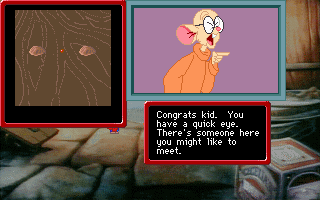
Developer Manley & Associates, Inc. built the scenes using digitized stills and hand-drawn art based on the movies. Producer David Turner, designer and artist Jonathan Sposato, programmer Robert Ridihalgh, and artist Miik Nichols brought the movie scenes into DOS resolutions. The game looks unmistakably like the animation property it is based on, even if the colors can look a bit muted depending on your monitor setup.
On the audio side, composer Tom McMail put together a soundtrack that shines if you happen to run it through a Roland MT-32 sound module. Hearing the background tracks synth out through a proper MIDI setup gives the western tunes a decent warmth, though players listening through a standard PC speaker at the time got a far harsher earful.
Mini-games replace real adventure puzzles in the DOS version of Fievel
Instead of complex inventory combinations, progress relies on completing simple built-in activities scattered across the maps. You will run into classic fairground games and simple brain teasers that yield crucial quest items upon completion:
- Thimblerig shell games where you track a hidden item under moving cups
- Card matching memory games to test your pattern recall
- Connect-the-dots puzzles that reveal key inventory shapes
- A target shooting gallery range out in the frontier town
Winning these activities gives Fievel the item he needs to satisfy the next character in line. Because you cannot lose, the mini-games act more as brief speed bumps than actual skill tests. When Judy Muldawer reviewed the title for Computer Gaming World in October 1992, she noted that solving these sequences gave younger children a genuine sense of accomplishment, suggesting it worked best as a shared project for parents and elementary school kids.
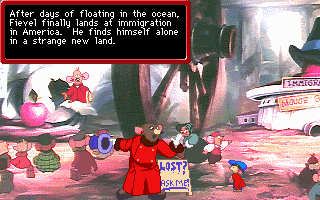
However, players looking for a tight narrative run will notice how loosely the story beats fit together. Scenes jump rapidly between locations without explaining how Fievel got there, meaning anyone who has not watched the movies will be left guessing why certain cats are friendly and why the family is suddenly heading out West.
Where the game stumbles for modern players
Retrospective reviewers on sites like Old-Games.RU have been considerably tougher on the title, often giving it mid-tier scores around 5 out of 10. The primary complaint is how brief the whole software package is. An experienced player can breeze through both halves of the story in under an hour without skipping a single line of text.

The visuals also draw mixed reactions today. While the hand-drawn character artwork mimics the movie style reasonably well, background details can feel blurry and sparse. Furthermore, the soundtrack features repetitive musical loops that can grate quickly if you get stuck waiting for a mini-game animation to finish. By 1994, Capstone Software recognized the game's niche role and bundled it onto CD-ROM inside the Capstone CD Game Kids Collection alongside Trolls and Rock-A-Doodle Computerized Coloring Book.
It ultimately functions less like a standard PC adventure and more like an animated storybook. It gives kids a gentle tour of Fievel's world without the frustration of early nineties adventure logic.
How to play An American Tail: Fievel Goes West online right now
If you come looking for deep adventure mechanics or tricky inventory puzzles, this title will feel thin very fast. But if you want to see how early nineties developers crafted software specifically designed not to frustrate young kids, it is a neat piece of DOS software design. The graphics hold their animated charm, and the total lack of death screens makes it a completely relaxed play.
You can play An American Tail: Fievel Goes West online directly in your web browser without downloading files or tweaking memory settings. If you want to check out this classic Capstone Software title, launch An American Tail: Fievel Goes West free in your browser right now and help Fievel run the cats out of New York.
Players' controls
Touch and gamepad controls
The on-screen keyboard and gamepad mapping the browser player uses on a phone, a tablet or a controller, as opposed to the real keys above. $PRO members make their own in the player and share them here; anyone can pick one to play with.
Make your own touch controlsPRO
- 1Open the editorSign in below, then pick what to make. The game starts with the editor open over it.
- 2Place your keysAdd keys and drag them where your thumbs rest, or map a controller's buttons. Test plays the game with them; Save keeps them, and you play with them from then on.
- 3Share themShare them right after saving in the game, or name and share them here. Players vote, and the best become this game's controls for everyone.
Go PROSee how it worksSign in+20 XP for sharing · +50 XP if yours become the game's own
- The game's own controlsNone yet: played with a real keyboard only.In use
3 screenshots
From the archive
No gameplay video yet
No gameplay video for An American Tail: Fievel Goes West yet. Sign in to add one.
No reviews yet
Tell the community what you think of An American Tail: Fievel Goes West. Reviews are public and tied to your username.
No archived manuals for An American Tail: Fievel Goes West yet
No manuals archived for this title yet. Sign in to upload the first scan.
Cheat codes, console commands and memory pokes for An American Tail: Fievel Goes West — each one verified and attributed.
Sign in to submitNo cheats yet for this title
Know a working cheat, poke or trainer? Add it with the button above. Moderators check every entry before it goes live.
No archived soundtrack for An American Tail: Fievel Goes West yet
No soundtrack archived for this title yet. Sign in to upload the first rip.
No save states for An American Tail: Fievel Goes West yet
No save states for this title yet. Sign in to share one.
Discussions
Sign in to post- Threads0
- Total posts0
- Online now6
Community · An American Tail: Fievel Goes West
Who's contributing, and what's new
- Reviews0
- Threads0
- Uploadsapproved0
- Contributors0
Recent activity