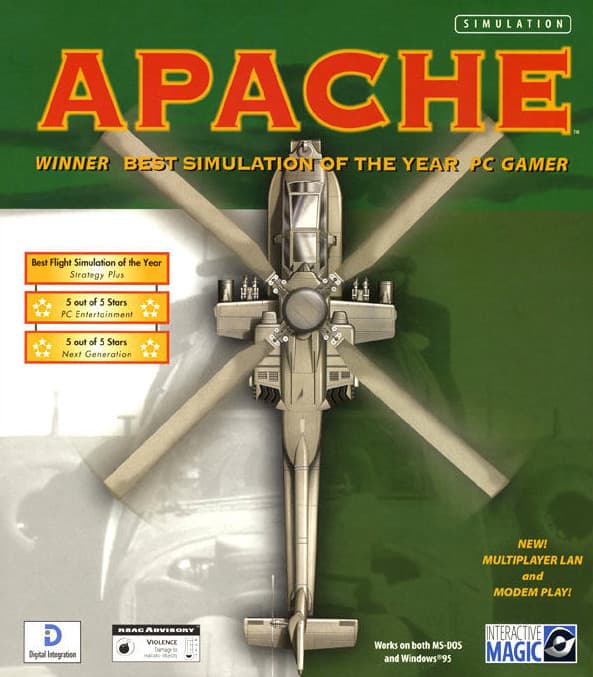

Apache forces you to master laser-guided Hellfires and low-altitude flight dynamics before you can survive five minutes over the Korean demilitarized zone.
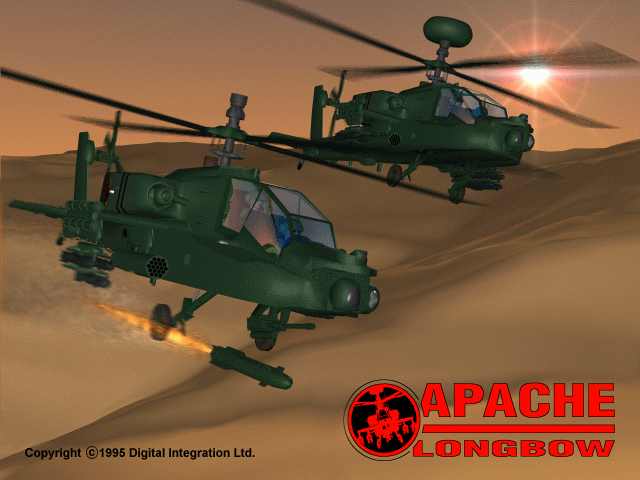
When this simulator landed in 1995, it split players into two camps: those who embraced its dense avionics and those who spiraled into the dirt before reaching their first waypoint. Developed and published by British studio Digital Integration, the 1995 release brought an unprecedented level of physical fidelity to military aviation on the PC. You sit in the seat of an AH-64D Longbow, managing weapons systems and radar profiles across three realistic warzones in Cyprus, Yemen, and Korea.
The first few minutes of a tour mission leave no room for error. You flick between your Heads-Up Display, Forward-Looking Infrared camera, and Low Light Level TV to identify targets hidden in the terrain. Ground fire from radar-guided anti-aircraft guns cuts through the sky the moment you break cover. To hit armor with an AGM-114 Hellfire missile, you must maintain a stable laser lock while maneuvering behind hills, juggling altitude controls that forgive zero sloppiness.
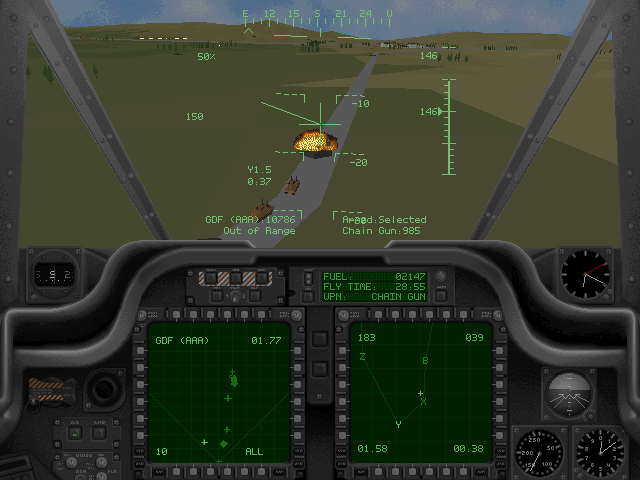
The developers brought in real AH-64 pilots to refine how the airframe reacts under heavy load, and it shows in every bank and turn. If you pull the collective back too fast while carrying a full load of Hydra rockets and Stinger air-to-air missiles, the aircraft stalls and drops into the dirt. A simplified arcade mode exists for casual flying, but running full flight physics turns every low-altitude sweep into a high-stakes balancing act.
That realism brings a sharp wall of friction. Setting up controls on a period joystick felt nightmarish due to a complex default mapping scheme. The flight assistance features, particularly altitude hold, are notoriously slow to react when you need to drop behind a ridge line to break a MiG-29 lock. If you rely on automatic stabilization to pull you out of a dive, you will crash long before the computer finishes adjusting the rotor pitch.
The engine renders its battlefield using Gouraud-shaded 3D polygons. While it lacked detailed texture mapping on terrain, resulting in somewhat flat rolling plains, it pushed high frame rates for its day. Sound design made great use of the Miles Sound System framework, pumping punchy engine hums and 30mm chain gun bursts through Sound Blaster 16 hardware.
Digital Integration pulled off a clever engineering trick with their networking code. When they released their follow-up title Hind a year later, they designed it to link directly with their existing combat simulator. This allowed two players on a local network or dial-up connection to fly together or dogfight in head-to-head matches, with one piloting the American airframe and the other managing a Soviet Mi-24.
Simulations of this caliber rarely hit big mainstream numbers, but PC pilots bought over 200,000 copies globally by early 1996. Reviewers at the time raved about the depth, with PC Gamer US handing down a 95% rating and its Best Simulation award, while Next Generation gave it a full five stars for scenario design. Even with complaints about flat ground textures, the tactical depth of the mission planner kept players hooked.
The flat ground geometry might look plain today, but the flight physics, mission planning, and laser targeting systems demand real work. It sits in the simulation games catalog as a pure test of pilot workload management. Anyone interested in military sim design should take a crack at setting up a night interdiction strike over Yemen.
You can play Apache free in your browser right here. Hop into the pilot seat for ten minutes, launch a salvo of laser-guided missiles at an enemy frigate, and see if you can handle the flight stick without nose-diving into the terrain.
Apache forces you to master laser-guided Hellfires and low-altitude flight dynamics before you can survive five minutes over the Korean demilitarized zone.
When this simulator landed in 1995, it split players into two camps: those who embraced its dense avionics and those who spiraled into the dirt before reaching their first waypoint. Developed and published by British studio Digital Integration, the 1995 release brought an unprecedented level of physical fidelity to military aviation on the PC. You sit in the seat of an AH-64D Longbow, managing weapons systems and radar profiles across three realistic warzones in Cyprus, Yemen, and Korea.
The first few minutes of a tour mission leave no room for error. You flick between your Heads-Up Display, Forward-Looking Infrared camera, and Low Light Level TV to identify targets hidden in the terrain. Ground fire from radar-guided anti-aircraft guns cuts through the sky the moment you break cover. To hit armor with an AGM-114 Hellfire missile, you must maintain a stable laser lock while maneuvering behind hills, juggling altitude controls that forgive zero sloppiness.

The developers brought in real AH-64 pilots to refine how the airframe reacts under heavy load, and it shows in every bank and turn. If you pull the collective back too fast while carrying a full load of Hydra rockets and Stinger air-to-air missiles, the aircraft stalls and drops into the dirt. A simplified arcade mode exists for casual flying, but running full flight physics turns every low-altitude sweep into a high-stakes balancing act.
That realism brings a sharp wall of friction. Setting up controls on a period joystick felt nightmarish due to a complex default mapping scheme. The flight assistance features, particularly altitude hold, are notoriously slow to react when you need to drop behind a ridge line to break a MiG-29 lock. If you rely on automatic stabilization to pull you out of a dive, you will crash long before the computer finishes adjusting the rotor pitch.
The engine renders its battlefield using Gouraud-shaded 3D polygons. While it lacked detailed texture mapping on terrain, resulting in somewhat flat rolling plains, it pushed high frame rates for its day. Sound design made great use of the Miles Sound System framework, pumping punchy engine hums and 30mm chain gun bursts through Sound Blaster 16 hardware.

Digital Integration pulled off a clever engineering trick with their networking code. When they released their follow-up title Hind a year later, they designed it to link directly with their existing combat simulator. This allowed two players on a local network or dial-up connection to fly together or dogfight in head-to-head matches, with one piloting the American airframe and the other managing a Soviet Mi-24.
Simulations of this caliber rarely hit big mainstream numbers, but PC pilots bought over 200,000 copies globally by early 1996. Reviewers at the time raved about the depth, with PC Gamer US handing down a 95% rating and its Best Simulation award, while Next Generation gave it a full five stars for scenario design. Even with complaints about flat ground textures, the tactical depth of the mission planner kept players hooked.
The flat ground geometry might look plain today, but the flight physics, mission planning, and laser targeting systems demand real work. It sits in the simulation games catalog as a pure test of pilot workload management. Anyone interested in military sim design should take a crack at setting up a night interdiction strike over Yemen.
You can play Apache free in your browser right here. Hop into the pilot seat for ten minutes, launch a salvo of laser-guided missiles at an enemy frigate, and see if you can handle the flight stick without nose-diving into the terrain.
How Apache is played — the keys the game listens to, grouped by what they do.
Highlighted keys are mapped — hover or tap one to see what it does.
Full in-game scanned manual key references can be accessed by pressing F1. Flight stick/joystick controls or key bindings are configured via the setup executable.
The on-screen keyboard and gamepad mapping the browser player uses on a phone, a tablet or a controller, as opposed to the real keys above. $PRO members make their own in the player and share them here; anyone can pick one to play with.
Cheat codes, console commands and memory pokes for Apache — each one verified and attributed.
Sign in to submitaka Apache Longbow
How Apache is played — the keys the game listens to, grouped by what they do.
Highlighted keys are mapped — hover or tap one to see what it does.
Full in-game scanned manual key references can be accessed by pressing F1. Flight stick/joystick controls or key bindings are configured via the setup executable.
The on-screen keyboard and gamepad mapping the browser player uses on a phone, a tablet or a controller, as opposed to the real keys above. $PRO members make their own in the player and share them here; anyone can pick one to play with.
Cheat codes, console commands and memory pokes for Apache — each one verified and attributed.
Sign in to submit