
Apocalyptic Quest
aka Apocalyptic Quest (v0.03 Teaser) · Apocalyptic Quest [demo v4]
Rate this game
- Played
- A lot
Apocalyptic Quest sets out to re-imagine the bleak, radioactive Australian outback of a post-nuclear war as an old-school graphic adventure using Sierra's classic AGI engine.
What happens when you launch the Apocalyptic Quest demo
Booting up Apocalyptic Quest brings an immediate wave of retro style, but not in the way an RPG fan might expect. Created by developer Brian Corr under the Vapoursoft banner, this project was envisioned as an ambitious homage and informal follow-up to the open-ended wasteland surviving of Fallout. Yet, when you sit down with the 0.03 Teaser release, you quickly realize you are not stepping into a sprawling world of tactical turn-based combat or deep inventory management. Instead of letting you roam around picking up gear or talking through dialogue trees, the teaser functions essentially as a slideshow of environment art and concept screens showing what the team hoped to build.
What you actually get on screen is a series of static preview scenes depicting a devastated Australian wilderness. The project relies on Sierra’s Adventure Game Interpreter, the same engine that powered early releases like King's Quest and Space Quest. Building a full-scale role-playing game on an engine designed for low-resolution 16-color EGA graphics and text parsers was an odd fit. To bridge the gap, the build incorporates a famous community modification known as Brian Provinciano's AGI Mouse hack. This tweak allowed the engine to process direct mouse input and perform palette-swapping tricks that Sierra's original mid-1980s binaries never supported out of the box.
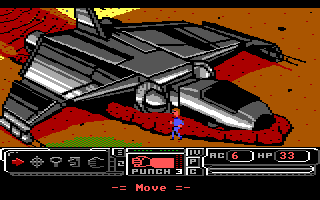
Comparing an ambitious design with the reality of an AGI build
Putting this project next to other releases from 2003 shows just how strange its technical choices were. While full-scale commercial developers were pushing heavy 3D engines, indie fans in the early 2000s were pushing retro engines past their limits. Trying to adapt the engine of Leisure Suit Larry into a gritty role-playing game meant fighting the software at every step. If you came looking for character stat screens, turn-based battle grids, or a branching narrative across the bush, the teaser stops short before any of those systems can be put through their paces.
The main frustration for anyone checking out this piece of fan history is the total absence of interactive depth. There are no mutant beasts to fight, no weapons to collect, and no inventory puzzles to solve. Later iterations of the concept, like the 4.00 Alpha produced by a group called SUNTEAM (including contributions from Sami Tervo, Niko Laakso, Scorposer, and Joker), attempted to carry the project further, but this early MS-DOS file never turns into something you can actually play. It is a blueprint for a game that never quite arrived.
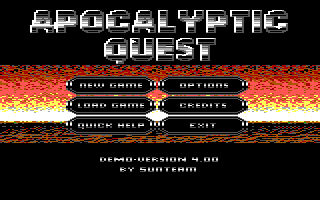
Who should spend time with this MS-DOS game slice today
If you are hoping for a twenty-hour campaign with brutal difficulty walls and party bookkeeping, this teaser will not satisfy that itch. The fundamental flaw is that it is a visual prototype rather than a playable game. You cannot get stuck on a tricky boss fight or lose progress to a broken save system because the underlying gameplay loop simply does not exist. It serves strictly as a curiosity for engine enthusiasts and fan-game archivists who want to see how far homebrew authors tried to bend 16-color tools to fit modern settings.
You can test this piece of homebrew history for yourself right now. You can play Apocalyptic Quest free in your browser with zero setup, taking a five-minute tour through one of the stranger engine experiments of the early indie fan scene.
How Apocalyptic Quest is played — the keys the game listens to, grouped by what they do.
- Interface
Highlighted keys are mapped — hover or tap one to see what it does.
Players' controls
Touch and gamepad controls
The on-screen keyboard and gamepad mapping the browser player uses on a phone, a tablet or a controller, as opposed to the real keys above. $PRO members make their own in the player and share them here; anyone can pick one to play with.
Make your own touch controlsPRO
- 1Open the editorSign in below, then pick what to make. The game starts with the editor open over it.
- 2Place your keysAdd keys and drag them where your thumbs rest, or map a controller's buttons. Test plays the game with them; Save keeps them, and you play with them from then on.
- 3Share themShare them right after saving in the game, or name and share them here. Players vote, and the best become this game's controls for everyone.
Go PROSee how it worksSign in+20 XP for sharing · +50 XP if yours become the game's own
- The game's own controlsNone yet: played with a real keyboard only.In use
2 screenshots
From the archive
No gameplay video yet
No gameplay video for Apocalyptic Quest yet. Sign in to add one.
No reviews yet
Tell the community what you think of Apocalyptic Quest. Reviews are public and tied to your username.
No archived manuals for Apocalyptic Quest yet
No manuals archived for this title yet. Sign in to upload the first scan.
Cheat codes, console commands and memory pokes for Apocalyptic Quest — each one verified and attributed.
Sign in to submitNo cheats yet for this title
Know a working cheat, poke or trainer? Add it with the button above. Moderators check every entry before it goes live.
No archived soundtrack for Apocalyptic Quest yet
No soundtrack archived for this title yet. Sign in to upload the first rip.
No save states for Apocalyptic Quest yet
No save states for this title yet. Sign in to share one.
Discussions
Sign in to post- Threads0
- Total posts0
- Online now6
Community · Apocalyptic Quest
Who's contributing, and what's new
- Reviews0
- Threads0
- Uploadsapproved0
- Contributors0
Recent activity
Nothing here yet
Reviews, discussion threads and approved uploads appear here as members add them.