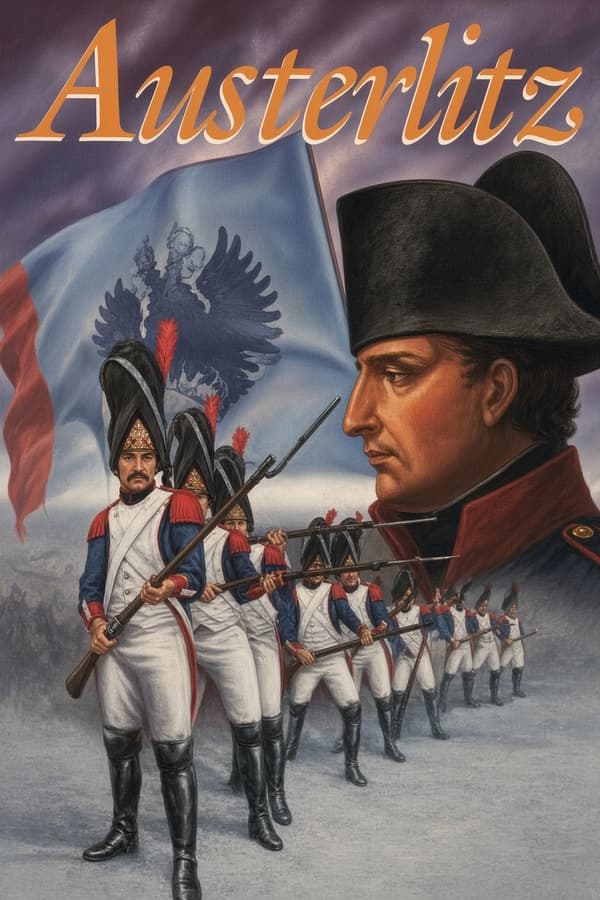
Austerlitz
Rate this game
- Played
- A lot
In Austerlitz, you do not drag a box around cavalry or click a map to attack; you type text messages to your generals and hope your messenger riders survive the trip. Dr. Peter Turcan designed this 1989 wargame to replace the omniscient overhead view of classic strategy titles with the real friction of battlefield command.
Commanding Napoleon's army through messenger riders
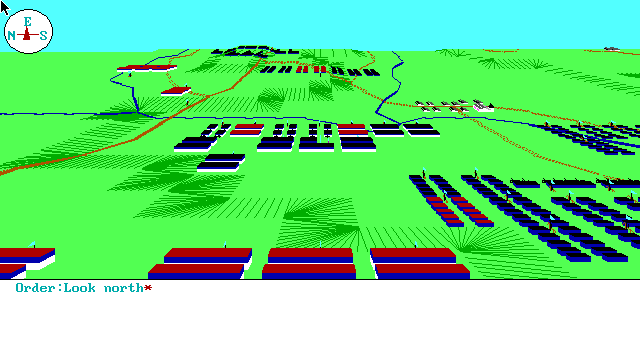
Most strategy games treat you like an invisible deity floating over the battlefield with instant control over every soldier. Turcan took the opposite path by locking your view to what your commander-in-chief could actually see from a horse. Positioned atop high ground, you scan the terrain through a vector-drawn 3D perspective that renders hills and distant troop blocks with basic line-of-sight mathematics.
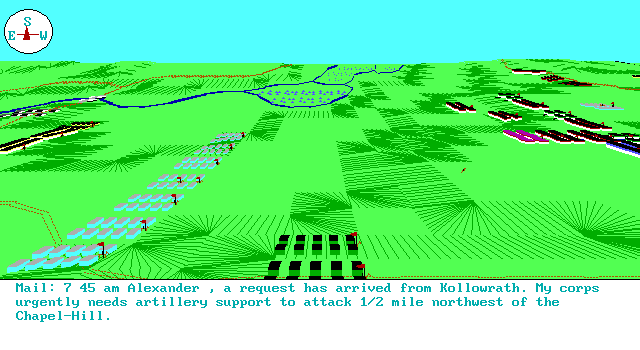
To move a division, you do not click on them. You open an order window and construct a text message from predefined syntax blocks, specifying the commanding officer, target location, and time of execution. Once typed, a virtual courier rides out across the terrain to deliver the paper note. If your messenger gets delayed or intercepted, that division stands idle while enemy artillery chews through their lines.
Following earlier entries like Waterloo and Borodino, this third Napoleonic wargame uses 15-minute turn cycles to simulate historical military delay. You spend your turns reading delayed updates from corps commanders while attempting to keep track of distant smoke on the horizon.
Why the lack of a printed map makes Austerlitz unplayable
Playing this title without a physical manual or printed paper map is almost impossible. Modern players loading the digital re-releases often find themselves utterly lost within two minutes because the screen does not display place names or coordinate grids. The game expects you to look at a paper map on your desk to figure out where the Pratzen Heights or Goldbach stream sit relative to your forces.
The internal simulation tracks several deep combat variables behind its terse command menus:
- Troop morale, fatigue, and unit experience levels for every battalion
- Chain-of-command delays based on courier distance across realistic terrain elevation
- Line-of-sight visibility that hides enemy columns hidden behind ridge lines
If you tell a subordinate general to occupy a village he cannot reach, he sends back a brief report stating the order could not be completed. That design rigor creates genuine tension, but it also creates an interface wall that turned away casual players accustomed to direct mouse control in other strategy tactics games from 1989.
Critical praise and the total absence of sound
At launch, contemporary magazine reviews split sharply over Turcan's austere design choices. Amiga Computing awarded it 91 percent and called it "War without tears," praising the novelty of the 3D line-of-sight perspective. The Games Machine gave it 83 percent, while ACE rated it 72 percent, pointing out that the text interface served a very narrow wargaming audience according to the Austerlitz Wikipedia entry.
The single strangest technical detail across all versions is audio. There is none. Whether you played on Amiga, Atari ST, or standard PC hardware, the game runs in absolute silence. No musket fire, no cannon blasts, and no background march tunes ever play through your speakers.
Developer Personal Software Services released the title shortly after publisher Mirrorsoft bought the studio and shifted its focus to hardcore historical wargames. The code pushed early home computers hard to calculate 3D visual geometry, leaving zero CPU cycles spare for audio routines.
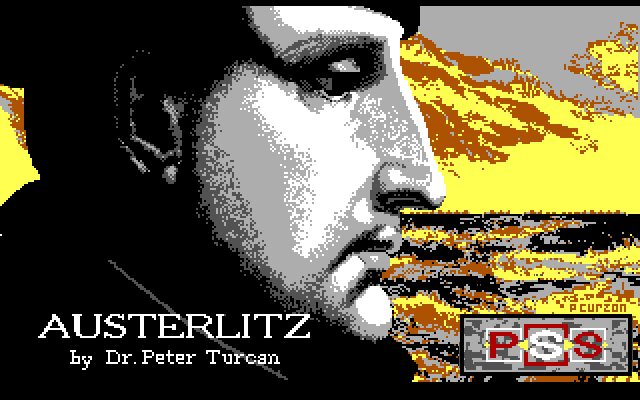
Taking your turn on the heights of Pratzen
What holds up today is the sheer nerve of the game design. It forces you to manage uncertainty rather than micro-managing individual infantrymen. What fails completely is the total opacity of the software without original printed documentation in your lap, making raw trial-and-error a punishing ordeal.
You can play Austerlitz online right now directly inside your browser window with nothing to install. When you launch the MS-DOS game Austerlitz free in your browser, choose to command Napoleon's forces first and send your initial courier to Marshal Soult on the right flank. Watching that tiny messenger horse trudge slowly across the wireframe hills will instantly show you how brutal Napoleonic command really was.
How Austerlitz is played — the keys the game listens to, grouped by what they do.
- Look
Highlighted keys are mapped — hover or tap one to see what it does.
Full MS-DOS manual key mapping tables are not completely preserved in public archives; commands are primarily entered via typed text parser.
Players' controls
Touch and gamepad controls
The on-screen keyboard and gamepad mapping the browser player uses on a phone, a tablet or a controller, as opposed to the real keys above. $PRO members make their own in the player and share them here; anyone can pick one to play with.
Make your own touch controlsPRO
- 1Open the editorSign in below, then pick what to make. The game starts with the editor open over it.
- 2Place your keysAdd keys and drag them where your thumbs rest, or map a controller's buttons. Test plays the game with them; Save keeps them, and you play with them from then on.
- 3Share themShare them right after saving in the game, or name and share them here. Players vote, and the best become this game's controls for everyone.
Go PROSee how it worksSign in+20 XP for sharing · +50 XP if yours become the game's own
- The game's own controlsKeyboardGamepadWhat every player starts with.In use
3 screenshots
From the archive
No reviews yet
Tell the community what you think of Austerlitz. Reviews are public and tied to your username.
No archived manuals for Austerlitz yet
No manuals archived for this title yet. Sign in to upload the first scan.
Cheat codes, console commands and memory pokes for Austerlitz — each one verified and attributed.
Sign in to submitNo cheats yet for this title
Know a working cheat, poke or trainer? Add it with the button above. Moderators check every entry before it goes live.
No archived soundtrack for Austerlitz yet
No soundtrack archived for this title yet. Sign in to upload the first rip.
No save states for Austerlitz yet
No save states for this title yet. Sign in to share one.
Discussions
Sign in to post- Threads0
- Total posts0
- Online now6
Community · Austerlitz
Who's contributing, and what's new
- Reviews0
- Threads0
- Uploadsapproved0
- Contributors0
Recent activity