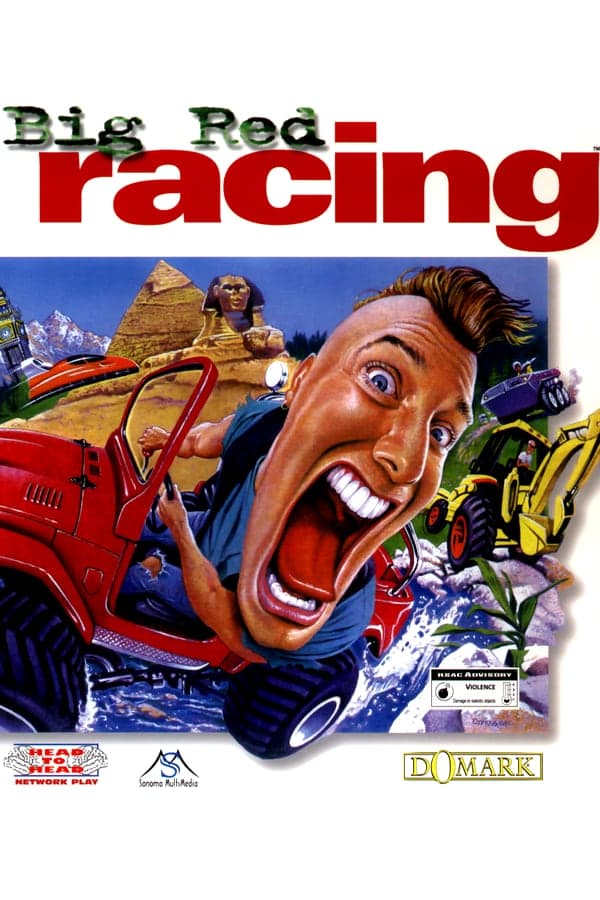
By the mid-1990s, arcade racers were desperate to escape standard asphalt, and Big Red Racing answered by throwing powerboats, dump trucks, and space shuttles onto the same messy starting grid.
When a bulldozer runs rings around a space shuttle
In 1996, racing arcade games faced a tricky puzzle: PC hardware could finally render full 3D poly tracks, but sticking to standard stock cars on flat tarmac was suddenly feeling tame. Developer The Big Red Software Company Ltd. solved this by tossing out realistic motor sports rules entirely. Instead of tweaking suspension parameters on standard coupes, you pick a driver body type, splash decals on your machine, and take a Mini, a snowcat, a hovercraft, or a monster truck onto dirt, water, and alien soil.
You notice the absolute absurdity of the physics model within five seconds of launching your first event. Steering feels lightweight and bouncy, meaning hitting a slight bump in a heavy vehicle sends you sailing off the track into the low-polygon scenery. Handling varies wildly across the 16 distinct vehicle choices, but lightness always wins out over bulk when you take sharp turns across bumpy terrain. Trying to pilot a rigid space shuttle or a lumbering bulldozer down a tight dirt pass usually ends with your vehicle tumbling endlessly end over end.
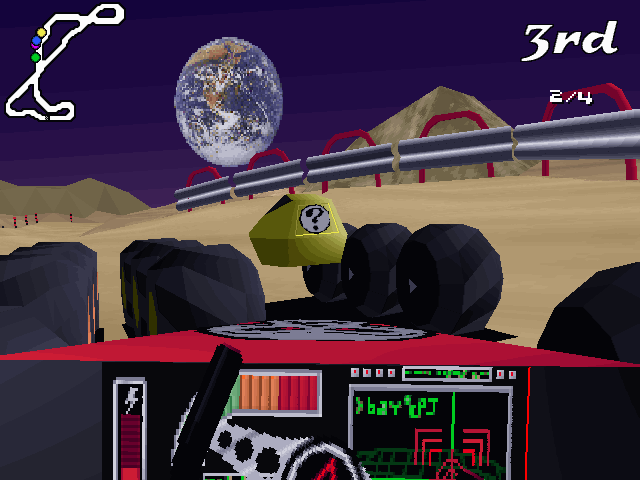
The course selection covers 24 tracks organized across six global and off-world cups. One minute you are navigating muddy turns in Mexico or passing precariously close to a cliff edge in Italy, and the next you are bouncing off craters on the surface of Venus, Mars, or the Moon. Track names lean heavily into parodies of pop culture, featuring titles like "Excellent Adventure" that set a nonsensical tone for the entire package.
Why Big Red Racing trade stability for pure chaos
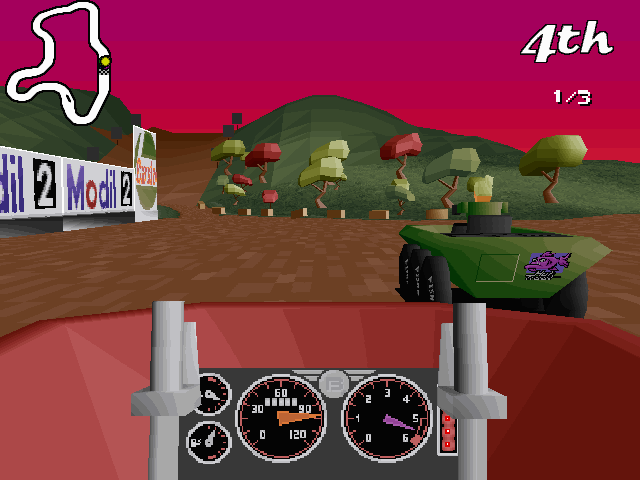
The moment you swap to the first-person internal cockpit camera, the true mechanical flaws of the engine show up. Because every ditch, curb, and hillock sends the suspension into spasms, the dashboard view violently shakes up and down until you lose all sense of horizon. The behind-the-vehicle third-person perspective is the only sane way to navigate a race without catching motion sickness, though even then, high camera sensitivity on faster hardware can make steering feel jittery.
Audio design follows the same loud, silly approach as the handling. The developers brought in recognized voice talents Jon St. John, known as the voice of Duke Nukem, alongside Lani Minella to record menu bites, race calls, and localized commentary. Hearing energetic quips paired with crude sound effects like belches and farts gives the menus plenty of personality, though hearing the exact same audio lines repeated on every single lap will have most players reaching for the sound options menu after ten minutes.
If you look closely off the main track layout, the designers hid small structural jokes in the scenery. The Italian course, for instance, features a yellow bus balanced precariously over a sheer cliff edge as a direct homage to classic cinema. Exploring these off-track oddities is often more entertaining than keeping ideal racing lines, mostly because the floaty physics actively encourage you to run off course anyway.
A chaotic release schedule and canceled ports
Publisher Domark Software Ltd. originally planned to put the game on store shelves in late 1995, but development delays pushed the debut into 1996 so the team could polish the extra vehicles and tracks. A writer named Keith Stuart spent weeks crafting a detailed backstory manual for the release, only for the publisher to axe the printed booklet right before shipping to cut costs. To keep load times down for players booting from CD-ROM, the team even placed the intro movie into a standalone batch file named VIDEO.BAT inside the directory structure.
Console versions were initially planned for almost every platform available at the time, including the PlayStation, Sega Saturn, Nintendo 64, 3DO, and Atari Jaguar. However, during the tail end of production, Big Red Software was absorbed into Eidos Interactive. Following the corporate restructuring, every single console port was scrapped, leaving the original MS-DOS version as the sole finished build of the game.
Looking back at other racing / driving games from the exact same year, few titles matched this sheer variety of machinery. While traditional simulation racers demanded precise brake timing and proper apex management, this package offered pure arcade mayhem meant for messing around with friends via split-screen, modem, or local network play.
How the handling holds up today
What makes this title memorable decades later is not strict competitive balance, but its refusal to take racing seriously. Here is what you can expect when jumping into the driver seat:
- Sixteen wildly different vehicles ranging from nimble Minis and monster trucks to powerboats and space shuttles.
- Twenty-four circuits split between terrestrial locations like Egypt and Russia and low-gravity off-world tracks on Mars.
- Driver character customization letting you pick suit colors, body shapes, and custom decals.
- Voice lines provided by Jon St. John and Lani Minella that add loud arcade flavor to menus and laps.
- Chaotic handling physics that treat gravity as an optional suggestion rather than a strict law.
The core graphics are blocky and simple, and the floaty physics will frustrate anyone looking for precision, but the raw speed and ridiculous vehicle matches still deliver genuine laughs. If you treat it as a silly arcade game where a bulldozer can drag race a helicopter, it delivers plenty of dumb fun.
Take a lap with Big Red Racing online right now
You can jump straight into the action and play Big Red Racing online right in your browser without downloading extra files or configuring system settings. The absurd weightlessness of the hovercrafts and the bizarre screen-bouncing cockpit view are things you really have to feel on a keyboard to appreciate. Pick a monster truck, turn down the repetitive speech commentary, and see if you can survive the dirt jumps on Mars today.