
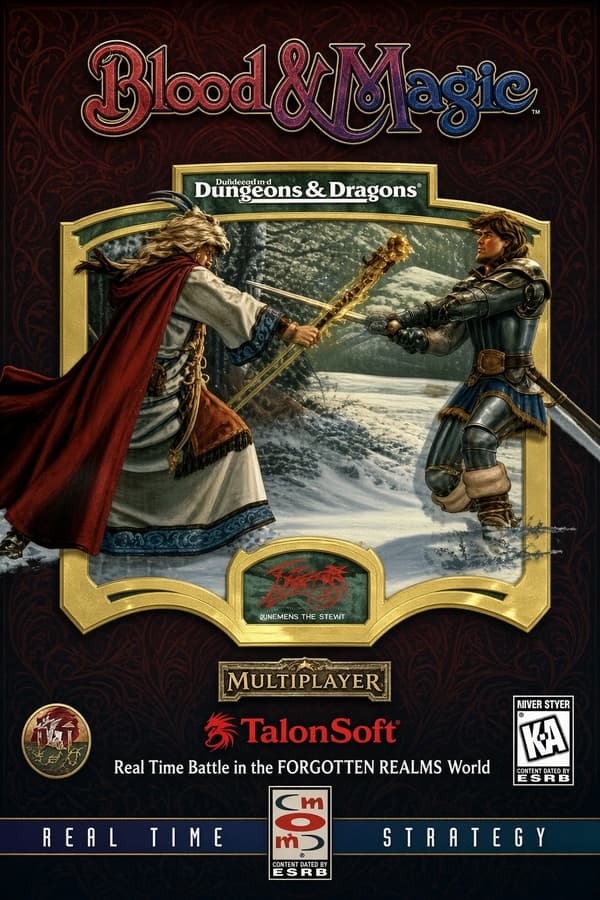
Booting up Blood & Magic in 1996 meant leaving behind standard base building for something far weirder: sitting around a circle of stone statues and manually clicking them every few seconds as they sweat out mana points.
Forget gold and timber: Blood & Magic runs entirely on stone and mana
When Interplay Productions acquired the TSR software license in 1995, most players expected a traditional role-playing game set in the Forgotten Realms. Instead, developer Tachyon Studios delivered a real-time strategy game that abandoned traditional resource gatherers, command centers, and tech trees. You do not send peasants into forests or send miners into gold pits; you sit at a bloodforge and create stone constructs called Basal Golems.
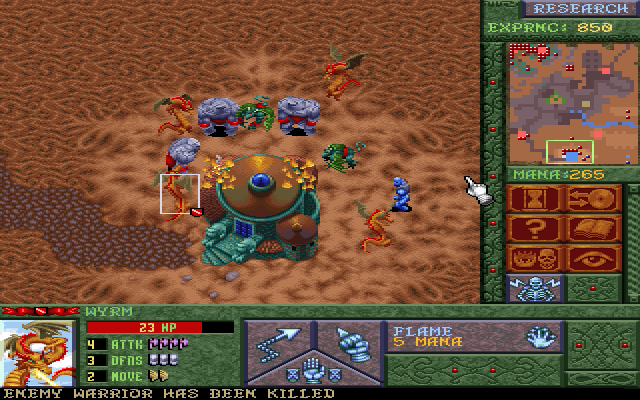
These Golems act as the foundation for your entire economy and military force. Left to sit on the map, a Basal Golem generates mana over time. When you accumulate enough energy, you transform that Golem directly into an AD&D combat creature or lock four of them together on pre-designated stone foundations to form a structure. Because foundations are fixed onto specific spots on each map, expansion is less about custom base layout and more about pushing your front line outward to secure the next available plot of land.
The core tension comes from balancing production against military strength. A Golem morphing into a fighter unit stops producing mana permanently, forcing you to constantly manage your income stream. If you push forward too aggressively without replacing your passive generators, your economy halts entirely while the opponent rebuilds.
Thirty scenarios across five campaign arcs
The single-player campaign in this 1996 DOS release is split across five distinct story modules: Howl of Vengeance, Matchmaker Mayhem, Tartyron Unbound, Nuts and Bolts, and Harvest of Horrors. Each arc contains three missions, but every mission is playable from either side of the conflict. Playing both sides effectively gives you thirty scenario setups to beat, doubling the mileage you get out of the single-player content.
Research works through battle experience rather than dedicated laboratory buildings. Creating units, constructing walls, casting spells, and taking down enemy forces awards experience points that unlock advanced unit transformations. This creates a fast feedback loop where early aggressive skirmishes directly accelerate your higher-tier unit access.
- Basal Golem: The baseline construct that generates mana and morphs into higher tier units or static buildings.
- Combat Constructs: Fantasy troops from the AD&D universe converted directly from Golems once research thresholds are met.
- Foundations and Walls: Fixed structural locations on the map where Golems anchor themselves to block chokepoints or build structures.
- Magical Artifacts: Single-use magical items scattered around the field that any combat unit can pick up and use in battle.
Units can also discover and carry magical artifacts dropped across the terrain. Watching a lower-tier creature pick up a game-changing magic item off the dirt and turn the tide of a local duel keeps static skirmishes unpredictable, especially since enemy AI units will actively snatch those items if you ignore them.
Ron Saltmarsh delivers the sound while pathfinding drags the battle
Setting up your sound card using SETSND2.EXE pays off immediately because the audio presentation is easily the high point of the package. Composer Ron Saltmarsh provided a stellar redbook CD soundtrack alongside crisp digitised voice lines that add weight to unit commands. Launching BAM.EXE brings up a 2D top-down view built from colorful pixel art, though the unit sprites themselves are noticeably tiny and somewhat grainy on a high-resolution display.
Where the design struggles heavily is in its mechanical pacing and unit navigation. The lack of defensive towers beyond basic static stone walls means players often turtle inside their starting perimeter, building up an unhindered exponential growth of mana before rolling out with a massive horde. Once that horde starts moving, the abysmal pathfinding becomes your primary enemy. Units snag on narrow terrain, wander into danger single-file, and require constant manual steering to stay in formation.
The economic interface adds another layer of friction. Collecting generated mana requires manually clicking individual Golems repeatedly throughout a match, turning resource gathering into an exhausting chore of micromanagement. Instead of focusing purely on high-level tactical movement, you spend half your attention cycling through your home base just to click on glowing stone statues.
Where this MS-DOS fantasy strategy experiment lands today
Compared to 1996 powerhouse titles like Warcraft II or Command & Conquer, Tachyon Studios Inc. took a genuine risk by abandoning the standard RTS formula. The cover art, based on Larry Elmore's painting Deadlock, promised a grand fantasy epic. What players got was an unusual, tightly constrained tactical puzzle game wrapped in Dungeons & Dragons lore.
While the clumsy pathfinding and click-heavy mana harvesting hold it back from top-tier status, the unique unit-transformation mechanic and split campaign perspective make it worth trying for tactics fans. It offers an odd design detour from a time when real-time strategy rules were not yet set in stone.
You can play Blood & Magic online right now in your browser. There is nothing to install and no setup required, so you can jump straight into the Bloodforge, test out the Golem economy, and experience this unusual piece of Interplay Productions history in seconds.