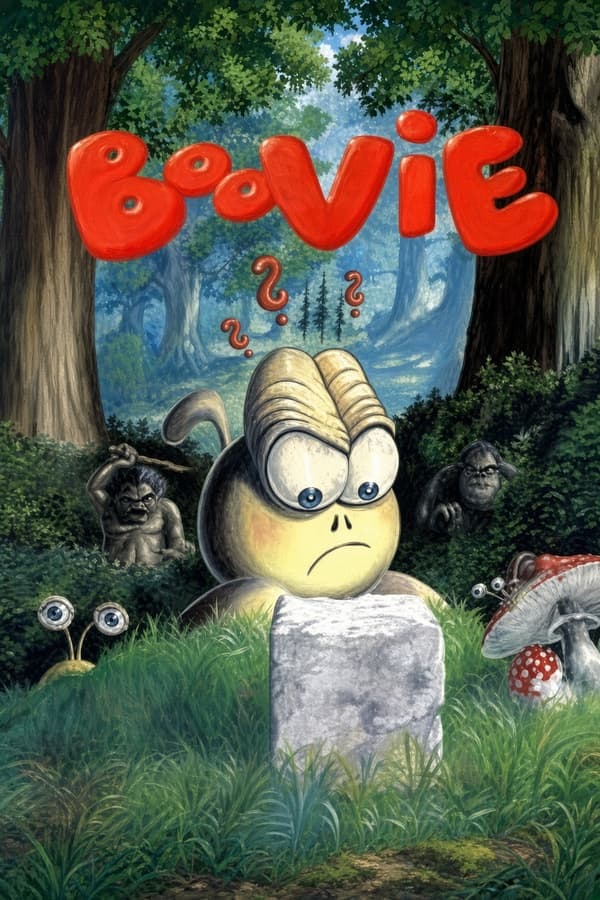
Boovie
Rate this game
- Played
- A lot
If you ever wanted to play a puzzle platformer where you float across grid squares to shove construction supplies into target portals, Boovie is precisely that kind of odd game.
Floating bricks, missing ransom, and zero jumping
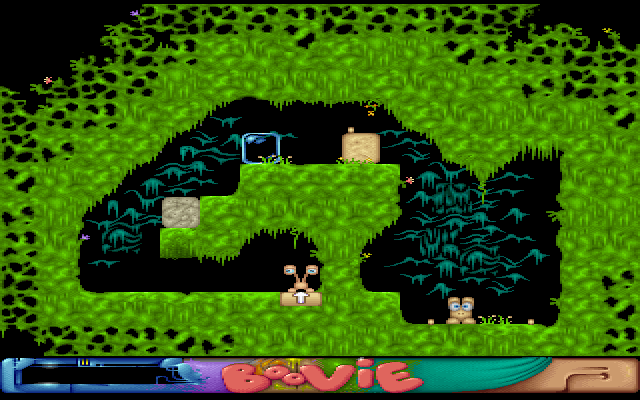
When you sit down with Boovie, the first thing that throws you off is how movement works. You are controlling a round little hero in a side-view puzzle game, but there is no jump button and gravity barely applies to your body. As long as a grid square on the screen is unobstructed, you can move directly up, down, left, or right as if you were weightlessly drifting through the air.
The backstory sets up this strange mechanic with straightforward puzzle-game logic. Boovie and his wife Lili were living a quiet life on the edge of town until an absurdly wealthy neighbor started building a massive mansion next door. When building materials vanished from the construction site, the site foreman blamed the couple, kidnapped Lili, and demanded a ransom paid entirely in those missing bricks. To save her, you have to navigate single-screen stages and deliver heavy bright blocks to specific exit tiles.
It takes inspiration from the 1983 arcade puzzle classic Flappy, though it actually began its life as a 1994 ZX Spectrum release before Czech developer Future Games s.r.o. rebuilt it for PC platforms in 1998. Rather than a quick cash-in port, this MS-DOS action puzzle game expanded the single-screen formula, giving players anywhere from 20 to 40 levels based on the chosen difficulty setting.
How the puzzle mechanics test your brain
Every single screen in this game is a self-contained logic puzzle where one wrong move easily ruins your run. Your objective is always to transport a specific target brick across the board to a tile marked with a teleporter or arrow, but reaching that goal requires a disciplined sequence of actions:
- Manipulating, shooting, and pushing heavy blocks into narrow passages to forge a clean path across the stage.
- Destroying specific obstacle blocks while leaving key structural bricks intact so you do not trap yourself.
- Dodge or neutralize wandering enemies that patrol tight corridors while you maneuver heavy freight around them.
- Planning your route backward from the target tile, as pushing a block into a dead-end corner usually means restarting the stage.
The game looks deceptive at first glance. Because you move freely across unobstructed squares, you might assume navigating the board is trivial. However, once you start shoving large blocks around, you quickly realize how easy it is to seal off your own access route or wedge the target brick against a wall with no way to pull it back out.
Enemy movement adds a steady pulse of pressure to what would otherwise be a slow, turn-based spatial riddle. While you are mentally calculating four moves ahead, hazards glide across the grid, forcing you to shoot them down or stay nimble while carrying out your spatial rearrangement. The atmospheric chiptunes and audio work composed by Ondrej Matejka give these tight puzzle screens a rhythmic, methodical tempo that keeps you focused.
The flaws behind Boovie's construction
For all its clever spatial puzzles, this title suffers from the sharp difficulty spikes typical of late-nineties European indie releases. Early stages introduce the push-and-pull mechanics at a comfortable pace, but by the time you reach the higher difficulty levels with all 40 stages unlocked, the solution windows become exceptionally narrow. A single misstep five minutes into a puzzle forces a full screen restart.
The controls can also feel a bit slippery during high-stress moments. Floating across a grid without platform physics means you rely entirely on precise tap-steering, and misaligning yourself with an alleyway while a creature approaches will routinely cost you a life. It is the sort of harsh design where success feels great, but trial-and-error fatigue sets in quickly if you drop into the harder difficulties right away.
The history behind the title is just as bumpy as its learning curve. After releasing the MS-DOS original and a expanded CD-ROM release in early 1999, the team attempted to produce an official sequel later that spring. However, severe team turnover at Future Games killed the project before it ever left the drawing board, leaving this unique PC release as a singular release in their library.
Why you should play Boovie online today
If you enjoy tight retro block-pushers that ditch standard platformer tropes in favor of spatial brain-teasers, this obscure MS-DOS release is well worth an evening of your time. The floating movement mechanic offers a distinct tempo that separates it from standard platformers, making each stage feel like a high-stakes spatial board game.
You can play Boovie free in your browser right now, with no need to wrestle with old hardware emulation setups. Fire it up, stick to the standard difficulty setting for your first run to get a feel for block positioning, and see if you can rescue Lili from the world's most aggressive building contractor.
Players' controls
Touch and gamepad controls
The on-screen keyboard and gamepad mapping the browser player uses on a phone, a tablet or a controller, as opposed to the real keys above. $PRO members make their own in the player and share them here; anyone can pick one to play with.
Make your own touch controlsPRO
- 1Open the editorSign in below, then pick what to make. The game starts with the editor open over it.
- 2Place your keysAdd keys and drag them where your thumbs rest, or map a controller's buttons. Test plays the game with them; Save keeps them, and you play with them from then on.
- 3Share themShare them right after saving in the game, or name and share them here. Players vote, and the best become this game's controls for everyone.
Go PROSee how it worksSign in+20 XP for sharing · +50 XP if yours become the game's own
- The game's own controlsNone yet: played with a real keyboard only.In use
2 screenshots
From the archive
No reviews yet
Tell the community what you think of Boovie. Reviews are public and tied to your username.
No archived manuals for Boovie yet
No manuals archived for this title yet. Sign in to upload the first scan.
Cheat codes, console commands and memory pokes for Boovie — each one verified and attributed.
Sign in to submitNo cheats yet for this title
Know a working cheat, poke or trainer? Add it with the button above. Moderators check every entry before it goes live.
No archived soundtrack for Boovie yet
No soundtrack archived for this title yet. Sign in to upload the first rip.
No save states for Boovie yet
No save states for this title yet. Sign in to share one.
Discussions
Sign in to post- Threads0
- Total posts0
- Online now6
Community · Boovie
Who's contributing, and what's new
- Reviews0
- Threads0
- Uploadsapproved0
- Contributors0
Recent activity
Nothing here yet
Reviews, discussion threads and approved uploads appear here as members add them.