
Charlie II
aka Charlie the Duck II · Charlie the Duck 2
Rate this game
- Played
- A lot
Charlie II takes the weaponless platforming of its predecessor and turns it into a high-stakes scavenger hunt across 18 levels of hidden underwater passages and breakable crates. You play an adventurous duck who cannot shoot a single projectile, relying instead on timed head-bounces and shield power-ups to clear a path through swarms of bees and spiked fish.
Bouncing on enemies and chasing required completion percentages
Most side-scrolling platformers ask you to reach an exit sign, but this 2001 release forces you to do your accounting first. Opening a level exit depends on hitting a specific collection threshold, ranging from 55 percent on easy mode up to 75 percent on hard. If you touch the end flag short of that target, the game turns you away, forcing you to restart the entire map from scratch.
That design choice completely alters how you approach every environment. Running straight to the right gets you nowhere, so you spend your time hunting through breakable wooden boxes and diving underwater to find hidden alcoves. Charlie moves with a light, buoyant rhythm that feels great when swimming through deep lakes, though land movement requires precision. Since you carry no firearms, fighting back means dropping directly onto an enemy head or running through them while protected by a temporary shield pickup.
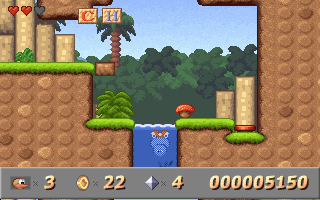
Mike Wiering built the game at Wiering Software around a simple set of survival mechanics. Health consists of red hearts, which can be expanded by grabbing rare super hearts or replenished with regular pickups. You can also hunt down seven letter items scattered across a level to spell out CHARLIE for an instant extra life, alongside hidden eggs that grant the same bonus.
The frustrating reality of blind drops and instant death
While the movement feels responsive, the level construction regularly tests your patience. The biggest problem in this Charlie II MS-DOS game comes from blind falls into unmapped shafts. Pits and drops often hide floor spikes that kill you instantly on contact, completely bypassing your remaining heart containers and sending you straight back to a checkpoint.
Because the screen viewport does not let you look downward before jumping, every deep pit becomes an act of faith. Modern players often struggle with these unguided hazard layouts, especially when a missed secret exit forces a complete replay. The game features 18 core levels split into four distinct environments, ranging from sunny beaches and dense green forests to frozen glaciers and gloomy subterranean caverns.
Every six levels, the platforming pauses for a boss encounter against a recurring mechanical villain. This robot orbits itself with floating metal spheres, forcing you to time your jumps cleanly over its defensive shield while dodging incoming attacks. It provides a stern challenge, though the lack of mid-level saves turns every boss attempt into a nerve-wracking ordeal.
VGA graphics paired with authentic digitized quacks
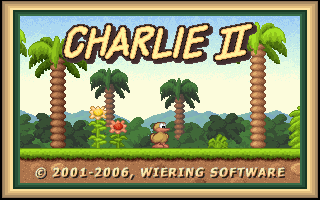
Visually, the title relies on classic 320x200 VGA Mode 13h graphics that give the backgrounds a clean look, even if the overall art style stays fairly spartan. Where it noticeably steps up from Charlie the Duck is in the audio department. Listening to the soundtrack through Sound Blaster hardware yields cheerful background tunes, crisp death jingles, and surprisingly realistic duck quacks every time Charlie takes damage or lands a jump.
The progression route includes secret levels marked on the world map with question marks, reachable only if you discover hidden exits tucked behind breakable walls or deep underwater channels. Finding these extra zones helps cushion your total lives and hearts, which you will desperately need for the final stretch of world maps.
To succeed across the harder stages, players should keep a short checklist in mind during every run:
- Break every crate by jumping beneath or on top of it to reveal hidden diamonds.
- Submerge Charlie in every deep body of water to check for submerged tunnels.
- Track down all seven name letters to earn extra lives before entering boss arenas.
- Avoid jumping blindly off ledges without checking the terrain layout first.
Why you should play Charlie II online today
While the text-only victory screen at the very end feels like an anticlimax after surviving 18 demanding stages, the actual moment-to-moment action holds up as a tight piece of shareware-style design. If you enjoy bright, treasure-heavy action games that demand thorough exploration rather than mindless shooting, this sequel still delivers plenty of solid jumping fun.
You can play Charlie II free in your browser right now with no setup required. Screenshots do not properly capture the momentum of Charlie's dive mechanics or the exact rhythm needed to bounce safely across clusters of enemies. Launching the game directly in your window lets you feel that weight instantly, giving you a quick test of your platforming instincts against those unforgiving spike pits.
How Charlie II is played — the keys the game listens to, grouped by what they do.
- Movement
- Action
- Interface
Highlighted keys are mapped — hover or tap one to see what it does.
Players' controls
Touch and gamepad controls
The on-screen keyboard and gamepad mapping the browser player uses on a phone, a tablet or a controller, as opposed to the real keys above. $PRO members make their own in the player and share them here; anyone can pick one to play with.
Make your own touch controlsPRO
- 1Open the editorSign in below, then pick what to make. The game starts with the editor open over it.
- 2Place your keysAdd keys and drag them where your thumbs rest, or map a controller's buttons. Test plays the game with them; Save keeps them, and you play with them from then on.
- 3Share themShare them right after saving in the game, or name and share them here. Players vote, and the best become this game's controls for everyone.
Go PROSee how it worksSign in+20 XP for sharing · +50 XP if yours become the game's own
- The game's own controlsKeyboardGamepadWhat every player starts with.In use
2 screenshots
From the archive
No reviews yet
Tell the community what you think of Charlie II. Reviews are public and tied to your username.
No archived manuals for Charlie II yet
No manuals archived for this title yet. Sign in to upload the first scan.
Cheat codes, console commands and memory pokes for Charlie II — each one verified and attributed.
Sign in to submitNo cheats yet for this title
Know a working cheat, poke or trainer? Add it with the button above. Moderators check every entry before it goes live.
No archived soundtrack for Charlie II yet
No soundtrack archived for this title yet. Sign in to upload the first rip.
No save states for Charlie II yet
No save states for this title yet. Sign in to share one.
Discussions
Sign in to post- Threads0
- Total posts0
- Online now6
Community · Charlie II
Who's contributing, and what's new
- Reviews0
- Threads0
- Uploadsapproved0
- Contributors0
Recent activity
Nothing here yet
Reviews, discussion threads and approved uploads appear here as members add them.