
Chasm: The Rift
aka Chasm: The Shadow Zone
Streaming build
Checking storage…415 MB
Preload in background
JIT compiler
Rate this game
- Played
- A lot
If you played Chasm: The Rift back in 1997, you probably remember the exact moment a sawblade bounced off a wall, took off an alien's arm, and left him bleeding while still trying to charge you.
Shooting off limbs in a 2D world
When you launch Chasm: The Rift, it looks like a full 3D shooter from the era of Quake, but it plays with a very specific set of geometric rules. The engine built by Ukrainian developer Action Forms relies on a flat two-dimensional grid layout. That means you will never find a room stacked on top of another room, and vertical aiming is mostly an illusion handled by the software renderer.
What the engine lacks in vertical level design, it makes up for with raw combat details. You can target individual limbs on hostile soldiers and grotesque monsters. Lopping off an enemy's right arm strips away their primary firearm, turning a deadly firefight into a simple cleanup task. It was a clever mechanical touch that rewarded precise aim with genuine tactical advantages.
The arsenal gives you plenty of ways to test that dismemberment system. Alongside standard shotguns and machine guns, your main prize is the Blade Gun. Throwing spinning buzzsaw blades down narrow stone hallways works every time, especially when a bad angle sends the blade ricocheting right back toward your own face.
How Kyiv Polytechnic students built a 486 powerhouse
The origin story of Action Forms explains a lot about why the technology behaves the way it does. A team of students from Kyiv Polytechnic Institute started out working on a project titled Tron: The Hammer of War. They wanted to create an advanced action game that could run on standard home PCs without requiring an expensive 3D accelerator card like a 3dfx Voodoo.
Their custom software engine managed to deliver high-resolution rendering, weather effects, dynamic lighting, and skeletal animation interpolation on a humble 486 DX4-100 processor. By avoiding heavy hardware requirements, they delivered a playable action game to thousands of computer owners who had been locked out of the hardware revolution. Publisher GT Interactive Software Corp. picked up the title for global distribution, making it one of the earliest Ukrainian PC releases to hit retail shelves in the West.
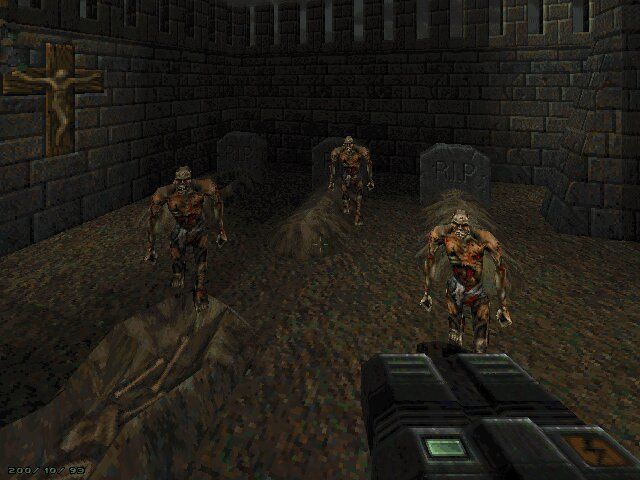
The trade-offs are obvious the moment you start exploring. Because the levels share structural limits with earlier 2D-grid engines, the maps in this 1997 release can feel flat and maze-like. You spend a lot of time hunting down color-coded keycards and hitting wall switches inside corridors that look practically identical.
Time travel, strict boss fights, and Red Book audio
The story places you in the boots of an unnamed commando investigating a power failure at a military facility. You soon discover that time-traveling invaders called Timestrikers are stealing power to tear open dimensional rifts. To stop them, you travel across 16 single-player levels divided into four historical periods: Present Day, Ancient Egypt, Medieval Times, and a alien future dimension.
Each era brings distinct enemy models, from heavy security guards in the opening base to mummies and skeleton knights later on. The campaign progression is straightforward, but the episode bosses hit like a brick wall. Instead of letting you circle-strafe and dump ammo, every major boss fight works like a strict environmental puzzle.
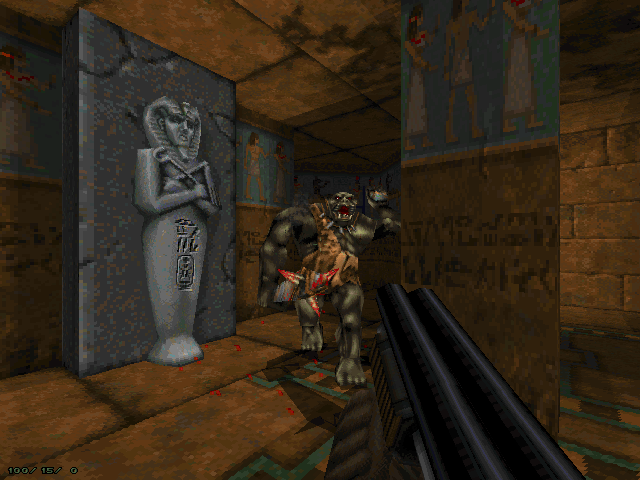
If you do not figure out the exact sequence of switches or traps required to kill a boss, your standard weapons will barely leave a scratch. That puzzle-heavy approach frustrated plenty of players who just wanted a brutal firefight. Still, the game had plenty of cool extra details tucked away, including sound support that let players drop the game disc into a standard stereo CD player to listen to the soundtrack tracks.
Players who wanted to bypass the struggle altogether often memorized the built-in console commands. Entering chojin handed you full invulnerability, while weapon unlocked the complete armory instantly. There was even a secret stereo cheat command, reverse, which flipped the audio output channels in real time if your headphone cables were tangled.
Where the combat succeeds and where the grid fails
Deciding to fire this up today comes down to what you want out of an early 3D shooter. The environmental geometry is boxy and rigid, and the lack of true vertical rooms makes spatial navigation feel plain compared to rival shooters of the late nineties. Furthermore, the deathmatch multiplayer mode forced players to run standard single-player maps to unlock doors, which ruined the flow of competitive play.
Where the design wins is in the weight of its combat encounters. The feedback when landing a heavy shotgun blast or severing a monster's arm remains incredibly satisfying. The enemy response animations and localized damage models give every hallway skirmish a punchy, tactile feel that few software-rendered titles managed to pull off.
You can play Chasm: The Rift by Action Forms Ltd. right now to see how those technical tricks hold up on modern screens. If you want to sample a distinct piece of MS-DOS history, launch into the opening power station level and chop off your first guard's rifle arm with the Blade Gun.
Experience this retro shooter instantly
You can play Chasm: The Rift online, right here in your web browser with zero setup required. It is the perfect chance to test your aim with the Blade Gun, try out classic cheat codes like chojin, and experience this landmark Ukrainian shooter firsthand. Grab your shotgun, head into the first power plant corridor, and see how fast you can clear out the Timestrikers.
How Chasm: The Rift is played — the keys the game listens to, grouped by what they do.
- Movement
- Weapons & items
- Interface
Highlighted keys are mapped — hover or tap one to see what it does.
Keybindings can be modified under Setup control in the Options menu. Specific in-game movement, jump, and fire keys were not detailed in the provided documentation.
Players' controls
Touch and gamepad controls
The on-screen keyboard and gamepad mapping the browser player uses on a phone, a tablet or a controller, as opposed to the real keys above. $PRO members make their own in the player and share them here; anyone can pick one to play with.
Make your own touch controlsPRO
- 1Open the editorSign in below, then pick what to make. The game starts with the editor open over it.
- 2Place your keysAdd keys and drag them where your thumbs rest, or map a controller's buttons. Test plays the game with them; Save keeps them, and you play with them from then on.
- 3Share themShare them right after saving in the game, or name and share them here. Players vote, and the best become this game's controls for everyone.
Go PROSee how it worksSign in+20 XP for sharing · +50 XP if yours become the game's own
- The game's own controlsKeyboardGamepadWhat every player starts with.In use
2 screenshots
From the archive
No gameplay video yet
No gameplay video for Chasm: The Rift yet. Sign in to add one.
No reviews yet
Tell the community what you think of Chasm: The Rift. Reviews are public and tied to your username.
No archived manuals for Chasm: The Rift yet
No manuals archived for this title yet. Sign in to upload the first scan.
Cheat codes, console commands and memory pokes for Chasm: The Rift — each one verified and attributed.
Sign in to submitNo cheats yet for this title
Know a working cheat, poke or trainer? Add it with the button above. Moderators check every entry before it goes live.
No archived soundtrack for Chasm: The Rift yet
No soundtrack archived for this title yet. Sign in to upload the first rip.
No save states for Chasm: The Rift yet
No save states for this title yet. Sign in to share one.
Discussions
Sign in to post- Threads0
- Total posts0
- Online now6
Community · Chasm: The Rift
Who's contributing, and what's new
- Reviews0
- Threads0
- Uploadsapproved0
- Contributors0
Recent activity