
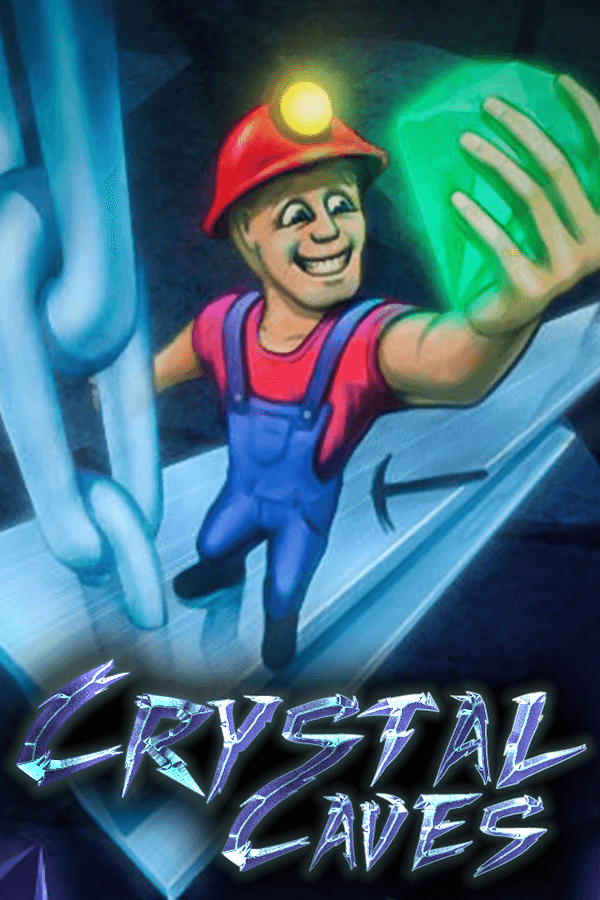

In Crystal Caves, space trader Mylo Steamwitz lands on the mining planet Altair to collect rocks, pay off his debts, and fund his ultimate dream of buying a twibble farm.
By 1991, shareware publishers needed a quick way to deliver colorful platformers to players who were tired of bare-bones PC ports. Apogee designer Frank Maddin took inspiration from the classic Atari 8-bit game Miner 2049er, creating a system where levels lived on a non-linear map hub. Working alongside Lucinda Maddin and George Broussard, who named the hero Mylo Steamwitz specifically to sound like a natural born loser, the team built a framework that felt reactive and busy.
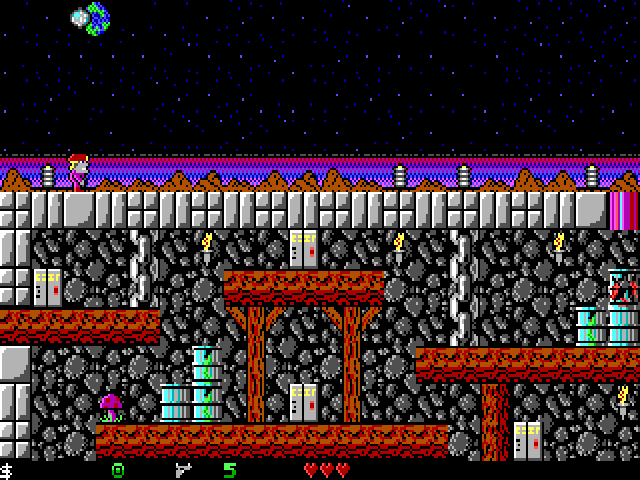
That exact engine was so solid that Apogee reused it a year later for Secret Agent. The trade-off was in the visual presentation. Even for early nineties standard 16-color EGA displays, the blocky environments and stark color palettes look rough. The trade-offs made sense at the time: keeping file sizes small meant the game fit easily on shareware floppy disks, making the first episode, "Troubles with Twibbles", free to pass around.
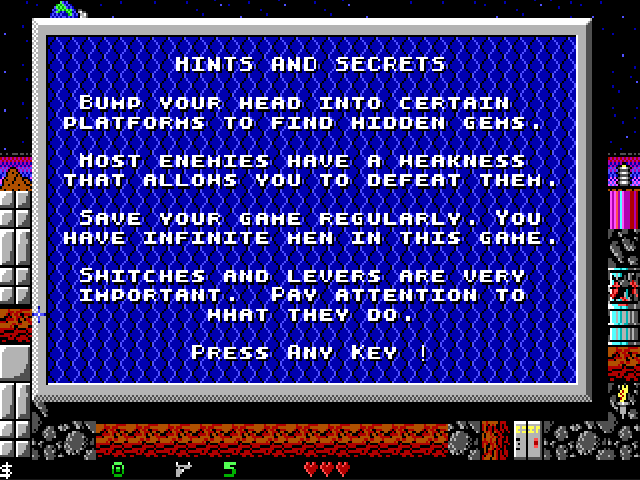
Every cave in Crystal Caves has one main objective: grab every single crystal on the map to unlock the exit door. You drop into a level with a three-point health meter, unlimited lives, and a missile pistol loaded with limited ammo. Monsters like bats, mine carts, dinosaurs, and twibbles block your paths, alongside toxic water leaks, falling stalactites, and instant-kill mushrooms.
Precision is mandatory. Mylo handles with a stiff, heavy jump, meaning a single missed ledge often drops you straight into toxic slime or a row of spikes. Ammo boxes are scarce enough that shooting every creature on sight guarantees you will run dry right when a line of robots blocks your only route to a lever.
The real trap lies in the level design itself. You can softlock a stage by flipping levers out of order or wasting rocket ammo on enemies you could have avoided. If you seal off an elevator before collecting the crystal sitting inside it, your only option is to press the self-destruct key and restart the level from scratch.
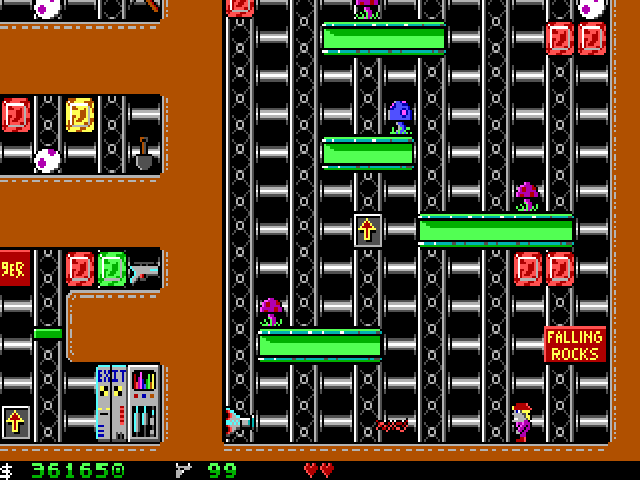
To keep the platforming fresh across three main episodes ("Troubles with Twibbles", "Slugging It Out", and "Mylo Versus the Supernova"), Maddin introduced temporary power-ups that alter how you move and fight. Gravity switches flip the level upside down, sending Mylo walking across the ceiling to reach high ledges. Red mushrooms give you brief invincibility to smash through hazards, stop signs freeze enemy movement entirely, and smart-shot power-ups let your rocket gun clear the screen.
The game also rewards players who search every corner of the screen. You can use pickaxes to break through crumbling walls or shoot floating eggs to reveal hidden bonus letters. Collecting the letters B, O, N, U, and S in order hands out a massive score payout at the end of the level.
Curiously, the original DOS version contained an infamous system clock bug. Playing the untouched v1.0 executable on modern Windows XP machines would occasionally reset the host computer's system clock back by 100 years. 3D Realms eventually issued a v1.0a patch in 2005 just to fix that hardware glitch for modern Windows collectors.
If you judge this 1991 release purely on its chunky EGA graphics or its simple PC speaker chirps, you might dismiss it as an average DOS platformer. Yet the puzzle-focused level design holds up surprisingly well if you enjoy methodical, high-stakes games like Miner 2049er. There are no actual boss fights at the end of the three episodes, but the late-game cavern layouts supply all the tension you need.
The unfair softlocks and sudden spikes in difficulty are hard to ignore. A single misplaced jump can wipe out ten minutes of thorough crystal hunting, forcing you to memorize enemy patterns and plan your route before pulling a single lever. For fans of classic action games developed by Apogee Software, Ltd., that balance of execution and resource management remains deeply satisfying.
You can play Crystal Caves online free in your browser right now with no setup required. The heavy jump physics and tight lever mechanics are things you only get a feel for once you take control of Mylo yourself. Fire up episode one, keep an eye on your pistol ammunition, and double-check your path before pulling that first green switch.
In Crystal Caves, space trader Mylo Steamwitz lands on the mining planet Altair to collect rocks, pay off his debts, and fund his ultimate dream of buying a twibble farm.
By 1991, shareware publishers needed a quick way to deliver colorful platformers to players who were tired of bare-bones PC ports. Apogee designer Frank Maddin took inspiration from the classic Atari 8-bit game Miner 2049er, creating a system where levels lived on a non-linear map hub. Working alongside Lucinda Maddin and George Broussard, who named the hero Mylo Steamwitz specifically to sound like a natural born loser, the team built a framework that felt reactive and busy.
That exact engine was so solid that Apogee reused it a year later for Secret Agent. The trade-off was in the visual presentation. Even for early nineties standard 16-color EGA displays, the blocky environments and stark color palettes look rough. The trade-offs made sense at the time: keeping file sizes small meant the game fit easily on shareware floppy disks, making the first episode, "Troubles with Twibbles", free to pass around.

Every cave in Crystal Caves has one main objective: grab every single crystal on the map to unlock the exit door. You drop into a level with a three-point health meter, unlimited lives, and a missile pistol loaded with limited ammo. Monsters like bats, mine carts, dinosaurs, and twibbles block your paths, alongside toxic water leaks, falling stalactites, and instant-kill mushrooms.
Precision is mandatory. Mylo handles with a stiff, heavy jump, meaning a single missed ledge often drops you straight into toxic slime or a row of spikes. Ammo boxes are scarce enough that shooting every creature on sight guarantees you will run dry right when a line of robots blocks your only route to a lever.
The real trap lies in the level design itself. You can softlock a stage by flipping levers out of order or wasting rocket ammo on enemies you could have avoided. If you seal off an elevator before collecting the crystal sitting inside it, your only option is to press the self-destruct key and restart the level from scratch.

To keep the platforming fresh across three main episodes ("Troubles with Twibbles", "Slugging It Out", and "Mylo Versus the Supernova"), Maddin introduced temporary power-ups that alter how you move and fight. Gravity switches flip the level upside down, sending Mylo walking across the ceiling to reach high ledges. Red mushrooms give you brief invincibility to smash through hazards, stop signs freeze enemy movement entirely, and smart-shot power-ups let your rocket gun clear the screen.
The game also rewards players who search every corner of the screen. You can use pickaxes to break through crumbling walls or shoot floating eggs to reveal hidden bonus letters. Collecting the letters B, O, N, U, and S in order hands out a massive score payout at the end of the level.
Curiously, the original DOS version contained an infamous system clock bug. Playing the untouched v1.0 executable on modern Windows XP machines would occasionally reset the host computer's system clock back by 100 years. 3D Realms eventually issued a v1.0a patch in 2005 just to fix that hardware glitch for modern Windows collectors.

If you judge this 1991 release purely on its chunky EGA graphics or its simple PC speaker chirps, you might dismiss it as an average DOS platformer. Yet the puzzle-focused level design holds up surprisingly well if you enjoy methodical, high-stakes games like Miner 2049er. There are no actual boss fights at the end of the three episodes, but the late-game cavern layouts supply all the tension you need.
The unfair softlocks and sudden spikes in difficulty are hard to ignore. A single misplaced jump can wipe out ten minutes of thorough crystal hunting, forcing you to memorize enemy patterns and plan your route before pulling a single lever. For fans of classic action games developed by Apogee Software, Ltd., that balance of execution and resource management remains deeply satisfying.
You can play Crystal Caves online free in your browser right now with no setup required. The heavy jump physics and tight lever mechanics are things you only get a feel for once you take control of Mylo yourself. Fire up episode one, keep an eye on your pistol ammunition, and double-check your path before pulling that first green switch.
How Crystal Caves is played — the keys the game listens to, grouped by what they do.
Highlighted keys are mapped — hover or tap one to see what it does.
Keyboard controls can be remapped in-game by pressing F1. Game saving can only be performed from the mine shaft.
The on-screen keyboard and gamepad mapping the browser player uses on a phone, a tablet or a controller, as opposed to the real keys above. $PRO members make their own in the player and share them here; anyone can pick one to play with.
Cheat codes, console commands and memory pokes for Crystal Caves — each one verified and attributed.
Sign in to submitaka Crystal Mines · Episode 1: Troubles with Twibbles · Episode 2: Slugging It Out · Episode 3: Mylo Versus the Supernova
How Crystal Caves is played — the keys the game listens to, grouped by what they do.
Highlighted keys are mapped — hover or tap one to see what it does.
Keyboard controls can be remapped in-game by pressing F1. Game saving can only be performed from the mine shaft.
The on-screen keyboard and gamepad mapping the browser player uses on a phone, a tablet or a controller, as opposed to the real keys above. $PRO members make their own in the player and share them here; anyone can pick one to play with.
Cheat codes, console commands and memory pokes for Crystal Caves — each one verified and attributed.
Sign in to submit