In Cyberdogs, a top-down mercenary shooter, you spend half your time hunting for floppy disks and teddy bears through pitch-black corridors and the other half realizing you spent all your cash on a plasma rifle you cannot afford ammo for.
Before top-down shooters leaned heavily into modern dual-stick twin-stick layouts, Swedish developer Ronny Wester built a lean, gritty action game entirely by himself using Turbo Pascal 7.0. Choosing your mercenary from Jones, Ice, or Warbaby is purely a cosmetic decision, as all three run at the same speed and take the same beating. What actually sets your run apart is how you spend your cash between missions and whether you can navigate tight, maze-like levels without getting cornered in the dark.
If you played the original 1994 Cyberdogs MS-DOS game on a shareware compilation CD, you probably remember how stark it felt compared to flashy arcade ports of the era. The overhead viewport gives you a clear look at the surrounding room, but it forces a claustrophobic line-of-sight system that blanks out anything behind a wall or outside your direct field of vision. Moving through a doorway meant stepping blind into rooms full of angry guards and automated turrets.
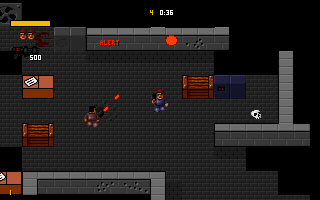
The mission structure spans ten distinct operations that pull you through tight corridors searching for colored keycards, money drops, and mandatory objective targets. You might enter a level with a contract to assassinate a specific target count or rescue hostages, but most runs turn into frantic scavenger hunts. Objectives range wildly across each map:
Money dropped by dead enemies or found in supply crates carries over between stages, opening up an armory shop where you buy armor, extra lives, and heavy weaponry. You can pick up standard shotguns, flame throwers, plasma rifles, lasers, and even a heavy chainsaw. The economic catch is brutal: high-tier weapons do zero good without expensive ammunition. If you blow all your cash on a fancy laser cannon and forget to buy energy cells, the game strips you down to a weak melee punch that leaves you practically helpless against armed guards.
The most distinctive and polarizing design choice in this action game is its vision system. As your character turns, the engine recalculates line-of-sight in real time, casting everything behind obstacles into total blackness. On fast PC monitors, this generated a severe flickering effect along light borders that gave more than a few players headaches after half an hour of play. Yet that same mechanic created immense tension, as enemies would step out of invisible shadows directly into your firing line.
Sound design was minimal but shockingly familiar to any PC gamer of the era. Rather than composing custom soundtrack audio, Wester lifted sound effects directly from Doom, filling the silence between gunshot blasts with familiar heavy door slides and enemy grunts. There is no background music to soften the atmosphere, making the gunfire echo loudly through empty halls as long as your Sound Blaster settings are properly configured.
While the single-player campaign offers solid tension, playing co-operatively on a shared keyboard is where the game really shines. Two players squeezed around one board, watching their respective vision cones flicker while covering opposite sightlines, turns routine corridor clearing into chaotic survival. Overspending on heavy weapons during co-op creates a hilarious scramble as one partner runs entirely out of shell clips and has to punch automated turrets while the other lays down plasma fire.
The original release was constrained by 16-bit protected mode limits, which eventually pushed Wester to write its open-source follow-up C-Dogs a few years later. Wester released the original Turbo Pascal source code in late 1998, giving curious programmers a rare look at how a complete shareware shooter was wired together. Despite its structural roughness, the core combat loop still works for anyone who appreciates tight economic management paired with unforgiving action mechanics.
You can play Cyberdogs online for free right now in your browser with zero setup required. The line-of-sight flicker feels much smoother in a modern browser container than it did on vintage CRT monitors, letting you focus on watching your sightlines rather than straining your eyes. Jump in with a budget shotgun, hold onto your cash for spare ammo rather than shiny energy cannons, and keep an eye on your automap so you don't get trapped in a dead-end corridor with an empty magazine.
In Cyberdogs, a top-down mercenary shooter, you spend half your time hunting for floppy disks and teddy bears through pitch-black corridors and the other half realizing you spent all your cash on a plasma rifle you cannot afford ammo for.
Before top-down shooters leaned heavily into modern dual-stick twin-stick layouts, Swedish developer Ronny Wester built a lean, gritty action game entirely by himself using Turbo Pascal 7.0. Choosing your mercenary from Jones, Ice, or Warbaby is purely a cosmetic decision, as all three run at the same speed and take the same beating. What actually sets your run apart is how you spend your cash between missions and whether you can navigate tight, maze-like levels without getting cornered in the dark.
If you played the original 1994 Cyberdogs MS-DOS game on a shareware compilation CD, you probably remember how stark it felt compared to flashy arcade ports of the era. The overhead viewport gives you a clear look at the surrounding room, but it forces a claustrophobic line-of-sight system that blanks out anything behind a wall or outside your direct field of vision. Moving through a doorway meant stepping blind into rooms full of angry guards and automated turrets.

The mission structure spans ten distinct operations that pull you through tight corridors searching for colored keycards, money drops, and mandatory objective targets. You might enter a level with a contract to assassinate a specific target count or rescue hostages, but most runs turn into frantic scavenger hunts. Objectives range wildly across each map:
Money dropped by dead enemies or found in supply crates carries over between stages, opening up an armory shop where you buy armor, extra lives, and heavy weaponry. You can pick up standard shotguns, flame throwers, plasma rifles, lasers, and even a heavy chainsaw. The economic catch is brutal: high-tier weapons do zero good without expensive ammunition. If you blow all your cash on a fancy laser cannon and forget to buy energy cells, the game strips you down to a weak melee punch that leaves you practically helpless against armed guards.

The most distinctive and polarizing design choice in this action game is its vision system. As your character turns, the engine recalculates line-of-sight in real time, casting everything behind obstacles into total blackness. On fast PC monitors, this generated a severe flickering effect along light borders that gave more than a few players headaches after half an hour of play. Yet that same mechanic created immense tension, as enemies would step out of invisible shadows directly into your firing line.
Sound design was minimal but shockingly familiar to any PC gamer of the era. Rather than composing custom soundtrack audio, Wester lifted sound effects directly from Doom, filling the silence between gunshot blasts with familiar heavy door slides and enemy grunts. There is no background music to soften the atmosphere, making the gunfire echo loudly through empty halls as long as your Sound Blaster settings are properly configured.
While the single-player campaign offers solid tension, playing co-operatively on a shared keyboard is where the game really shines. Two players squeezed around one board, watching their respective vision cones flicker while covering opposite sightlines, turns routine corridor clearing into chaotic survival. Overspending on heavy weapons during co-op creates a hilarious scramble as one partner runs entirely out of shell clips and has to punch automated turrets while the other lays down plasma fire.
The original release was constrained by 16-bit protected mode limits, which eventually pushed Wester to write its open-source follow-up C-Dogs a few years later. Wester released the original Turbo Pascal source code in late 1998, giving curious programmers a rare look at how a complete shareware shooter was wired together. Despite its structural roughness, the core combat loop still works for anyone who appreciates tight economic management paired with unforgiving action mechanics.
You can play Cyberdogs online for free right now in your browser with zero setup required. The line-of-sight flicker feels much smoother in a modern browser container than it did on vintage CRT monitors, letting you focus on watching your sightlines rather than straining your eyes. Jump in with a budget shotgun, hold onto your cash for spare ammo rather than shiny energy cannons, and keep an eye on your automap so you don't get trapped in a dead-end corridor with an empty magazine.
How Cyberdogs is played — the keys the game listens to, grouped by what they do.
Highlighted keys are mapped — hover or tap one to see what it does.
Controls are fully definable in game. Holding the change weapon key allows strafing without changing facing direction.
The on-screen keyboard and gamepad mapping the browser player uses on a phone, a tablet or a controller, as opposed to the real keys above. $PRO members make their own in the player and share them here; anyone can pick one to play with.
Cheat codes, console commands and memory pokes for Cyberdogs — each one verified and attributed.
Sign in to submitHow Cyberdogs is played — the keys the game listens to, grouped by what they do.
Highlighted keys are mapped — hover or tap one to see what it does.
Controls are fully definable in game. Holding the change weapon key allows strafing without changing facing direction.
The on-screen keyboard and gamepad mapping the browser player uses on a phone, a tablet or a controller, as opposed to the real keys above. $PRO members make their own in the player and share them here; anyone can pick one to play with.
Cheat codes, console commands and memory pokes for Cyberdogs — each one verified and attributed.
Sign in to submit