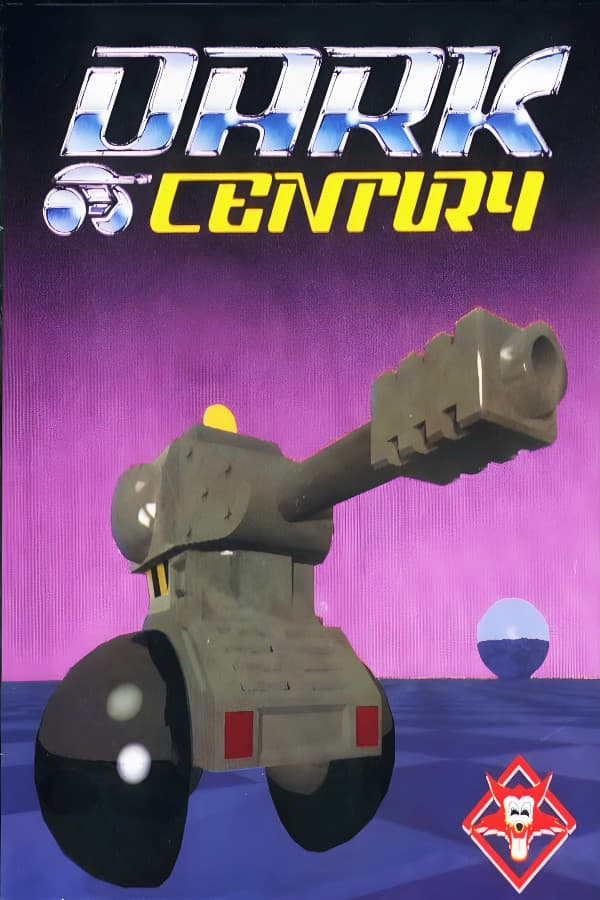

Dark Century
Rate this game
- Played
- Often
Titus Interactive threw six high-tech tanks onto a barren 3D landscape in Dark Century, handing players quick turns, omnidirectional firing, and a squad-level duel to the death.
By the late 1980s, game coders were desperate to pull wireframe and solid-3D calculations out of home computers that were never built to handle them. The team at Titus Interactive, led by programmers Eric Caen, Gil Espeche, Eric Zmiro, and Eric Deman, took on that exact challenge. Their answer was a combat title where you manage high-tech armor across flat terrain, attempting to outmaneuver rival machines before your armor gives out.
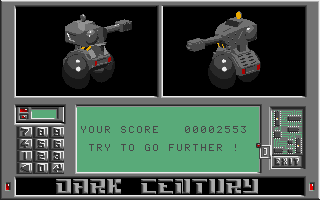
Commanding heavy armor in Dark Century
When you drop into this Titus Software Corporation production, the fight gets down to business instantly. You take charge of a tank squad fighting in a futuristic arena where survival depends entirely on spatial awareness. Your vehicle moves fast, pivots on a dime, and lets you rotate your turret to fire in any direction while backing away from incoming fire.
The combat engine restricts the battlefield to a maximum of six tanks active at one time. That limit sounds modest today, but managing three enemy targets while keeping track of your own wingmen demands quick reflexes. You spend your first few minutes adjusting to how fast the horizon spins when you make a sharp turn to align a shot.
The actual gunplay plays out like an arena shooter. You track enemy vector lines, dodge plasma bursts, and try to isolate single hostile tanks away from their main formation. Victory comes down to tearing through the opponent squad before your own vehicles get chipped down to scrap.
Why the programming experiment overshadowed the action
When the game arrived on store shelves, critics held vastly different views on whether the formula worked. Magazines like French outlet Génération 4 handed it a massive 93% rating and a "Gen D'or" award, praising the visual presentation crafted by Hubert Scymzak and animator Ty Sohor. French publication Joystick also praised the release, awarding it an 85% score.
British reviewers were far more skeptical of the exercise. ACE magazine noted in Issue 31 that the title felt more like a programming exercise than a complete tank simulation or strategy game. While they found the user interface accessible and the printed manual helpful, they pointed out that the lack of terrain variety and flat vehicle capabilities made the shooter loop feel thin after an hour of play. Over on the Atari ST, ST Format slammed it with a 52% score for similar reasons.
That criticism lands fairly when you spend extended time with this action title today. Driving around flat plains hunting target reticles lacks the tactical depth of a full simulation, yet the tank movement is too deliberate to work as a straightforward arcade blast. It sits squarely between two design philosophies without taking complete advantage of either.
Code tricks, posters, and hidden disk messages
Beyond the primary combat, the development history carries several details that fans of 1990 software still talk about. Lead programmer Eric Caen worked directly on porting the title across Amiga and PC hardware, adapting the underlying math to keep frame rates consistent on varying CPU speeds. Christophe Fevre provided the original audio score that gave the futuristic combat its tone.
Titus packaged the physical release with a full-color poster to bolster its retail presence, but the software itself contained a few odd technical choices:
- On the Amstrad CPC version, plugging in a Multiface 2 hardware device triggers heavy screen flickering, built intentionally as an anti-copy routine.
- The original 3.5-inch CPC floppy disk release hides a custom text message embedded directly in the disk structure for curious users to discover with a hex editor.
- The MS-DOS version traded raw color depth for smooth frame rates, allowing fast turret sweeps on modest computer setups.
Despite releasing across MS-DOS, Amiga, Atari ST, and Amstrad platforms, Titus never produced a direct sequel. The game remained a single, distinct entry in their early lineup before the studio shifted its focus toward side-scrolling platformers and licensed properties.
Finding the fun in Dark Century online
The core shooting mechanics present a distinct moment that makes a quick session worthwhile. Trying to hit a lateral shot while power-sliding your tank around an incoming cluster of turret fire delivers a satisfying hit of pure manual dexterity. That is how early computer action games built tense tactical fights out of basic geometric shapes.
You can jump into the driver seat and experience this classic Dark Century MS-DOS game straight from your web browser. You can play Dark Century online for free right here, with no need for emulator setups or manual software configurations. Fire up the engine, take control of your tank squad, and see if you can clear all six enemy combatants off the field in your very first drop.
Players' controls
Touch and gamepad controls
The on-screen keyboard and gamepad mapping the browser player uses on a phone, a tablet or a controller, as opposed to the real keys above. $PRO members make their own in the player and share them here; anyone can pick one to play with.
Make your own touch controlsPRO
- 1Open the editorSign in below, then pick what to make. The game starts with the editor open over it.
- 2Place your keysAdd keys and drag them where your thumbs rest, or map a controller's buttons. Test plays the game with them; Save keeps them, and you play with them from then on.
- 3Share themShare them right after saving in the game, or name and share them here. Players vote, and the best become this game's controls for everyone.
Go PROSee how it worksSign in+20 XP for sharing · +50 XP if yours become the game's own
- The game's own controlsNone yet: played with a real keyboard only.In use
2 screenshots
From the archive
No gameplay video yet
No gameplay video for Dark Century yet. Sign in to add one.
No reviews yet
Tell the community what you think of Dark Century. Reviews are public and tied to your username.
No archived manuals for Dark Century yet
No manuals archived for this title yet. Sign in to upload the first scan.
Cheat codes, console commands and memory pokes for Dark Century — each one verified and attributed.
Sign in to submitNo cheats yet for this title
Know a working cheat, poke or trainer? Add it with the button above. Moderators check every entry before it goes live.
No archived soundtrack for Dark Century yet
No soundtrack archived for this title yet. Sign in to upload the first rip.
No save states for Dark Century yet
No save states for this title yet. Sign in to share one.
Discussions
Sign in to post- Threads0
- Total posts0
- Online now6
Community · Dark Century
Who's contributing, and what's new
- Reviews0
- Threads0
- Uploadsapproved0
- Contributors0
Recent activity
Nothing here yet
Reviews, discussion threads and approved uploads appear here as members add them.