
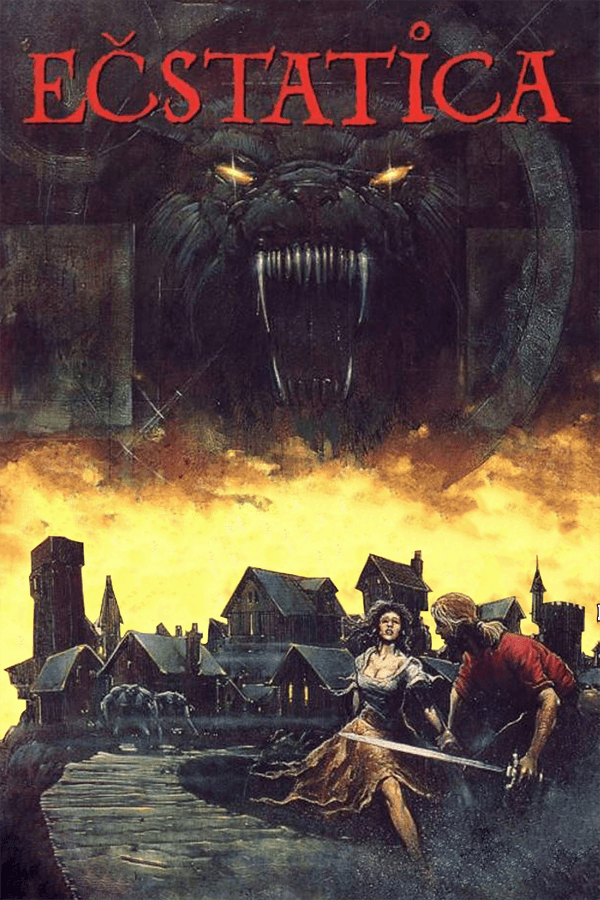

Playing Ecstatica means wandering into an isolated European village where an unkillable werewolf will literally beat you to death within your first sixty seconds of arrival.
By 1994, flat-shaded polygons were the standard solution for rendering three-dimensional characters on screen, but they brought jagged edges and stiff, robotic movements to low-spec hardware. Andrew Spencer set out to solve that visual limitation by building a completely custom engine for Ecstatica, using distorted 3D ellipsoids instead of standard flat facets. Spanning years of solitary work before animation expert Alain Maindron joined the team, Spencer constructed a system out of spheres and ellipses stretched into limbs, torsos, and faces.
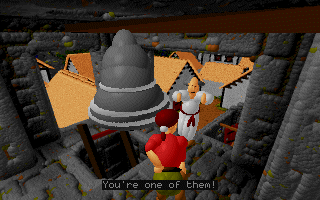
The result gave character models a soft, surprisingly fluid look that set it apart from contemporaries like Alone in the Dark. Opponents do not move like blocky wooden puppets; they swell, flex, and tumble across fixed camera angles. Critics at the time pointed out that the rounded figures looked a bit like distant relatives of the Michelin Man, but the smooth animation brought a genuine sense of mass to every strike and stumble.
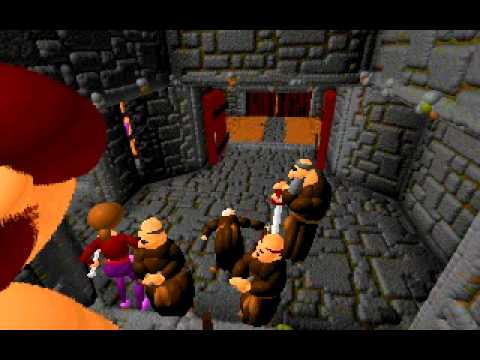
Your nameless traveler steps into the cursed town of Tirich aiming to help the locals and end up rescuing a young sorceress named Ecstatica from demonic possession. The northern village, its overgrown garden paths, and the damp underground passages beneath it are packed with goblins, gremlins, minotaurs, and a wicked witch. Worse still is the crazed werewolf who stalks the streets constantly. You cannot kill him in the early hours of the game, so when you hear him approaching, your options are to run, hide, or get flattened.
Combat depends entirely on managing your physical stance. You can cycle between sneaking, walking, and running modes, adjusting your combat posture if you plan to swing a sword or need to quiet your footsteps behind a demon. Item management is brutally restrictive: you have no invisible backpack, meaning you can carry exactly two items at once, one in each hand. If you need to carry a heavy staff and an empty water canteen across the town square, your hands are full, leaving no room to draw a blade if a goblin jumps out from a doorway.
If you want to try this 1994 release today, you have to wrestle with its fixed tank controls. By default, movement maps directly to the numeric keypad, making turning and maneuvering in tight spaces a frantic exercise when an enemy closes the distance. There is no remapping available natively, so navigating complex puzzle zones like the garden spike traps while adjusting to sudden cinematic camera shifts takes real patience.
The UK's BBFC hit the game with a strict 18 rating upon release due to its graphic violence and dark religious imagery. That dark tone carries directly into the dynamic enemy behavior. Knocking down an enemy does not mean the fight is over. If you manage to hit the stalking werewolf with a heavy blow, he will back off and literally lick his wounds before charging you again. That dynamic AI creates immense dread, but it also creates moments where low-health players get pinned into corners with zero chance of recovery.
As an action game with survival horror leanings, the title relies heavily on environmental puzzles and observational exploration. Navigating the town requires careful experimentation with interactable objects scattered around houses and shops. It is easy to get completely lost, wandering back and forth across Tirich with no idea how to unlock the next area while dodging unkillable monsters. That lack of direction is easily the weakest part of the experience, leaving modern players prone to hitting brick walls without a walkthrough handy.
Yet, the audio design holds its ground. Built with support for top-tier sound cards of its day including the Gravis UltraSound, Roland MT-32, and Sound Blaster AWE32, the atmospheric groans and sudden rustles in the dark make every encounter far tenser. Publisher Psygnosis helped ship roughly 300,000 copies on commercial release, turning a unique tech experiment from Andrew Spencer Studios into a hit that spawned a 1997 sequel.
You can play Ecstatica online for free right here in your web browser, with nothing to download or configure. If you want to experience one of the most unusual engine designs of the DOS era, launch the MS-DOS game directly and test your luck against the werewolf in the opening minutes of Tirich. Try creeping past the first set of houses in sneak mode just to see how the unique ellipsoid character animations move up close.
Playing Ecstatica means wandering into an isolated European village where an unkillable werewolf will literally beat you to death within your first sixty seconds of arrival.
By 1994, flat-shaded polygons were the standard solution for rendering three-dimensional characters on screen, but they brought jagged edges and stiff, robotic movements to low-spec hardware. Andrew Spencer set out to solve that visual limitation by building a completely custom engine for Ecstatica, using distorted 3D ellipsoids instead of standard flat facets. Spanning years of solitary work before animation expert Alain Maindron joined the team, Spencer constructed a system out of spheres and ellipses stretched into limbs, torsos, and faces.
The result gave character models a soft, surprisingly fluid look that set it apart from contemporaries like Alone in the Dark. Opponents do not move like blocky wooden puppets; they swell, flex, and tumble across fixed camera angles. Critics at the time pointed out that the rounded figures looked a bit like distant relatives of the Michelin Man, but the smooth animation brought a genuine sense of mass to every strike and stumble.

Your nameless traveler steps into the cursed town of Tirich aiming to help the locals and end up rescuing a young sorceress named Ecstatica from demonic possession. The northern village, its overgrown garden paths, and the damp underground passages beneath it are packed with goblins, gremlins, minotaurs, and a wicked witch. Worse still is the crazed werewolf who stalks the streets constantly. You cannot kill him in the early hours of the game, so when you hear him approaching, your options are to run, hide, or get flattened.
Combat depends entirely on managing your physical stance. You can cycle between sneaking, walking, and running modes, adjusting your combat posture if you plan to swing a sword or need to quiet your footsteps behind a demon. Item management is brutally restrictive: you have no invisible backpack, meaning you can carry exactly two items at once, one in each hand. If you need to carry a heavy staff and an empty water canteen across the town square, your hands are full, leaving no room to draw a blade if a goblin jumps out from a doorway.

If you want to try this 1994 release today, you have to wrestle with its fixed tank controls. By default, movement maps directly to the numeric keypad, making turning and maneuvering in tight spaces a frantic exercise when an enemy closes the distance. There is no remapping available natively, so navigating complex puzzle zones like the garden spike traps while adjusting to sudden cinematic camera shifts takes real patience.
The UK's BBFC hit the game with a strict 18 rating upon release due to its graphic violence and dark religious imagery. That dark tone carries directly into the dynamic enemy behavior. Knocking down an enemy does not mean the fight is over. If you manage to hit the stalking werewolf with a heavy blow, he will back off and literally lick his wounds before charging you again. That dynamic AI creates immense dread, but it also creates moments where low-health players get pinned into corners with zero chance of recovery.

As an action game with survival horror leanings, the title relies heavily on environmental puzzles and observational exploration. Navigating the town requires careful experimentation with interactable objects scattered around houses and shops. It is easy to get completely lost, wandering back and forth across Tirich with no idea how to unlock the next area while dodging unkillable monsters. That lack of direction is easily the weakest part of the experience, leaving modern players prone to hitting brick walls without a walkthrough handy.
Yet, the audio design holds its ground. Built with support for top-tier sound cards of its day including the Gravis UltraSound, Roland MT-32, and Sound Blaster AWE32, the atmospheric groans and sudden rustles in the dark make every encounter far tenser. Publisher Psygnosis helped ship roughly 300,000 copies on commercial release, turning a unique tech experiment from Andrew Spencer Studios into a hit that spawned a 1997 sequel.
You can play Ecstatica online for free right here in your web browser, with nothing to download or configure. If you want to experience one of the most unusual engine designs of the DOS era, launch the MS-DOS game directly and test your luck against the werewolf in the opening minutes of Tirich. Try creeping past the first set of houses in sneak mode just to see how the unique ellipsoid character animations move up close.
How Ecstatica is played — the keys the game listens to, grouped by what they do.
Highlighted keys are mapped — hover or tap one to see what it does.
Keyboard controls cannot be remapped in-game. Sound and installation options are configured by running SETUP.EXE from DOS.
The on-screen keyboard and gamepad mapping the browser player uses on a phone, a tablet or a controller, as opposed to the real keys above. $PRO members make their own in the player and share them here; anyone can pick one to play with.
Cheat codes, console commands and memory pokes for Ecstatica — each one verified and attributed.
Sign in to submitaka Ečstatica
How Ecstatica is played — the keys the game listens to, grouped by what they do.
Highlighted keys are mapped — hover or tap one to see what it does.
Keyboard controls cannot be remapped in-game. Sound and installation options are configured by running SETUP.EXE from DOS.
The on-screen keyboard and gamepad mapping the browser player uses on a phone, a tablet or a controller, as opposed to the real keys above. $PRO members make their own in the player and share them here; anyone can pick one to play with.
Cheat codes, console commands and memory pokes for Ecstatica — each one verified and attributed.
Sign in to submit