
Playing Elvira: The Arcade Game means lobbing daggers at bats, dodging dragons in ice caves, and wrestling with controls that make jumping onto small ledges far more stressful than it needs to be.
The screen opens on a vision from King Gustav of Transylvania, an ancestor who tasks Elvira with purging monsters from lost realms to reclaim her castle. You start by choosing between two initial stages: the Underworld of Fire and Arctic Earth. The goal in each world is to find keys, hit switches, and navigate maze-like levels to clear the area, which eventually unlocks the Transylvanian Enchanted Castle.
Along the way, you pick up food to refill health, collect treasure chests, and gather rune stones to trade with a merchant. You attack with ranged weapons like throwing daggers or magic spells. The visual style is pure late-eighties comic horror, featuring animated demons, dragons, bats, and dinosaurs, but the presentation masks a strict side-view platformer where every single jump requires careful positioning.
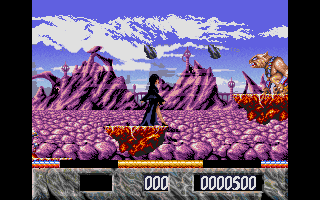
While magazines like Amiga Action rated the game at 87% back in early 1992, modern players usually encounter the same frustration that Amiga Power hinted at when they noted a total lack of gameplay surprises. The movement relies on a sluggish response time that turns precise platforming into a chore. If you try to jump while throwing a dagger, the strict collision detection often punishes you by dropping you directly onto an enemy hit box or an off-screen hazard.
Level architecture leans heavily on tedious backtracking. You will routinely wander down a long tunnel in the Arctic Earth world, hit a locked gate, and realise you missed a single key three screens back. Because enemies respawn or pop in right at the edge of the screen, retracing your steps often leads to taking cheap damage before you even see what hit you.
Sound design depends entirely on your audio setup. On standard systems, you got sparse PC speaker clicks, but enabling AdLib or Sound Blaster support brings out the full soundtrack. In some releases, toggling the "S" key turns the background tunes on or off, which was a welcome feature when you just wanted to focus on surviving a brutal boss jump.
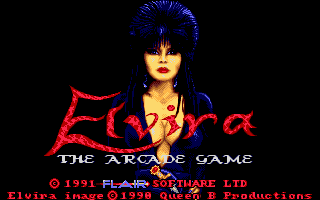
Unlike the point-and-click RPGs Elvira: Mistress of the Dark and its sequel Elvira II: The Jaws of Cerberus, this action spin-off was published and developed directly by Flair Software in conjunction with Horrorsoft. Designed by Mick Hedley, Phil Scott, Phillip Nixon, and Mark Sample, the project aimed to turn the horror icon into a straightforward run-and-gun character.
The 1991 action game requires standard system specs: 640K RAM, DOS 2.0 or higher, and EGA or VGA graphics. While the art by Phillip Nixon captures Elvira's signature look effectively, the underlying code programmed by Mick Hedley does not offer the fluid movement seen in contemporary action titles like Commander Keen. It plays like an arcade machine tuned to swallow quarters through sheer friction.
To survive the sudden difficulty spikes without throwing your keyboard, many players turned to cracked versions or trainer hacks. Hotkeys like pressing F5 to grab nine extra lives became the standard way to actually see the inner halls of the castle, bypassing the punishment of starting a world from scratch.
If you want to experience an Elvira: The Arcade Game MS-DOS game run today, it shows how licensed properties were adapted across completely different genres. The visual flair and enemy designs hold up well, even if the controls demand absolute patience. It comes straight out of early nineties British platformer design, where high difficulty and cryptic level layouts were expected to extend play time.
You can play Elvira: The Arcade Game free in your browser right now, with nothing to install and no setup required. Modern players usually expect character movement to carry momentum, so the biggest mistake newcomers make is trying to run and jump continuously as if it were a modern platformer. Treat every room as a tactical sequence: stop on each platform, clear the screen with daggers before moving ahead, and watch the top edge for incoming bats.
Playing Elvira: The Arcade Game means lobbing daggers at bats, dodging dragons in ice caves, and wrestling with controls that make jumping onto small ledges far more stressful than it needs to be.
The screen opens on a vision from King Gustav of Transylvania, an ancestor who tasks Elvira with purging monsters from lost realms to reclaim her castle. You start by choosing between two initial stages: the Underworld of Fire and Arctic Earth. The goal in each world is to find keys, hit switches, and navigate maze-like levels to clear the area, which eventually unlocks the Transylvanian Enchanted Castle.
Along the way, you pick up food to refill health, collect treasure chests, and gather rune stones to trade with a merchant. You attack with ranged weapons like throwing daggers or magic spells. The visual style is pure late-eighties comic horror, featuring animated demons, dragons, bats, and dinosaurs, but the presentation masks a strict side-view platformer where every single jump requires careful positioning.

While magazines like Amiga Action rated the game at 87% back in early 1992, modern players usually encounter the same frustration that Amiga Power hinted at when they noted a total lack of gameplay surprises. The movement relies on a sluggish response time that turns precise platforming into a chore. If you try to jump while throwing a dagger, the strict collision detection often punishes you by dropping you directly onto an enemy hit box or an off-screen hazard.
Level architecture leans heavily on tedious backtracking. You will routinely wander down a long tunnel in the Arctic Earth world, hit a locked gate, and realise you missed a single key three screens back. Because enemies respawn or pop in right at the edge of the screen, retracing your steps often leads to taking cheap damage before you even see what hit you.
Sound design depends entirely on your audio setup. On standard systems, you got sparse PC speaker clicks, but enabling AdLib or Sound Blaster support brings out the full soundtrack. In some releases, toggling the "S" key turns the background tunes on or off, which was a welcome feature when you just wanted to focus on surviving a brutal boss jump.

Unlike the point-and-click RPGs Elvira: Mistress of the Dark and its sequel Elvira II: The Jaws of Cerberus, this action spin-off was published and developed directly by Flair Software in conjunction with Horrorsoft. Designed by Mick Hedley, Phil Scott, Phillip Nixon, and Mark Sample, the project aimed to turn the horror icon into a straightforward run-and-gun character.
The 1991 action game requires standard system specs: 640K RAM, DOS 2.0 or higher, and EGA or VGA graphics. While the art by Phillip Nixon captures Elvira's signature look effectively, the underlying code programmed by Mick Hedley does not offer the fluid movement seen in contemporary action titles like Commander Keen. It plays like an arcade machine tuned to swallow quarters through sheer friction.
To survive the sudden difficulty spikes without throwing your keyboard, many players turned to cracked versions or trainer hacks. Hotkeys like pressing F5 to grab nine extra lives became the standard way to actually see the inner halls of the castle, bypassing the punishment of starting a world from scratch.
If you want to experience an Elvira: The Arcade Game MS-DOS game run today, it shows how licensed properties were adapted across completely different genres. The visual flair and enemy designs hold up well, even if the controls demand absolute patience. It comes straight out of early nineties British platformer design, where high difficulty and cryptic level layouts were expected to extend play time.
You can play Elvira: The Arcade Game free in your browser right now, with nothing to install and no setup required. Modern players usually expect character movement to carry momentum, so the biggest mistake newcomers make is trying to run and jump continuously as if it were a modern platformer. Treat every room as a tactical sequence: stop on each platform, clear the screen with daggers before moving ahead, and watch the top edge for incoming bats.
How Elvira: The Arcade Game is played — the keys the game listens to, grouped by what they do.
Highlighted keys are mapped — hover or tap one to see what it does.
In-game platforming movement keys are omitted as they were not explicitly detailed line-by-line for PC in the excerpt. SETUP.EXE allows sound and video configuration.
The on-screen keyboard and gamepad mapping the browser player uses on a phone, a tablet or a controller, as opposed to the real keys above. $PRO members make their own in the player and share them here; anyone can pick one to play with.
Cheat codes, console commands and memory pokes for Elvira: The Arcade Game — each one verified and attributed.
Sign in to submitHow Elvira: The Arcade Game is played — the keys the game listens to, grouped by what they do.
Highlighted keys are mapped — hover or tap one to see what it does.
In-game platforming movement keys are omitted as they were not explicitly detailed line-by-line for PC in the excerpt. SETUP.EXE allows sound and video configuration.
The on-screen keyboard and gamepad mapping the browser player uses on a phone, a tablet or a controller, as opposed to the real keys above. $PRO members make their own in the player and share them here; anyone can pick one to play with.
Cheat codes, console commands and memory pokes for Elvira: The Arcade Game — each one verified and attributed.
Sign in to submit