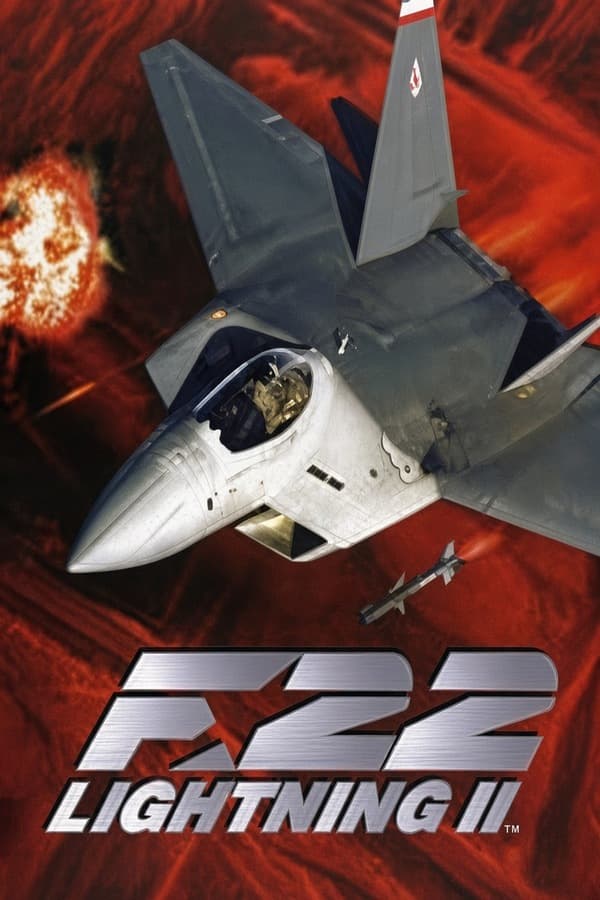
NovaLogic built F-22 Lightning II to dump players straight into supersonic dogfights rather than make them spend twenty minutes studying pre-flight checklists. It traded strict physical flight modeling for immediate, weapon-heavy combat across hundreds of square miles of flat terrain.
NovaLogic picked blistering arcade action over flight fidelity for F-22 Lightning II
If you walked into a software store looking for a hardcore study sim, Randy Casey's design was bound to disappoint you. The flight dynamics feel light, almost floaty, lacking the heavy inertia and stall characteristics that sim enthusiasts demanded from contemporary PC titles. Yet that deliberate trade-off is exactly why the game moves so fast. Designed and programmed for the NovaLogic, Inc. engine running in 256-color VESA SVGA at 640x480 resolution, it delivered smooth framerates, page-flipping routines, and atmospheric hazing that made ground targets pop out of the horizon long before your radar locked onto them.
The cockpit layout hooks functional multi-function displays (MFDs) right into virtual 3D panning, created under official license and documentation from Lockheed Martin. You get a sleek front-row seat to the experimental stealth jet, complete with working night vision and interactive displays. But once the wheels leave the tarmac, the game drops any pretense of pure realism. Enemy fighters throw themselves at you in wave after wave, forcing you to rely on hit-and-run tactics rather than drawn-out energy maneuvers. Purists scoffed at the soft physics, yet for anyone who just wanted to lock an AIM-120C AMRAAM onto a distant target, it delivered pure momentum.
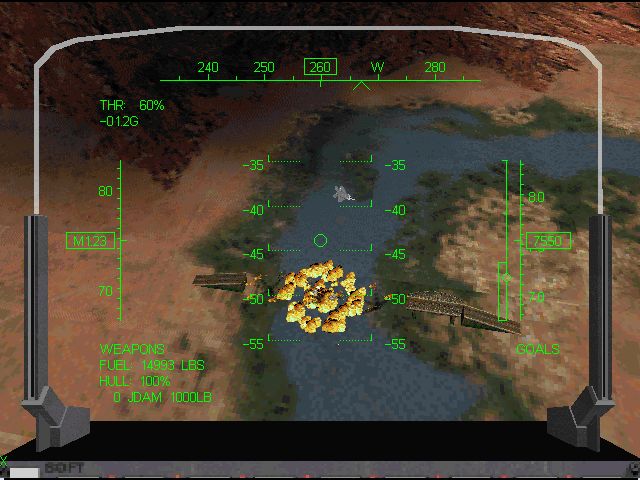
Scud hunting and stealth strikes define the campaign missions
The single-player game structures its operations across distinct regional theatres after an introductory training run at Nellis AFB in Nevada. You deploy across campaigns like Gambling on the Mekong, Siberian Turncoats, Iraqi Machinations, Odessa Vacation, and Back to Africa. Missions range from high-altitude intercepts to low-level ground strikes against Scud missile launchers, surface-to-air missile sites, and heavy AAA installations. Hunting ground armor while keeping an eye out for patrolling Su-27 Flankers or MiG-29 Fulcrums requires constant radar management and quick cycling between air-to-air and air-to-ground ordnance.
Your armory contains high-tech hardware fitted for covert operations: short-range AIM-9X Sidewinders for tight dogfights, radar-guided AMRAAMs for long-range kills, the M61A1 20mm Vulcan cannon for close encounters, and GPS-guided JDAM MK 83 bombs for heavy structures. Managing your internal weapons bay is crucial, as opening the bay doors temporarily expands your radar footprint and leaves you vulnerable to enemy tracking systems. Flare and chaff countermeasures keep SAMs off your tail, though running out of defenses in enemy airspace almost guarantees a quick launch into the ground.
NovaLogic tucked a few lighthearted details into the mission maps to break up the serious military tone. In Mission 7 of Campaign 4, players who scan the pastures below can locate ground targets labeled "Unidentified Norman". Locking a JDAM onto these unsuspecting cows unlocks the infamous Cow Killer secret, complete with a unique target destroyed confirmation. It was a bizarre inclusion for a licensed military project, but it became one of those details players whispered about on early Internet message boards.
F-22 Lightning II demands a keyboard reference chart just to manage your radar
While the joystick handles basic flight surfaces, navigating the sub-menus for radar modes, weapon selection, and target acquisition requires quick fingerwork across the keyboard. Without a copy of the printed keyboard overlay, early players frequently ejected by mistake or dumped their countermeasures while trying to toggle their target tracking modes. The steep control layout creates a trial-by-fire learning curve during chaotic dogfights, where a single mistyped keystroke leaves you defensive against incoming fire.
When the combat gets too thick, built-in debug commands offer a quick bailout. Typing Ctrl + Alt + Shift + Insert mid-flight fully refuels and rearms your jet, while Ctrl + Alt + Home fills your weapons bay with max missiles. For complete invincibility, Ctrl + Alt + Shift + Home turns your airframe indestructible against ground fire and mid-air collisions. International releases shifted the rearm shortcut to Ctrl + Alt + Shift + F2, giving overseas pilots the same instant supply drop.
Audio design was another area where NovaLogic invested heavily, supporting 16-bit stereo Dolby Surround Sound alongside digital audio drivers for Sound Blaster cards, Microsoft Sound System, and Crystal CS4232 chips. The synth soundtrack scales nicely across General MIDI, 8-bit OPL2, and 16-bit OPL3 hardware. Hearing the deep rumble of your twin engines alongside crisp warning tones on a Sound Blaster AWE32 gave every intercept extra tension.
Why this flight combat title pulled in massive sales in 1996
When magazine reviewers rated the game upon release in late 1996, opinions split sharply along genre lines. Outlets looking for a strict flight model, such as Next Generation, awarded it 2 out of 5 stars, writing off its accessible flight envelope as too simple for serious sim enthusiasts. Conversely, French publication Génération 4 rated it 4 out of 5, praising its rapid combat pacing and multiplayer options. GameSpot highlighted its smart enemy AI and visuals while pointing out that campaign missions often felt isolated from one another.
Despite critical friction over its physical modeling, the game exploded commercially. It became the top-selling military simulation game in the United States for the first half of 1997, topping 350,000 units sold globally within months of release. Part of that popularity stemmed from its flexible multiplayer, which let players host head-to-head dogfights or cooperative missions over local networks and dial-up connections using a lightweight spawn installation system similar to Warcraft II.
- Fast-paced dogfights prioritising immediate action over complex pre-flight procedures.
- Detailed 256-color SVGA graphics utilizing smooth hazing effects and 3D cockpits.
- Extensive single-player campaigns spanning Nevada, Asia, Siberia, the Middle East, and Africa.
- Robust multiplayer support featuring deathmatch and cooperative modes.
If you missed this classic NovaLogic, Inc. release back in the nineties, modern players usually expect a rigid flight sim and are surprised by how much it plays like an intense arcade air-combat shooter. You can play F-22 Lightning II online free in your browser right now, with full keyboard support ready to go. Jump into the cockpit, line up your AMRAAMs on the nearest Flanker, and see why this classic F-22 Lightning II MS-DOS game captured so much of the mid-nineties flight combat crowd.