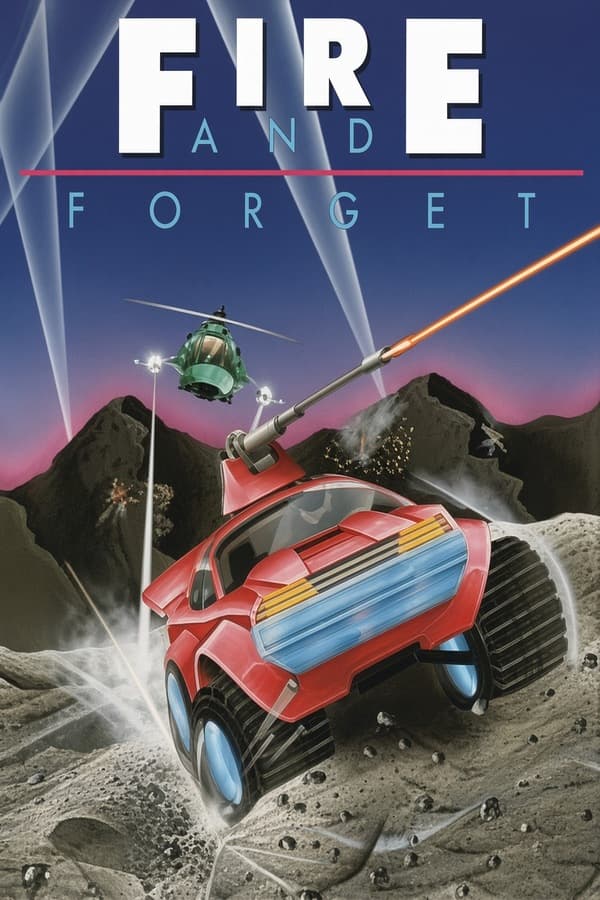
Fire and Forget
Rate this game
- Played
- Often
In Fire and Forget, your biggest enemy is not the fleet of armed cars blocking your path across global highways, but the fuel gauge steadily draining at the bottom of the screen. Titus France SA tried to fuse behind-the-car driving with explosive shooting, creating a high-speed arcade run where running out of gas brings an instant game over regardless of how many extra chances you have accumulated.
Fuel stops matter more than firepower on these tracks
Most action games from 1988 gave you three lives and sent you on your way, but Titus took a different route. You have unlimited lives in this drive, which sounds generous until you realize that death is only a minor penalty compared to coasting on an empty tank. If your tank hits zero, the run ends immediately, forcing you to treat every stray fuel canister on the road as a matter of survival.
The perspective places your armed vehicle squarely at the bottom center of the screen, looking down long stretches of highway dotted with enemy vehicles and static road hazards. You dodge oncoming traffic, align your guns with enemy cars, and blow them off the asphalt before they can drop your shields or block your path. The steering demands precise inputs, yet the controls on PC feel twitchy enough that a single sharp turn can send you straight into an obstacle you were trying to avoid.
Course structure splits the challenge across multiple difficulty settings, with each setting featuring six distinct tracks spread across global locations. Progressing through a track requires a constant balance between raw speed and target selection:
- Shooting lead vehicles clears a path through heavy traffic before collisions drain your momentum.
- Snagging fuel drops keeps the main timer alive long enough to reach the finish line.
- Weaving past road barriers avoids catastrophic crashes that waste precious seconds of fuel burn.
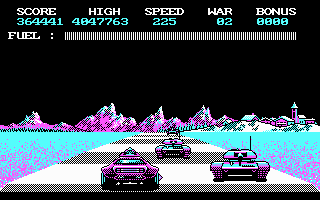
CGA graphics turn every road obstacle into a guessing game
If you originally loaded this title on an IBM PC clone back in the late eighties, the visual presentation made an immediate impression, though not necessarily a good one. While 16-bit home computers like the Amiga and Atari ST enjoyed detailed road textures and smoother scaling, the action on DOS had to struggle through harsh four-color CGA display modes or basic EGA renditions. The resulting palette turns enemy cars and roadside hazards into jagged clusters of pixels that blur together when the scrolling speeds up.
Sound design on the PC side suffered a similar fate. Without a dedicated sound card setup doing heavy lifting, the internal PC speaker chirps out dry engine hums and thin explosion effects that lack any real punch. Players launching the executable via FIRE.EXE or GAME.EXE were treated to an unforgiving arcade structure wrapped in a bare-bones visual package that felt old even when it was new.
Period reviews were quick to point out these technical shortcomings. German publication Power Play handed down a brutal 20% rating in late 1988, while Britain's Computer + Video Games scored it a meager 3/10. Magazines like ACE and ST Action were slightly more forgiving with scores near the 60% mark, but few critics overlooked how rough the PC port looked compared to its 16-bit console and computer cousins.
The Titus library shows how quickly the studio iterated
Brothers Éric and Hervé Caen built Titus France SA into a software house by pumping out arcade-inspired software at a steady pace. Alongside titles like Crazy Cars and Titan, this release served as one of the early commercial projects that established the company as a major French publisher. Credits on early releases were notoriously sparse, with home computer conversions often attributing development simply to names like "Gil" and "Paul" in text files or tape liner notes.
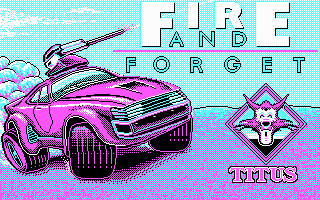
The core concept of an armed supercar shooting down convoys had clear potential, but the execution here felt like a test draft. Titus recognized those limitations quickly and released a refined follow-up shortly after. The sequel, Fire & Forget II: The Death Convoy, introduced flying mechanics and far better sprite scaling, effectively addressing the clunky movement and visual clutter that held the original back.
Fire up the original Titus France SA release today, and you can see how rough early PC arcade conversions used to be. It shows the vast gap that existed between standard DOS hardware and dedicated gaming microcomputers before VGA cards and Sound Blaster boards standardized PC gaming hardware in the nineties.
Take your turn behind the wheel
Playing this release today is an exercise in early PC survival. The fast pace and zero-margin fuel mechanics offer a honest snapshot of late-eighties arcade design, even if the visuals struggle to keep up with the action. If you want to sample this piece of French gaming history without wrestling with old disk images, you can play Fire and Forget online right now.
You can experience this classic Fire and Forget MS-DOS game directly in your web browser with zero configuration required. The twitchy steering and unforgiving fuel clock are preserved intact, letting you test your reflexes against the global courses just as they were built back in 1988. Hop into the driver's seat, keep an eye on your fuel gauge, and see if you can reach the final course before your tank runs completely dry.
How Fire and Forget is played — the keys the game listens to, grouped by what they do.
- Movement
- Action
Highlighted keys are mapped — hover or tap one to see what it does.
Key mapping compiled for MS-DOS from the original manual notes. Dedicated pause and save keys are not listed for MS-DOS.
Players' controls
Touch and gamepad controls
The on-screen keyboard and gamepad mapping the browser player uses on a phone, a tablet or a controller, as opposed to the real keys above. $PRO members make their own in the player and share them here; anyone can pick one to play with.
Make your own touch controlsPRO
- 1Open the editorSign in below, then pick what to make. The game starts with the editor open over it.
- 2Place your keysAdd keys and drag them where your thumbs rest, or map a controller's buttons. Test plays the game with them; Save keeps them, and you play with them from then on.
- 3Share themShare them right after saving in the game, or name and share them here. Players vote, and the best become this game's controls for everyone.
Go PROSee how it worksSign in+20 XP for sharing · +50 XP if yours become the game's own
- The game's own controlsKeyboardGamepadWhat every player starts with.In use
2 screenshots
From the archive
No gameplay video yet
No gameplay video for Fire and Forget yet. Sign in to add one.
No reviews yet
Tell the community what you think of Fire and Forget. Reviews are public and tied to your username.
No archived manuals for Fire and Forget yet
No manuals archived for this title yet. Sign in to upload the first scan.
Cheat codes, console commands and memory pokes for Fire and Forget — each one verified and attributed.
Sign in to submitNo cheats yet for this title
Know a working cheat, poke or trainer? Add it with the button above. Moderators check every entry before it goes live.
No archived soundtrack for Fire and Forget yet
No soundtrack archived for this title yet. Sign in to upload the first rip.
No save states for Fire and Forget yet
No save states for this title yet. Sign in to share one.
Discussions
Sign in to post- Threads0
- Total posts0
- Online now6
Community · Fire and Forget
Who's contributing, and what's new
- Reviews0
- Threads0
- Uploadsapproved0
- Contributors0
Recent activity
Nothing here yet
Reviews, discussion threads and approved uploads appear here as members add them.