
Playing Future Wars: Adventures In Time begins outside a skyscraper in 1989 with a bucket, a squeegee, and an angry boss named Ed shouting down from the window above.
You play as an unnamed hero who spills his cleaning bucket and ducks into a building to escape his boss. While trying to play a quick prank on Ed, you hit a secret switch behind a display case and step directly into a hidden temporal machine. That accidental discovery drags you straight into a battle against the Crughons, a shapeshifting alien race attempting to rewrite human history.
Your journey jumps across wildly different eras. You begin in medieval Europe in 1304 AD to rescue a noblewoman named Lo'Ann from a monastery. Later tasks drag you forward to a desolate 44th century and back into the prehistoric swamp of the Cretaceous period. The premise feels like a Saturday morning cartoon, but the tone leans surprisingly quiet and mysterious.
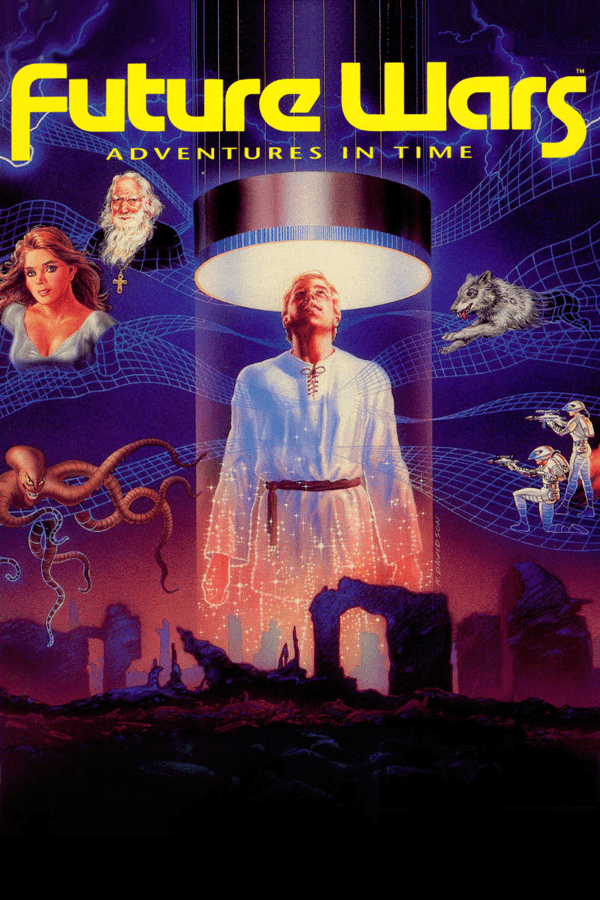
The visual presentation defined the game upon its release. Developed by Delphine Software International and published by Interplay Productions, Inc., the artwork by Éric Chahi gave every screen a cinematic look. Rich 256-color VGA backgrounds made each epoch feel detailed and convincing on PC displays.
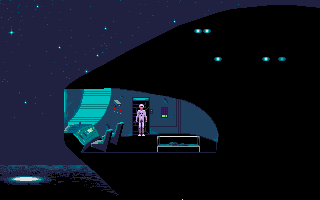
Designer Paul Cuisset built the experience using Delphine's proprietary Cinématique engine. Unlike the SCUMM interface from LucasArts, where available actions sit neatly at the bottom of the screen, right-clicking here opens a pop-up verb menu. You select commands like Examine, Take, Use, or Operate, then left-click your target in the environment.
That system sounds clean on paper, but it leads directly to the game's most notorious flaw. You will spend extensive amounts of time scanning background art for objects that consist of only two or three tiny pixels. Finding a crucial flag-pin or spotting hidden interactive gear requires exact cursor placement and endless patience.
The puzzle logic can feel equally ruthless. To proceed in medieval France, you must pull off odd sequences such as stealing clothes from a knight who went skinny-dipping. If you miss a tiny item in one era, the game lets you travel forward anyway, leaving you permanently stranded several hours later with no way to finish.
Instant deaths lurk around almost every corner. Walking into the wrong room or failing to react in a split second triggers an immediate game over screen. Players in 1990 quickly learned to keep multiple save slots active at all times.
The audio presentation offers a mixed bag for PC owners. Composer Jean Baudlot provided memorable synth themes, but the MS-DOS game relies on MIDI music that loops endlessly during long puzzle sessions. Amiga players received tracker modules, whereas DOS users got repetitive synthetic tunes that eventually wear down your focus.
Despite those frustrations, fans retained a fond affection for the story over the years. Gamers routinely poke fun at the evil Crughons, jokingly referring to the alien threats as "croutons" due to their awkward name. The narrative was supposed to start an ongoing series, but no direct sequel ever materialized.
If you enjoy classic adventure games with stunning hand-drawn scenes, this title delivers plenty of atmosphere. However, you must accept the harsh rules of late-eighties European game design. You will need to save often, inspect every corner of the screen, and prepare for occasional trial-and-error setups.
Here is what you need to keep in mind before jumping into the adventure:
The background art and historical jumping make the journey worth taking for patient retro enthusiasts. It shows a key early stage of cinematic gaming, right before the developer created Another World.
You can play Future Wars: Adventures In Time free in your browser right now with no setup required. Running the game directly on this page lets you experience the precise pixel hunting and atmospheric art instantly. Take a close look at that skyscraper window in the opening screen to see how the story begins.
Playing Future Wars: Adventures In Time begins outside a skyscraper in 1989 with a bucket, a squeegee, and an angry boss named Ed shouting down from the window above.
You play as an unnamed hero who spills his cleaning bucket and ducks into a building to escape his boss. While trying to play a quick prank on Ed, you hit a secret switch behind a display case and step directly into a hidden temporal machine. That accidental discovery drags you straight into a battle against the Crughons, a shapeshifting alien race attempting to rewrite human history.
Your journey jumps across wildly different eras. You begin in medieval Europe in 1304 AD to rescue a noblewoman named Lo'Ann from a monastery. Later tasks drag you forward to a desolate 44th century and back into the prehistoric swamp of the Cretaceous period. The premise feels like a Saturday morning cartoon, but the tone leans surprisingly quiet and mysterious.
The visual presentation defined the game upon its release. Developed by Delphine Software International and published by Interplay Productions, Inc., the artwork by Éric Chahi gave every screen a cinematic look. Rich 256-color VGA backgrounds made each epoch feel detailed and convincing on PC displays.
Designer Paul Cuisset built the experience using Delphine's proprietary Cinématique engine. Unlike the SCUMM interface from LucasArts, where available actions sit neatly at the bottom of the screen, right-clicking here opens a pop-up verb menu. You select commands like Examine, Take, Use, or Operate, then left-click your target in the environment.
That system sounds clean on paper, but it leads directly to the game's most notorious flaw. You will spend extensive amounts of time scanning background art for objects that consist of only two or three tiny pixels. Finding a crucial flag-pin or spotting hidden interactive gear requires exact cursor placement and endless patience.
The puzzle logic can feel equally ruthless. To proceed in medieval France, you must pull off odd sequences such as stealing clothes from a knight who went skinny-dipping. If you miss a tiny item in one era, the game lets you travel forward anyway, leaving you permanently stranded several hours later with no way to finish.
Instant deaths lurk around almost every corner. Walking into the wrong room or failing to react in a split second triggers an immediate game over screen. Players in 1990 quickly learned to keep multiple save slots active at all times.
The audio presentation offers a mixed bag for PC owners. Composer Jean Baudlot provided memorable synth themes, but the MS-DOS game relies on MIDI music that loops endlessly during long puzzle sessions. Amiga players received tracker modules, whereas DOS users got repetitive synthetic tunes that eventually wear down your focus.
Despite those frustrations, fans retained a fond affection for the story over the years. Gamers routinely poke fun at the evil Crughons, jokingly referring to the alien threats as "croutons" due to their awkward name. The narrative was supposed to start an ongoing series, but no direct sequel ever materialized.
If you enjoy classic adventure games with stunning hand-drawn scenes, this title delivers plenty of atmosphere. However, you must accept the harsh rules of late-eighties European game design. You will need to save often, inspect every corner of the screen, and prepare for occasional trial-and-error setups.
Here is what you need to keep in mind before jumping into the adventure:
The background art and historical jumping make the journey worth taking for patient retro enthusiasts. It shows a key early stage of cinematic gaming, right before the developer created Another World.
You can play Future Wars: Adventures In Time free in your browser right now with no setup required. Running the game directly on this page lets you experience the precise pixel hunting and atmospheric art instantly. Take a close look at that skyscraper window in the opening screen to see how the story begins.
How Future Wars: Adventures In Time is played — the keys the game listens to, grouped by what they do.
Highlighted keys are mapped — hover or tap one to see what it does.
Future Wars relies on Delphine's mouse-driven Cinematique interface. Function keys provide shortcuts to activation menu choices, and certain puzzles require typing numbers into on-screen keypads.
The on-screen keyboard and gamepad mapping the browser player uses on a phone, a tablet or a controller, as opposed to the real keys above. $PRO members make their own in the player and share them here; anyone can pick one to play with.
Cheat codes, console commands and memory pokes for Future Wars: Adventures In Time — each one verified and attributed.
Sign in to submitaka Future Wars: Time Travellers · Time Travellers: The Menace · Les Voyageurs du Temps: La Menace · Future Wars: Toki no Bōkensha
How Future Wars: Adventures In Time is played — the keys the game listens to, grouped by what they do.
Highlighted keys are mapped — hover or tap one to see what it does.
Future Wars relies on Delphine's mouse-driven Cinematique interface. Function keys provide shortcuts to activation menu choices, and certain puzzles require typing numbers into on-screen keypads.
The on-screen keyboard and gamepad mapping the browser player uses on a phone, a tablet or a controller, as opposed to the real keys above. $PRO members make their own in the player and share them here; anyone can pick one to play with.
Cheat codes, console commands and memory pokes for Future Wars: Adventures In Time — each one verified and attributed.
Sign in to submit