In Hammer of the Gods, conquering every tile on the map will not guarantee a win if you have offended Odin by ignoring his direct demands.
Most 1994 empire builders hand you a set of production queues and demand that you paint the map your color, but this turn-based strategy game operates on a completely different set of rules. Executive producer Jon Van Caneghem and developer Holistic Design set out to simulate a realm governed by Viking mythology, where raw land ownership is meaningless without divine favor. You can burn through coastal villages, seize rich monasteries, and construct defensive castles, but if your standing in the eyes of the Norse gods drops too low, you lose. The ultimate goal requires completing the specific quest assigned by Odin himself, making your reputation as vital as your military standing.
You begin a campaign by choosing one of four distinct factions: humans, elves, trolls, or dwarves. Each race alters your path to victory based on the divine patron linked to that group. Playing as human forces you to manage traditional military expansion, while playing as troll or dwarf shifts your priorities toward raiding and heroic feats. The world map represents Europe during the Viking golden age starting around 700 AD, though you can also generate a random map if you prefer an unpredictable layout. Connecting conquered towns with built roads speeds up your logistics, but leaving a province undefended against rival warbands will quickly gut your treasury.
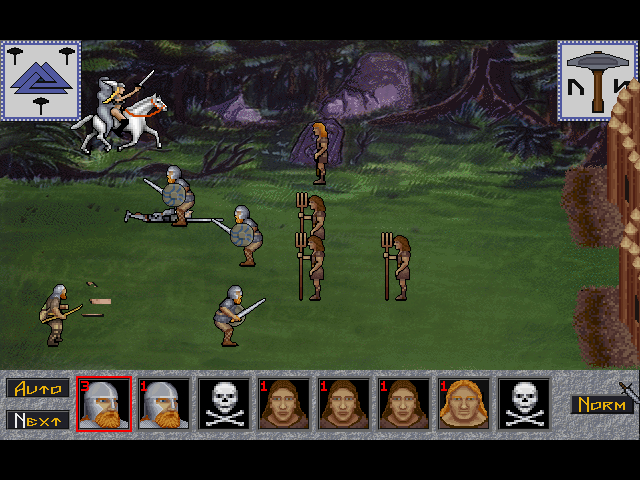
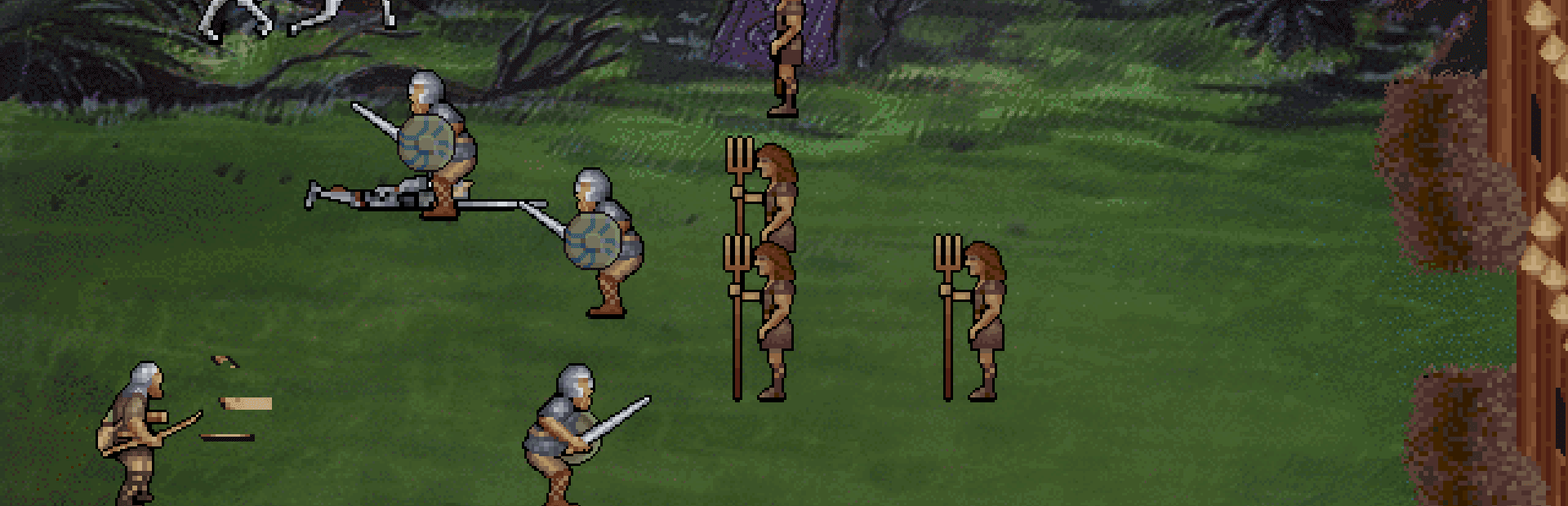
When two armies meet, the perspective shifts from the overland view to a side-view tactical battlefield. Programmers Ken Lightner and Rob Lefebvre designed a grid-based engagement system where troop placement directly dictates survival. Frontline melee units clash head-on, while long-range archers and spellcasting wizards fire across adjacent tiles. Position matters immensely because blocking narrow passes prevents heavy attackers from overwhelming your squishier backline units.
This layout made the game a direct mechanical predecessor to the combat engine that New World Computing would refine a year later for Heroes of Might and Magic. The influence is obvious the moment you arrange your troops on the side-view grid, but the stakes here feel harsher. Losing a high-tier unit mid-battle hurts deeply, especially early in a campaign when replacement armies take turns to train and ship out from your main hold.
Pleasing the gods pays off in concrete military power. At the end of a turn, completing divine tasks yields rewards that standard town production cannot match. Odin might grant you high-tier military units, boost the gold production of your towns, or hand over magical flying ships that bypass terrain movement penalties entirely. These divine gifts allow smaller armies to pull off absurd amphibious assaults, turning a losing war on its head in a single turn.
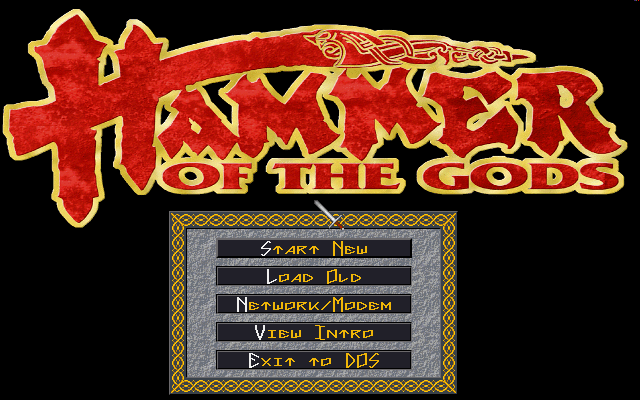
That power balance cuts both ways. Failing to respect the gods or playing too passively means rival AI factions will claim those divine blessings first. At the time of release, reviewers noted this dynamic mix of systems. Computer Gaming World praised its accessible scope, labeling it a strong contender for an introductory strategy title, while PC Gamer US awarded it an 83% score. The crisp SVGA graphics ran smoothly on standard 1994 PC hardware, though French magazine Gen4 felt the bright visuals looked almost too clean for a game about hardened Viking raiders.
For all its clever ideas, the campaign structure has clear friction points. The economic interface requires careful micromanagement once your territory spreads across multiple landmasses. Managing road networks and shifting guards between coastal castles can feel tedious during late-game turns when you are primarily waiting for specific quest conditions to trigger. The reliance on divine quests also means a run can drag out if the final target requires traversing the entire map through hostile territory just to trigger Odin's final approval.
The audio presentation features a driving score by Rob Lefebvre and Bruce Nunley, powered by the Human Machine Interfaces Sound Operating System. Through a Sound Blaster card, the music drives the march of your armies with crisp synthesized percussion, though the repetitive combat sound effects will test your patience during longer play sessions.
If you want to experience this piece of 1994 strategy history, you can play Hammer of the Gods online right now in your browser. Modern players often expect to play it like a standard 4X game by rushing technology and turtling behind castle walls, but doing so guarantees defeat when rival armies collect divine rewards. Jump in, choose your race, keep your raiders active, and focus on completing divine mandates from your very first turn.
In Hammer of the Gods, conquering every tile on the map will not guarantee a win if you have offended Odin by ignoring his direct demands.
Most 1994 empire builders hand you a set of production queues and demand that you paint the map your color, but this turn-based strategy game operates on a completely different set of rules. Executive producer Jon Van Caneghem and developer Holistic Design set out to simulate a realm governed by Viking mythology, where raw land ownership is meaningless without divine favor. You can burn through coastal villages, seize rich monasteries, and construct defensive castles, but if your standing in the eyes of the Norse gods drops too low, you lose. The ultimate goal requires completing the specific quest assigned by Odin himself, making your reputation as vital as your military standing.
You begin a campaign by choosing one of four distinct factions: humans, elves, trolls, or dwarves. Each race alters your path to victory based on the divine patron linked to that group. Playing as human forces you to manage traditional military expansion, while playing as troll or dwarf shifts your priorities toward raiding and heroic feats. The world map represents Europe during the Viking golden age starting around 700 AD, though you can also generate a random map if you prefer an unpredictable layout. Connecting conquered towns with built roads speeds up your logistics, but leaving a province undefended against rival warbands will quickly gut your treasury.

When two armies meet, the perspective shifts from the overland view to a side-view tactical battlefield. Programmers Ken Lightner and Rob Lefebvre designed a grid-based engagement system where troop placement directly dictates survival. Frontline melee units clash head-on, while long-range archers and spellcasting wizards fire across adjacent tiles. Position matters immensely because blocking narrow passes prevents heavy attackers from overwhelming your squishier backline units.
This layout made the game a direct mechanical predecessor to the combat engine that New World Computing would refine a year later for Heroes of Might and Magic. The influence is obvious the moment you arrange your troops on the side-view grid, but the stakes here feel harsher. Losing a high-tier unit mid-battle hurts deeply, especially early in a campaign when replacement armies take turns to train and ship out from your main hold.
Pleasing the gods pays off in concrete military power. At the end of a turn, completing divine tasks yields rewards that standard town production cannot match. Odin might grant you high-tier military units, boost the gold production of your towns, or hand over magical flying ships that bypass terrain movement penalties entirely. These divine gifts allow smaller armies to pull off absurd amphibious assaults, turning a losing war on its head in a single turn.
That power balance cuts both ways. Failing to respect the gods or playing too passively means rival AI factions will claim those divine blessings first. At the time of release, reviewers noted this dynamic mix of systems. Computer Gaming World praised its accessible scope, labeling it a strong contender for an introductory strategy title, while PC Gamer US awarded it an 83% score. The crisp SVGA graphics ran smoothly on standard 1994 PC hardware, though French magazine Gen4 felt the bright visuals looked almost too clean for a game about hardened Viking raiders.

For all its clever ideas, the campaign structure has clear friction points. The economic interface requires careful micromanagement once your territory spreads across multiple landmasses. Managing road networks and shifting guards between coastal castles can feel tedious during late-game turns when you are primarily waiting for specific quest conditions to trigger. The reliance on divine quests also means a run can drag out if the final target requires traversing the entire map through hostile territory just to trigger Odin's final approval.
The audio presentation features a driving score by Rob Lefebvre and Bruce Nunley, powered by the Human Machine Interfaces Sound Operating System. Through a Sound Blaster card, the music drives the march of your armies with crisp synthesized percussion, though the repetitive combat sound effects will test your patience during longer play sessions.
If you want to experience this piece of 1994 strategy history, you can play Hammer of the Gods online right now in your browser. Modern players often expect to play it like a standard 4X game by rushing technology and turtling behind castle walls, but doing so guarantees defeat when rival armies collect divine rewards. Jump in, choose your race, keep your raiders active, and focus on completing divine mandates from your very first turn.
How Hammer of the Gods is played — the keys the game listens to, grouped by what they do.
Highlighted keys are mapped — hover or tap one to see what it does.
Spatial movement and direct map interactions require the mouse. Keyboard shortcuts primarily mirror on-screen button hotkeys using white highlighted letters.
The on-screen keyboard and gamepad mapping the browser player uses on a phone, a tablet or a controller, as opposed to the real keys above. $PRO members make their own in the player and share them here; anyone can pick one to play with.
Cheat codes, console commands and memory pokes for Hammer of the Gods — each one verified and attributed.
Sign in to submitaka Hammer of the Gods Classic
How Hammer of the Gods is played — the keys the game listens to, grouped by what they do.
Highlighted keys are mapped — hover or tap one to see what it does.
Spatial movement and direct map interactions require the mouse. Keyboard shortcuts primarily mirror on-screen button hotkeys using white highlighted letters.
The on-screen keyboard and gamepad mapping the browser player uses on a phone, a tablet or a controller, as opposed to the real keys above. $PRO members make their own in the player and share them here; anyone can pick one to play with.
Cheat codes, console commands and memory pokes for Hammer of the Gods — each one verified and attributed.
Sign in to submit