


Harvester
Streaming build
Checking storage…1.1 GB
Preload in background
JIT compiler
Rate this game
- Played
- A lot
Harvester drops you into a surreal, violent 1953 Texas suburb as an amnesiac named Steve Mason, where the local townspeople speak in eerie pleasantries and demand that you commit increasingly bizarre crimes to join the local cult.
What happens when you wake up in Harvest, Texas
You start the first day of Harvester in a nuclear-family bedroom with a mother who acts like a television sitcom stereotype, completely unbothered by the fact that you do not remember who you are. Walking outside into the town of Harvest reveals an unsettling collection of digitized real-life actors pasted over pre-rendered 3D backgrounds. Every person you talk to responds to your confusion with detached apathy or off-kilter hostility, repeating the eerie line: "You always were a kidder, Steve." Even the local elementary school is named after serial killer Ed Gein, setting a deeply dark tone right from the opening screen.
Progressing through this adventure game requires completing a series of escalating tasks across six days to earn entry into "The Order of the Harvest Moon," the shadowy organization running the town. The objectives start relatively small before spiraling out of control entirely:
- Scratching a neighbor's automobile to cause unnecessary chaos.
- Sneaking into the local fire station to steal clothes.
- Vandallizing the main street by stealing a barber pole in broad daylight.
- Setting fire to Edna's Diner to prove your willingness to destroy property.
- Infiltrating the multi-floor Order Lodge to rescue your fiancée, Stephanie.
The point-and-click movement works fine for exploring screens and combining inventory items, but the town's atmosphere turns oppressive fast. You quickly learn that Harvest operates on bizarre moral rules where outright cruelty is rewarded and basic decency gets you nowhere.
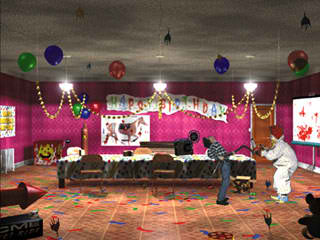
How Harvester breaks down when the fighting starts
While the first half of the game focuses on standard inventory puzzles and odd dialogue trees, the final act inside the Order's Lodge shifts heavily toward combat. This is where the design stumbles hard. The game offers 21 usable weapons ranging from basic melee options like wrenches and meat cleavers to high-powered firearms. However, the real-time combat mechanics are notoriously awkward. Swinging a weapon relies on clumsy collision detection, making fights against Lodge entities and hostiles feel like a frustrating chore rather than an exciting action sequence.
Fortunately, you can often bypass the clunky combat encounters entirely. Many situations allow you to use inventory items to solve puzzles or simply kill NPCs out of order to force progress. When reviewers looked at this 1996 game at release, opinions were split down the middle because of this mechanical rough edge. Magazines like PC Gamer scored it an 82% and PC Zone gave it an 83% for its engrossing, dark narrative. On the flip side, PC Format handed it a low 48% and Strategy Plus rated it 1.5 out of 5, pointing directly at the terrible fighting sequences and gruesome violence.
Delays, censorship, and the DigiFX production story
The journey to get this DigiFX Interactive project onto store shelves was as chaotic as its storyline. Designed by writer and director Gilbert P. Austin and produced by Lee Jacobson, filming for the live-action FMV sequences took place inside a warehouse owned by publisher Merit Studios. Creative work on the digitized actors and green-screen footage was mostly completed by 1994 on a budget of roughly $1 million. However, severe technical delays during engine programming pushed the actual release all the way back to late 1996.

By the time this Harvester MS-DOS game finally hit shelves, the market for full-motion video titles had already begun to cool off. The extreme gore and disturbing imagery also created massive distribution hurdles. The game faced heavy censorship worldwide and was outright banned in Germany. Between the two-year launch delay and the moral panic surrounding its violent content, it flopped commercially on release, only finding its real audience years later through word of mouth.
Why this odd piece of shock art is still worth playing
If you play it today, the crude pre-rendered backgrounds and digitized actors look straight out of an early 90s PC experiment. The combat in the Lodge is genuinely awful to control, and the moral choices handed to you in the final minutes feel intentionally campy and abrupt. Yet, as a dark satire of suburban conformity and media violence, it has a strange style that few games have ever dared to replicate.
You can play Harvester online directly through your browser today. If you want to experience one of the weirdest horror adventures of the 1990s, you can launch Harvester free in your browser right here, with no setup required. Just remember to grab the meat cleaver early, pay close attention to the town's strange dialogue clues, and do not expect anyone in Harvest to offer you a warm welcome.
How Harvester is played — the keys the game listens to, grouped by what they do.
- Movement
- Action
- Interface
- Left click — Interact / Move / Select
- Right click — Examine / Cancel / Attack
Highlighted keys are mapped — hover or tap one to see what it does.
Function keys for system menu, save, and load were omitted as they were not documented in the provided sources.
Players' controls
Touch and gamepad controls
The on-screen keyboard and gamepad mapping the browser player uses on a phone, a tablet or a controller, as opposed to the real keys above. $PRO members make their own in the player and share them here; anyone can pick one to play with.
Make your own touch controlsPRO
- 1Open the editorSign in below, then pick what to make. The game starts with the editor open over it.
- 2Place your keysAdd keys and drag them where your thumbs rest, or map a controller's buttons. Test plays the game with them; Save keeps them, and you play with them from then on.
- 3Share themShare them right after saving in the game, or name and share them here. Players vote, and the best become this game's controls for everyone.
Go PROSee how it worksSign in+20 XP for sharing · +50 XP if yours become the game's own
- The game's own controlsKeyboardGamepadWhat every player starts with.In use
2 screenshots
From the archive
No reviews yet
Tell the community what you think of Harvester. Reviews are public and tied to your username.
No archived manuals for Harvester yet
No manuals archived for this title yet. Sign in to upload the first scan.
Cheat codes, console commands and memory pokes for Harvester — each one verified and attributed.
Sign in to submitNo cheats yet for this title
Know a working cheat, poke or trainer? Add it with the button above. Moderators check every entry before it goes live.
No archived soundtrack for Harvester yet
No soundtrack archived for this title yet. Sign in to upload the first rip.
No save states for Harvester yet
No save states for this title yet. Sign in to share one.
Discussions
Sign in to post- Threads0
- Total posts0
- Online now6
Community · Harvester
Who's contributing, and what's new
- Reviews0
- Threads0
- Uploadsapproved0
- Contributors0
Recent activity
Nothing here yet
Reviews, discussion threads and approved uploads appear here as members add them.