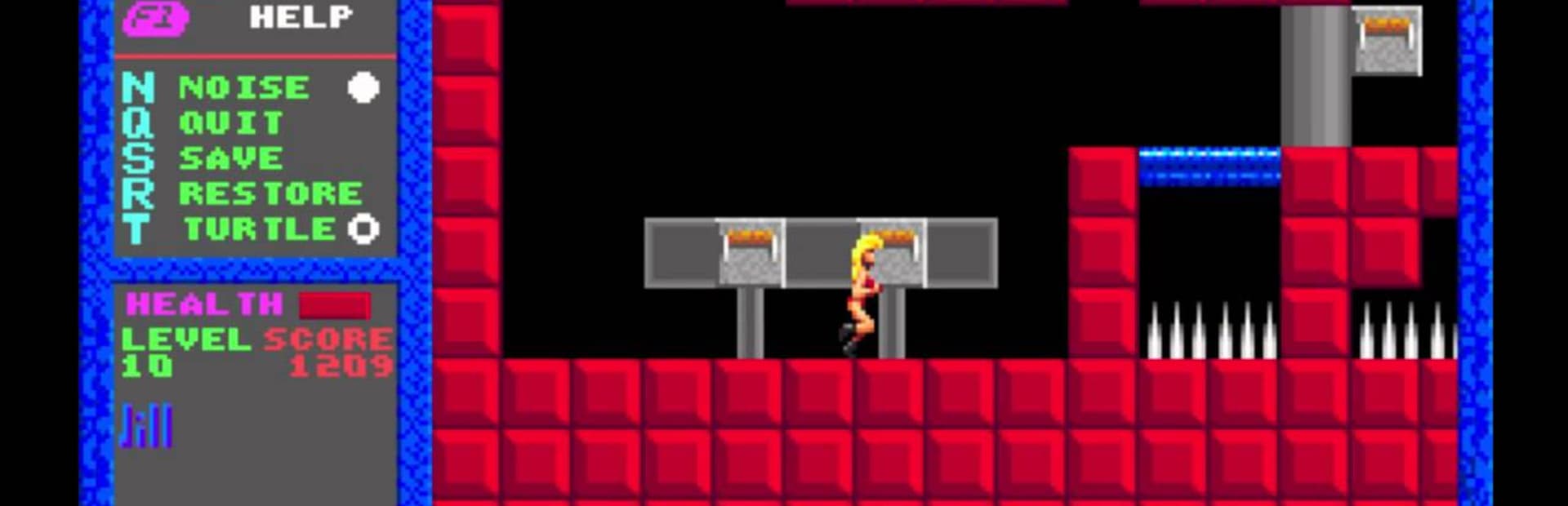
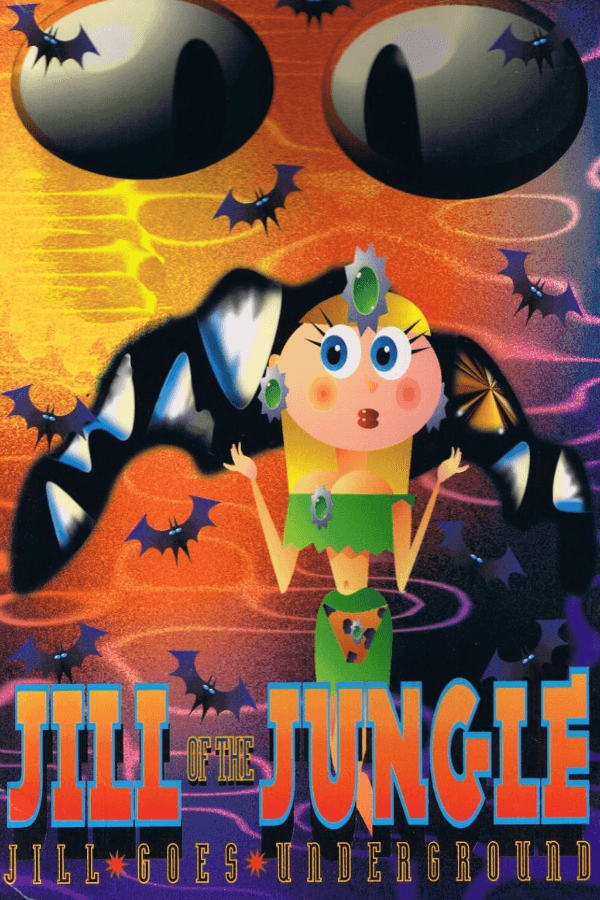

Playing Jill of the Jungle: Jill Goes Underground means swapping the open jungle canopy of the original shareware release for dark stone corridors, fire-breathing hazards, and a bright red outfit.
Stepping into Montezuma's castle drops the map and cranks the hazard density
The moment Level 1 loads, the first thing you notice is the missing world map. Where the original release let you wander between stages through an overarching jungle area, Jill of the Jungle: Jill Goes Underground shoves you straight into 19 linear levels plus a hidden bonus stage. You start underground in Montezuma's castle, holding a simple knife, tasked with finding your captured Prince. Red wall tiles replace the familiar green trees, and the game expects you to jump right into tight room puzzles without any warming up.
By the time you reach Level 3, the layout reveals what this episode actually wants from you. Instead of vast open screens, stages like Level 10, known as The Red Puzzle, turn into compact locked chambers. You search for color-coded keys while dodging caterpillars, jumping ants, bats, and fire-breathing monsters. The arcade combat is simple on paper: you toss your knife in straight horizontal lines or transform into specific beasts at marked pads. Becoming a fish lets you navigate underwater corridors in Level 11, Waterworld, while turning into a phoenix lets you shoot fireballs and soar over spikes.
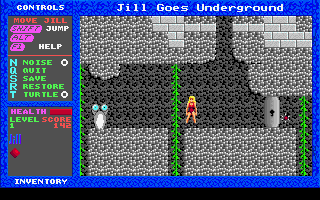
The level titles do not hide their intentions. Level 9 brings you into the Depths of Heck, where tough demon enemies absorb multiple knife hits while hopping toward you across narrow platforms. Further along, Level 15 hands you the Land of Eternal Weirdness, followed by the tight jump sequences of Level 16, Sticky Situation, and Level 17, Think Fast. You also get a dose of oddball humor when white bunnies suddenly turn and bite at your neck, a clear head-nod to Monty Python that caught plenty of players off guard when they first walked up to what looked like harmless ambient wildlife.
Tim Sweeney's custom engine turns grid movement into a precision test
Before launching Epic MegaGames, founder Tim Sweeney wrote a custom 2D scrolling platform editor in Turbo Pascal. That tool became the foundation for this game's engine, which Epic later modified for Xargon and Onesimus. Because Sweeney handled coding duty but lacked visual and musical skills, he brought on artists Joe Hitchens and John Pallett-Plowright alongside composer Dan Froelich. Together, they built an action platformer that ran smoothly on standard PC hardware of 1992.
That custom engine comes with mechanical quirks you feel on every single screen. Jill's character sprite aligns tightly with a strict tile grid. When you stop moving, she snaps toward the nearest grid boundary rather than drifting smoothly to a halt. Jumping across small ledges requires careful timing because missing the edge by a single pixel often drops you straight into a bed of spikes or a pool of lava. It can feel clunky if you expect modern momentum-based physics, but once you learn the exact width of her jump arc, clearing obstacle courses becomes a matter of strict rhythmic inputs.
To help players cope with the harsh tile traps, the developers left a very famous safety net in place. If a tricky jump in Level 13, the Demonic Maze, keeps sending you back to the start, holding down the X key on your keyboard for a few seconds completely refills your health bar, triggers temporary invincibility, and drops an extra key right into your inventory. It was the ultimate emergency button for kids who just wanted to see the end of the castle without replaying five levels in a row.
Transformations, Dan Froelich's soundtrack, and the cheat everyone typed
Sound design was one of the major selling points back when this hit the shareware market, selling around 20 to 30 copies a day through mail orders shortly after release. Tim Sweeney ensured the engine offered rich audio options for whatever card you had plugged into your ISA slots:
- Sound Blaster digital audio: Delivered crisp PCM voice clips, heavy thuds, and clear blade throwing effects.
- AdLib FM synthesis: Played Dan Froelich's rhythmic synth tracks with punchy basslines that kept the pacing brisk.
- Standard PC Speaker: Offered surprisingly competent square-wave beeps for players who had not upgraded their sound hardware yet.
Froelich's music gives each block of levels a distinct mood. The synth lines match the subterranean setting, giving damp caves and lava chambers a driving cadence. The morphing mechanics keep the platforming from feeling stale, too. Transforming into a green frog lets you bounce high over vertical wall barriers, while turning into a blue fish turns the floaty water physics of Level 11 into a swift swim through sharp coral reefs.
Development on the franchise was dynamic enough that a full third episode directly led into original projects. Epic initially began work on an official Jill of the Jungle II, but as production evolved, the asset set and design shifted so much that the studio reworked the project into an standalone platformer titled Vinyl Goddess from Mars, released in 1995.
How the save system cuts through the steep difficulty curve
The single biggest balance flaw in Jill of the Jungle: Jill Goes Underground comes down to how saving works. The engine lets you pause and save your exact position at any moment, including right before a risky leap across a lava pit or mid-air right before landing near a demon. While this prevents frustrating game-over screens, it also tempts players to save after every successful jump. Overusing save-scumming eliminates all tension from difficult levels like Level 9, turning an aggressive gauntlet into a trivial series of tiny resets.
Conversely, if you play without saving every five seconds, the game reveals how unforgiving early DOS platformers could be. Spikes cause instant damage, pushback from enemy hits can launch you off a ledge, and there are no traditional end-stage boss fights to cap off major sections. You clear a level simply by reaching the exit door, which can feel sudden when you step through after a particularly grueling puzzle room. The game relies entirely on level geometry and enemy placement to provide challenge rather than giant boss sprites.
Even with those harsh edges, the underlying movement loop remains satisfying for anyone who enjoys early PC arcade titles. The crisp visual layout makes it easy to read hazard placements, and the fast scroll speed keeps momentum high. It sits right alongside shareware classics of the same year, like Commander Keen in Goodbye, Galaxy!, offering an alternative that favored close-range blade throwing over gunplay and pogo sticks.
Play Jill of the Jungle: Jill Goes Underground in your browser
If you want to experience classic 1990s PC shareware action without messing around with system configs, you can play Jill of the Jungle: Jill Goes Underground online free in your browser right now. Launching the game straight from your browser brings back the exact grid snapping and FM synth audio that defined early DOS gaming. You can experience the swift knife-throwing, the sharp room puzzles, and the quick transformations without needing any specialized software setups on your modern machine.
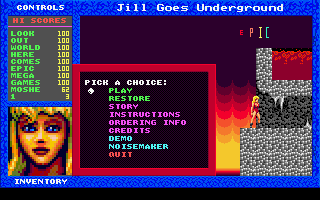
Once the title screen loads, head straight into the main options menu to check your key bindings, or dive directly into Level 1 to test your timing on the grid jumps. Keep an eye out for transformation icons on the floor when you hit the deeper levels, and if a swarm of demons in the Depths of Heck corners you against a lava wall, remember that holding down the X key gives you a quick way out!