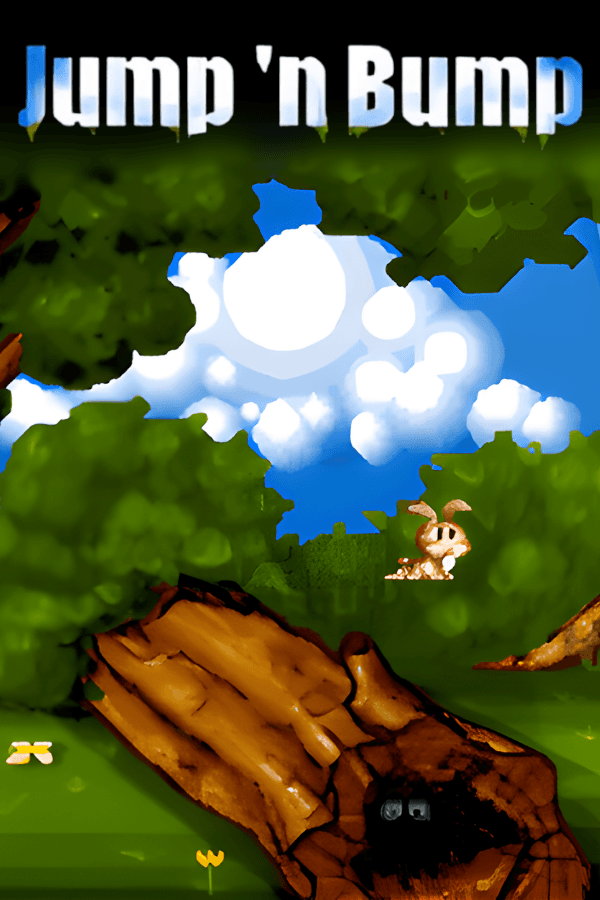

Four fluffy rabbits hop across a serene meadow in Jump 'n Bump, but one landing on a rival's head instantly turns them into a bloody explosion of gore.
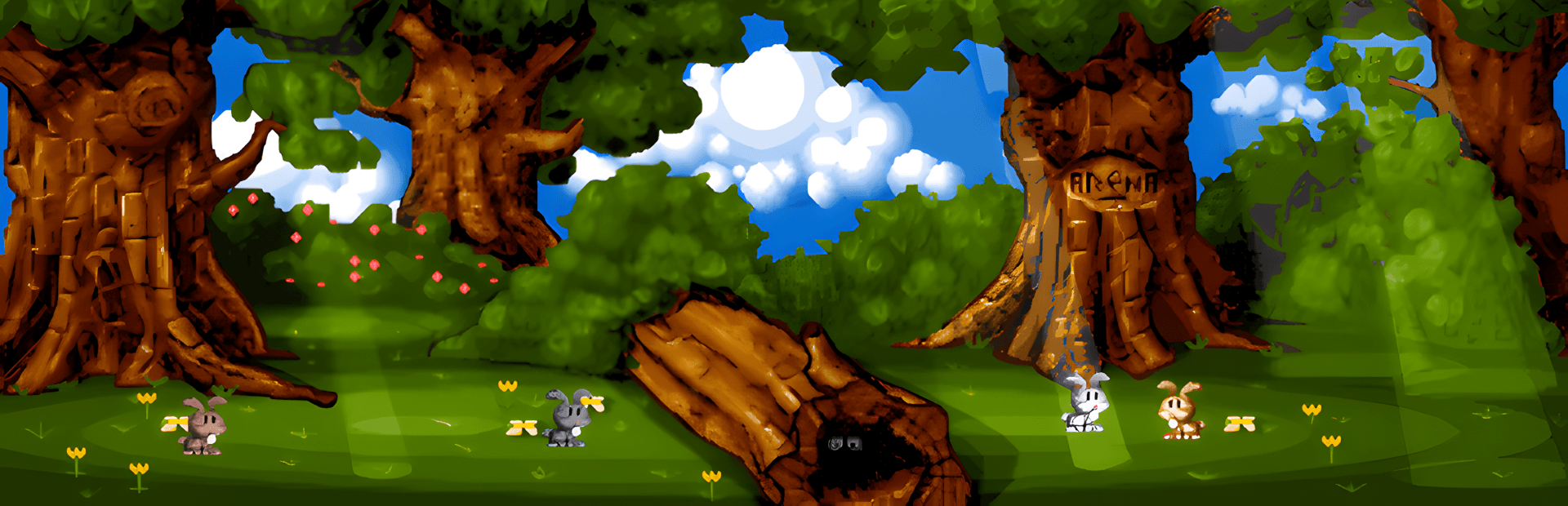
You start the game on a peaceful screen featuring Dott, Jiffy, Fizz, and Mijji. To begin the match, you have to leap your rabbit over a fallen tree trunk into the active arena. That interactive menu sets the tone right away. There are no splash screens or long cutscenes standing between you and the action.
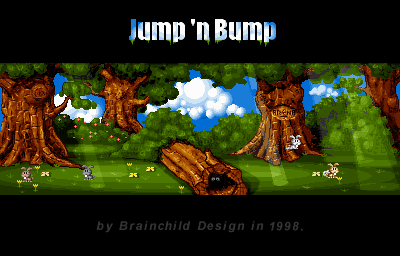
Brainchild Design created this action game in 1998, programming it in C and Assembly language. They drew the sprite art in Deluxe Paint 2 and PaintShop Pro 5, while the energetic background track was composed in FastTracker 2. It was originally released as emailware, meaning the developers simply asked happy players to send them a friendly message.
The core concept strips away everything unnecessary. There are no health bars, pickup items, power-ups, or standard enemies to fight. Your only goal is to crush the other three players beneath your feet. A heavy sound effect accompanies every successful squash, sending rabbit bits scattering across the grass before the victim immediately respawns.
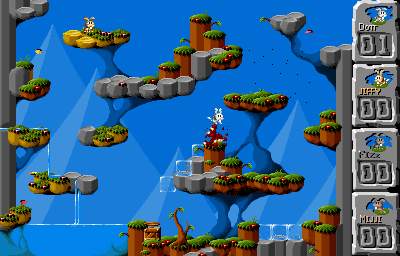
Movement physics give every rabbit a surprising amount of momentum and slide. The single arena floor is packed with hazards that constantly change your trajectory:
When four human players cluster around one keyboard, physical elbowing becomes part of the tactical depth. Navigating the 2D arena demands quick reflexes and sharp prediction. You jump to stomp a target below you, only to land on a springboard that launches you directly into someone else's descending boots.
Compared to other 2D deathmatch titles, this focus on raw platform mechanics keeps matches short and intense. There are no ammo reserves to track or weapons to spawn. If you want to score a point, you have to risk your own skull by leaping directly toward your opponents.
During active play, you can type secret cheat codes directly on the keyboard to twist the mechanics. One code unlocks jetpack physics, letting bunnies soar freely across the ceiling. Another cheat turns the water ponds in the middle of the arena into pools of deep red blood.
While the initial build only contains one default arena, the developers built support for custom level files. Players soon created hundreds of fan-made arenas using simple .dat packages. You can swap out the calm forest for cavernous death traps, metallic sci-fi corridors, or sky-high floating platforms.
The open structure helped the game outlive its original era. Brainchild Design released the complete source code under the GNU GPL in 1999. Community programmers quickly ported the engine to modern platforms using SDL, keeping the multiplayer engine alive long after DOS machines vanished from desks.
Despite its fast pacing, the original 1998 DOS release has obvious setup problems. The base game offers no native key-rebinding menu. Fitting four adult hands onto a single standard keyboard means players constantly block each other's fingers or trigger ghosting limits on cheaper hardware.
The rules also lack basic round structure. There is no built-in time limit, score cap, or automatic match summary screen. A battle continues endlessly until someone gives up and hits the Escape key to return to the main menu. If you play with a group, you must set your own win conditions out loud before starting.
Without AI-controlled bots in the original code, the title is strictly a local party game. Playing completely alone offers nothing to do besides bouncing around an empty screen by yourself. You need at least one friend crammed beside you on the desk for the design to function properly.
If you want a straightforward local party game that takes ten seconds to learn, this classic still delivers pure competitive tension. The brutal contrast between adorable pixel art and sudden splatter animation never fails to get a reaction out of a room full of friends. It strips local multiplayer down to pure timing, momentum, and positioning.
You can jump into a quick match right now without hunting down old hardware. You can play Brainchild Design's Jump 'n Bump free in your browser right on this page. Gather a couple of friends around your keyboard, leap over the menu log, and start squishing heads immediately.
Four fluffy rabbits hop across a serene meadow in Jump 'n Bump, but one landing on a rival's head instantly turns them into a bloody explosion of gore.
You start the game on a peaceful screen featuring Dott, Jiffy, Fizz, and Mijji. To begin the match, you have to leap your rabbit over a fallen tree trunk into the active arena. That interactive menu sets the tone right away. There are no splash screens or long cutscenes standing between you and the action.
Brainchild Design created this action game in 1998, programming it in C and Assembly language. They drew the sprite art in Deluxe Paint 2 and PaintShop Pro 5, while the energetic background track was composed in FastTracker 2. It was originally released as emailware, meaning the developers simply asked happy players to send them a friendly message.
The core concept strips away everything unnecessary. There are no health bars, pickup items, power-ups, or standard enemies to fight. Your only goal is to crush the other three players beneath your feet. A heavy sound effect accompanies every successful squash, sending rabbit bits scattering across the grass before the victim immediately respawns.

Movement physics give every rabbit a surprising amount of momentum and slide. The single arena floor is packed with hazards that constantly change your trajectory:
When four human players cluster around one keyboard, physical elbowing becomes part of the tactical depth. Navigating the 2D arena demands quick reflexes and sharp prediction. You jump to stomp a target below you, only to land on a springboard that launches you directly into someone else's descending boots.
Compared to other 2D deathmatch titles, this focus on raw platform mechanics keeps matches short and intense. There are no ammo reserves to track or weapons to spawn. If you want to score a point, you have to risk your own skull by leaping directly toward your opponents.
During active play, you can type secret cheat codes directly on the keyboard to twist the mechanics. One code unlocks jetpack physics, letting bunnies soar freely across the ceiling. Another cheat turns the water ponds in the middle of the arena into pools of deep red blood.
While the initial build only contains one default arena, the developers built support for custom level files. Players soon created hundreds of fan-made arenas using simple .dat packages. You can swap out the calm forest for cavernous death traps, metallic sci-fi corridors, or sky-high floating platforms.
The open structure helped the game outlive its original era. Brainchild Design released the complete source code under the GNU GPL in 1999. Community programmers quickly ported the engine to modern platforms using SDL, keeping the multiplayer engine alive long after DOS machines vanished from desks.

Despite its fast pacing, the original 1998 DOS release has obvious setup problems. The base game offers no native key-rebinding menu. Fitting four adult hands onto a single standard keyboard means players constantly block each other's fingers or trigger ghosting limits on cheaper hardware.
The rules also lack basic round structure. There is no built-in time limit, score cap, or automatic match summary screen. A battle continues endlessly until someone gives up and hits the Escape key to return to the main menu. If you play with a group, you must set your own win conditions out loud before starting.
Without AI-controlled bots in the original code, the title is strictly a local party game. Playing completely alone offers nothing to do besides bouncing around an empty screen by yourself. You need at least one friend crammed beside you on the desk for the design to function properly.
If you want a straightforward local party game that takes ten seconds to learn, this classic still delivers pure competitive tension. The brutal contrast between adorable pixel art and sudden splatter animation never fails to get a reaction out of a room full of friends. It strips local multiplayer down to pure timing, momentum, and positioning.
You can jump into a quick match right now without hunting down old hardware. You can play Brainchild Design's Jump 'n Bump free in your browser right on this page. Gather a couple of friends around your keyboard, leap over the menu log, and start squishing heads immediately.
How Jump 'n Bump is played — the keys the game listens to, grouped by what they do.
Highlighted keys are mapped — hover or tap one to see what it does.
Up to four players can compete on one PC using shared keyboard, mouse, and joystick controls. Secret cheat codes can be typed during gameplay.
The on-screen keyboard and gamepad mapping the browser player uses on a phone, a tablet or a controller, as opposed to the real keys above. $PRO members make their own in the player and share them here; anyone can pick one to play with.
Cheat codes, console commands and memory pokes for Jump 'n Bump — each one verified and attributed.
Sign in to submitaka Jumpbump · JumpnBump
How Jump 'n Bump is played — the keys the game listens to, grouped by what they do.
Highlighted keys are mapped — hover or tap one to see what it does.
Up to four players can compete on one PC using shared keyboard, mouse, and joystick controls. Secret cheat codes can be typed during gameplay.
The on-screen keyboard and gamepad mapping the browser player uses on a phone, a tablet or a controller, as opposed to the real keys above. $PRO members make their own in the player and share them here; anyone can pick one to play with.
Cheat codes, console commands and memory pokes for Jump 'n Bump — each one verified and attributed.
Sign in to submit