
If you loaded up Last Rites expecting the next leap in 3D shooters, you were immediately greeted by blocky DOS textures, massive zombie hordes, and four AI squadmates who spent half their time running face-first into concrete walls. Yet behind its crusty technology lies an aggressive extermination mission packed with upgradeable weaponry and a multi-lock missile launcher that obliterates Professor Mordae's undead legion.
By 1997, the first-person shooter market was moving fast toward complex lighting and true three-dimensional geometry. When Ocean Software released this title exclusively in Europe, the graphics engine felt like an artifact from several years earlier. Contemporary gaming press slammed the presentation hard, with German magazine Power Play noting that the game looked like an antique right out of the box. The environment relies on flat pixelated textures, coarse geometry, and low-resolution enemy sprites that pixelate heavily when they rush your position.
What the engine lacks in visual detail, it tries to recover in level scale. You play as the commander of a Special Forces resistance team sent to reclaim a ruined world from zombie swarms, rogue mercenaries, and automated defense turrets. In roughly half of the eleven story missions, you are not fighting alone. Four computer-controlled commandos spawn alongside you to provide covering fire. While their pathfinding often fails in tight corridors, having four friendly guns spitting lead into a crowd of fifty approaching corpses gives the combat a distinct rhythm compared to pure solo shooters of the mid-nineties.
If you want to experience this European release yourself, you can play Last Rites online to see how an internal team at Ocean handled squad combat just after the studio was acquired by Infogrames.
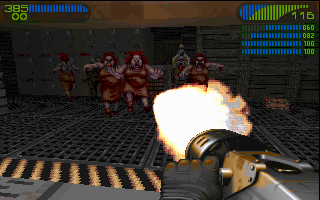
The campaign spans eleven objective-focused operations, beginning with back-to-back base relocations before pushing into dark laboratory complexes and extra-dimensional portals. Unfortunately, the level design heavily relies on repeating urban textures and industrial assets across multiple maps. You will often clear out a zone in one mission only to return to the exact same city block two levels later with a slightly modified list of tasks.
Progression through these areas frequently turns into a slow scavenger hunt. Instead of clear navigation markers or logical keycard placements, map advancement hinges on finding hidden switches and unlit doorways tucked into distant corners of the map. You will spend substantial time clearing out a district only to wander past identical gray walls, pressing spacebar against every flat panel to locate an invisible door or trigger a hidden lift.
The mission objectives attempt to break up standard key-hunting, but they occasionally introduce severe frustration. Mission 03 requires you to protect an AI-controlled robot unit nicknamed Fido while moving through hostile territory. Fido moves at a sluggish pace and possesses very little armor. Enemies ignore your squad to focus directly on the escort target, and because the AI lacks basic self-preservation, Fido frequently strolls directly into enemy plasma fire or stationary turret hazards.
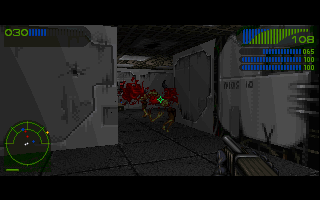
Keeping squadmates alive requires constant babysitting. When your commandos function correctly, they draw target attention away from you and chew through low-tier zombie groups. When they get stuck behind geometry, you have to back up, nudge their pathing, or leave them behind entirely while you handle objective targets solo. Managing health supplies and ammunition while babysitting broken pathfinding creates a spike in difficulty that wallops unprepared players midway through the campaign.
Where the game shines is in its destructive arsenal. You start your assignment armed with a standard automatic pistol featuring infinite ammunition, which keeps you from being completely helpless when primary ammo runs dry. As you clear out military depots, your inventory expands to include an uzi, a heavy combat shotgun, a flamethrower, a plasma rifle, a multi-barrel cannon, a multi lock-on rocket launcher, and a devastating nuclear grenade launcher.
The multi lock-on missile system is easily the highlight of the entire armory. Highlighting multiple targets across a courtyard and watching tracking rockets spiral out to clear an entire wave of mutants at once provides genuine satisfaction. You can also discover techno packs hidden inside crates or behind secret walls. Picking up these techno packs allows you to upgrade your favorite weapons directly, increasing their maximum range and raw damage output for the rest of the campaign.
Audio design supports the action surprisingly well if configured properly. Setting up sound options via the old LASTRITE.CFG file in MS-DOS allowed players to pipe heavy weapon booms and enemy groans through a Sound Blaster card, giving every shot from the nuclear launcher a punchy feedback loop that outshines the quiet ambient music tracks.
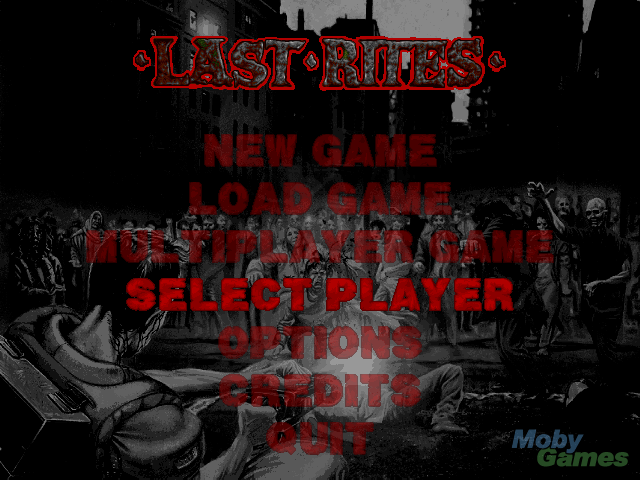
If you judge this title purely on its 1997 visual standards, it is easy to understand why critics at Home of the Underdogs gave it a brutal rating and branded it a failure. Released in the same year as heavily refined shooters, its flat environments and finicky escort missions drag down the experience. Yet if you enjoy mid-nineties action games that try unusual ideas, the combination of squad-assisted firefights, heavy weapon upgrades, and massive enemy counts offers plenty of retro charm. You can read more about its original release history on Wikipedia.
You can run this 1997 release directly in your browser without dealing with sound setup files or manual DOS emulation tweaks. Load up the Last Rites MS-DOS game right now, select your starting loadout, and see how long your squad survives the zombie horde in Mission 01.
If you loaded up Last Rites expecting the next leap in 3D shooters, you were immediately greeted by blocky DOS textures, massive zombie hordes, and four AI squadmates who spent half their time running face-first into concrete walls. Yet behind its crusty technology lies an aggressive extermination mission packed with upgradeable weaponry and a multi-lock missile launcher that obliterates Professor Mordae's undead legion.
By 1997, the first-person shooter market was moving fast toward complex lighting and true three-dimensional geometry. When Ocean Software released this title exclusively in Europe, the graphics engine felt like an artifact from several years earlier. Contemporary gaming press slammed the presentation hard, with German magazine Power Play noting that the game looked like an antique right out of the box. The environment relies on flat pixelated textures, coarse geometry, and low-resolution enemy sprites that pixelate heavily when they rush your position.
What the engine lacks in visual detail, it tries to recover in level scale. You play as the commander of a Special Forces resistance team sent to reclaim a ruined world from zombie swarms, rogue mercenaries, and automated defense turrets. In roughly half of the eleven story missions, you are not fighting alone. Four computer-controlled commandos spawn alongside you to provide covering fire. While their pathfinding often fails in tight corridors, having four friendly guns spitting lead into a crowd of fifty approaching corpses gives the combat a distinct rhythm compared to pure solo shooters of the mid-nineties.
If you want to experience this European release yourself, you can play Last Rites online to see how an internal team at Ocean handled squad combat just after the studio was acquired by Infogrames.

The campaign spans eleven objective-focused operations, beginning with back-to-back base relocations before pushing into dark laboratory complexes and extra-dimensional portals. Unfortunately, the level design heavily relies on repeating urban textures and industrial assets across multiple maps. You will often clear out a zone in one mission only to return to the exact same city block two levels later with a slightly modified list of tasks.
Progression through these areas frequently turns into a slow scavenger hunt. Instead of clear navigation markers or logical keycard placements, map advancement hinges on finding hidden switches and unlit doorways tucked into distant corners of the map. You will spend substantial time clearing out a district only to wander past identical gray walls, pressing spacebar against every flat panel to locate an invisible door or trigger a hidden lift.
The mission objectives attempt to break up standard key-hunting, but they occasionally introduce severe frustration. Mission 03 requires you to protect an AI-controlled robot unit nicknamed Fido while moving through hostile territory. Fido moves at a sluggish pace and possesses very little armor. Enemies ignore your squad to focus directly on the escort target, and because the AI lacks basic self-preservation, Fido frequently strolls directly into enemy plasma fire or stationary turret hazards.

Keeping squadmates alive requires constant babysitting. When your commandos function correctly, they draw target attention away from you and chew through low-tier zombie groups. When they get stuck behind geometry, you have to back up, nudge their pathing, or leave them behind entirely while you handle objective targets solo. Managing health supplies and ammunition while babysitting broken pathfinding creates a spike in difficulty that wallops unprepared players midway through the campaign.
Where the game shines is in its destructive arsenal. You start your assignment armed with a standard automatic pistol featuring infinite ammunition, which keeps you from being completely helpless when primary ammo runs dry. As you clear out military depots, your inventory expands to include an uzi, a heavy combat shotgun, a flamethrower, a plasma rifle, a multi-barrel cannon, a multi lock-on rocket launcher, and a devastating nuclear grenade launcher.
The multi lock-on missile system is easily the highlight of the entire armory. Highlighting multiple targets across a courtyard and watching tracking rockets spiral out to clear an entire wave of mutants at once provides genuine satisfaction. You can also discover techno packs hidden inside crates or behind secret walls. Picking up these techno packs allows you to upgrade your favorite weapons directly, increasing their maximum range and raw damage output for the rest of the campaign.
Audio design supports the action surprisingly well if configured properly. Setting up sound options via the old LASTRITE.CFG file in MS-DOS allowed players to pipe heavy weapon booms and enemy groans through a Sound Blaster card, giving every shot from the nuclear launcher a punchy feedback loop that outshines the quiet ambient music tracks.

If you judge this title purely on its 1997 visual standards, it is easy to understand why critics at Home of the Underdogs gave it a brutal rating and branded it a failure. Released in the same year as heavily refined shooters, its flat environments and finicky escort missions drag down the experience. Yet if you enjoy mid-nineties action games that try unusual ideas, the combination of squad-assisted firefights, heavy weapon upgrades, and massive enemy counts offers plenty of retro charm. You can read more about its original release history on Wikipedia.
You can run this 1997 release directly in your browser without dealing with sound setup files or manual DOS emulation tweaks. Load up the Last Rites MS-DOS game right now, select your starting loadout, and see how long your squad survives the zombie horde in Mission 01.
How Last Rites is played — the keys the game listens to, grouped by what they do.
Highlighted keys are mapped — hover or tap one to see what it does.
Controls are remappable using the in-game keyboard controls menu. Movement keys were not specified in the available sources.
The on-screen keyboard and gamepad mapping the browser player uses on a phone, a tablet or a controller, as opposed to the real keys above. $PRO members make their own in the player and share them here; anyone can pick one to play with.
Cheat codes, console commands and memory pokes for Last Rites — each one verified and attributed.
Sign in to submitHow Last Rites is played — the keys the game listens to, grouped by what they do.
Highlighted keys are mapped — hover or tap one to see what it does.
Controls are remappable using the in-game keyboard controls menu. Movement keys were not specified in the available sources.
The on-screen keyboard and gamepad mapping the browser player uses on a phone, a tablet or a controller, as opposed to the real keys above. $PRO members make their own in the player and share them here; anyone can pick one to play with.
Cheat codes, console commands and memory pokes for Last Rites — each one verified and attributed.
Sign in to submit