
Laura Bow 1: The Colonel's Bequest
aka The Colonel's Bequest · The Colonel's Bequest: A Laura Bow Mystery · Laura Bow 1 - The Colonel's Bequest · Laura Bow: The Colonel's Bequest
Rate this game
- Played
- Often
In Laura Bow 1: The Colonel's Bequest, designer Roberta Williams built a murder mystery where actual detective work is surprisingly optional, leaving you to peek through wall panels while greedy relatives drop dead around a 1920s Louisiana estate. It is a slow, eerie exercise in eavesdropping where surviving the night is tricky, but getting the whole story requires obsessive snooping.
Eavesdropping on a bayou mansion that wants to kill you
You play as Laura Bow, a 20-year-old student at Tulane University who tags along with her friend Lillian Prune to an isolated plantation house on a Louisiana bayou island. The year is 1925, and Lillian's uncle, Colonel Henri Dijon, has summoned his extended family for a dinner to announce his last will. The household is crammed with backstabbing relatives and suspicious staff, including the maid Fifi, drunk relatives like Ethel Prune, a noisy parrot named Polly, and a hound named Beauregard. Before long, members of the gathering begin turning up dead one by one.
Instead of sending you on a linear chase for keys, the game structures its story across eight acts. Time advances in 15-minute increments on an old grandfather clock whenever you witness a critical story beat or trigger a specific narrative event. You spend much of your time creeping through secret passages, peering through spyholes in paintings, and writing down notes in Laura's notebook. It feels like an interactive Gothic thriller, but the house itself is just as lethal as the murderer on the loose.
Laura Bow 1: The Colonel's Bequest judges your curiosity rather than counting points
Most Sierra On-Line, Inc. titles from this era tallied your progress with an ongoing score counter in the status bar. This game abandons that metric completely. You can stumble through to the final act having missed half the murders and barely understanding who committed the crimes, and the game will still allow you to escape the island alive. The real catch comes at the very end during the post-game summary screen.
When the story concludes, the game delivers a comprehensive detective evaluation that rates your investigative skill. It tallies every secret conversation you overheard, every hidden item you inspected with your magnifying glass, and every physical clue you discovered in places like the basement or behind suit of armor. I spent my first complete playthrough thinking I had mastered the case, only for the final report to inform me I had overlooked half the physical evidence in the house. It turns the entire adventure into an exercise in thorough observation rather than raw puzzle solving.
Brutal death traps and strict time triggers test player patience
The open-ended structure comes with sharp edges that infuriated players upon release in 1989. Because time only advances when you hit specific triggers, you often end up wandering aimlessly from room to room waiting for something to happen. If you miss a crucial interaction in an early act, you might find yourself trapped in a later section without the necessary context to understand what transpired. The text parser can also prove stubbornly narrow, rejecting standard phrasing and forcing you to guess exact noun and verb combinations like typing Ask Ethel Prune about Fifi or Look Garden.
Sudden, unannounced deaths are everywhere in this adventure game. Exploring the estate's belltower can drop a heavy iron bell on Laura without warning, falling chandeliers wipe you out instantly, and walking under unstable structures frequently ends your run. Because death strikes quickly and parsing errors can leave you vulnerable, keeping multiple rotating save files is essential if you want to see the ending without restarting from the beginning.
Rich sound hardware support came with a curious synth bug
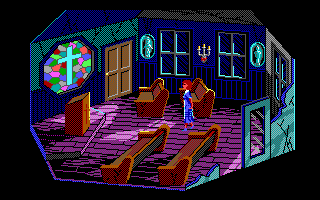
As an early entry in Sierra's SCI0 engine generation, the game pushed 320x200 graphics in a understated 16-color EGA palette that suited its gloomy, atmospheric setting. What really stood out at launch was the sheer depth of its audio support. Composer Ken Allen crafted a soundtrack that scaled across everything from basic PC speakers and AdLib cards to high-end hardware like the Sound Blaster, the IBM Music Feature Card, and Casio MT-540 keyboards.
The audio engine held a technical oddity regarding the Roland MT-32 synthesizer module. The sound drivers were programmed against the custom memory offsets of the original early revision MT-32 hardware. If you run the original executable on later synthesizer units like the CM-32L, the game triggers incorrect sound effects during key scenes, swapping subtle ambient noises for loud audio stings. That memory offset mismatch caused surprise sound bugs for anyone playing on newer synth hardware.
Play Laura Bow 1: The Colonel's Bequest online free in your browser
Despite its picky parser and sudden death traps, Roberta Williams created a murder mystery setup that rewards genuine curiosity over brute-force inventory hunting. The atmosphere of the bayou estate, coupled with the unique end-of-game detective evaluation, makes it worth experiencing for anyone who enjoys old-school mystery design. If you want to sample this classic Laura Bow 1: The Colonel's Bequest MS-DOS game, you can jump straight into the investigation without hunting down vintage disk images.
You can play Laura Bow 1: The Colonel's Bequest free in your browser right now with nothing to install. The pixel art, subtle EGA color work, and rich sound synthesizer tracks don't translate fully into plain screenshots, but they come alive the moment you launch the game. Type commands, keep your notebook handy, watch your step near the belltower, and see how high a detective score you can earn on your first night at the Dijon plantation.
How Laura Bow 1: The Colonel's Bequest is played — the keys the game listens to, grouped by what they do.
- Movement
- Interface
Highlighted keys are mapped — hover or tap one to see what it does.
The game uses a text parser alongside keyboard or optional mouse movement controls.
Players' controls
Touch and gamepad controls
The on-screen keyboard and gamepad mapping the browser player uses on a phone, a tablet or a controller, as opposed to the real keys above. $PRO members make their own in the player and share them here; anyone can pick one to play with.
Make your own touch controlsPRO
- 1Open the editorSign in below, then pick what to make. The game starts with the editor open over it.
- 2Place your keysAdd keys and drag them where your thumbs rest, or map a controller's buttons. Test plays the game with them; Save keeps them, and you play with them from then on.
- 3Share themShare them right after saving in the game, or name and share them here. Players vote, and the best become this game's controls for everyone.
Go PROSee how it worksSign in+20 XP for sharing · +50 XP if yours become the game's own
- The game's own controlsKeyboardGamepadWhat every player starts with.In use
2 screenshots
From the archive
No gameplay video yet
No gameplay video for Laura Bow 1: The Colonel's Bequest yet. Sign in to add one.
No reviews yet
Tell the community what you think of Laura Bow 1: The Colonel's Bequest. Reviews are public and tied to your username.
No archived manuals for Laura Bow 1: The Colonel's Bequest yet
No manuals archived for this title yet. Sign in to upload the first scan.
Cheat codes, console commands and memory pokes for Laura Bow 1: The Colonel's Bequest — each one verified and attributed.
Sign in to submitNo cheats yet for this title
Know a working cheat, poke or trainer? Add it with the button above. Moderators check every entry before it goes live.
No archived soundtrack for Laura Bow 1: The Colonel's Bequest yet
No soundtrack archived for this title yet. Sign in to upload the first rip.
No save states for Laura Bow 1: The Colonel's Bequest yet
No save states for this title yet. Sign in to share one.
Discussions
Sign in to post- Threads0
- Total posts0
- Online now6
Community · Laura Bow 1: The Colonel's Bequest
Who's contributing, and what's new
- Reviews0
- Threads0
- Uploadsapproved0
- Contributors0
Recent activity
