
Magic Pockets
Rate this game
- Played
- Often
In Magic Pockets, every single screen forces you to weigh speed against safety as you charge up your trousers to turn monsters into collectible treats before the invisible clock runs out.
The Bitmap Kid leaves no toy behind
The core design decision of Magic Pockets hangs entirely on momentum and shot charging. You control the Bitmap Kid, a protagonist wearing magical baggy trousers handed to him by a mysterious old man in a park. Creatures living inside those deep pockets have snatched his favorite possessions: a bicycle, boxing gloves, a diving helmet, and a space hopper. To get them back, you have to fight through four distinct worlds: Cave, Jungle, River, and Mountain. Rather than firing basic lasers, your default projectile changes with each region, starting with small whirlwinds in the Cave and shifting to clouds, snowballs, and ice cubes as you progress.
Holding down the fire button charges your attack into a massive projectile. Tossing a fully charged whirlwind or cloud traps nearby enemies or sucks them up entirely, converting them into pickups like sweets, soda bottles, or silver and gold stars. The catch is that while you are holding down that button, you cannot jump or reposition quickly. You are forced to stand your ground, watch an enemy walk toward you, and release the button at the exact last second to clear the screen.
Convoluted controls and strict timer limits
While the visual presentation features smooth 2D scrolling and bright sprite work, the mechanical execution often gets in its own way. The Bitmap Brothers reused technical systems built for Gods, which gives movement a heavy, deliberate pacing that does not always suit an arcade platformer. The high jump is the most notorious culprit. To launch into a spinning leap that destroys overhead enemies, you must hold down, charge a shot, release it to spawn a whirlwind, step onto that whirlwind, and press down again. In the middle of an intense enemy wave, executing that five-step sequence feels unnervingly awkward.
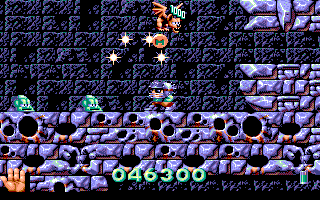
Then there are the levels themselves, which drag on far longer than the level design can support. Magic Pockets features a hidden time limit that never displays a countdown on screen. If you spend too much time hunting for hidden star rooms or carefully charging attacks, an inescapable balloon appears and kills your character instantly. Falling into a pit or getting caught by the timer sends you back, making late-game stages feel like a trial of memory rather than reflex.
Obscure scoring systems and unique stage clear rewards
The underlying mechanics hide a surprising amount of complexity, much of it unmentioned in the quick-start instructions. Collecting 5,000 points triggers an item cycling system tied to your count of silver and gold stars, allowing skilled players to spawn invincibility potions, laser helmets, or screen-clearing nukes. Reach specific score milestones, and you can unlock warp points that skip entire worlds or access secret bonus rooms packed with teleport helmets.
- Charge your weapon fully before entering narrow corridors to catch patrolling enemies off guard.
- Step directly onto your own whirlwinds to trigger the spinning high jump for extra vertical height.
- Collect silver stars to manage your item cycle and force useful power-ups to drop.
- Keep moving forward to avoid triggering the invisible level timer.
When you do reach the end of a world, the game swaps genres entirely. The Jungle world culminates in a full boxing match against a gorilla boss. Finishing other worlds unlocks custom minigames based on the toy you just recovered, including a bicycle race against primates or a high-bouncing balloon course.

How the DOS port holds up today
When Konami brought the game to the PC in 1992, it faced stiff competition from standard platform games of the era. The MS-DOS version preserved the original 16-color visual aesthetic and featured an official chiptune rendition of Betty Boo's 1990 hit single "Doin' the Do" arranged by Richard Joseph. However, the lack of mid-level saves in the original release meant that one bad jump late in a run ended the entire session.
At the time of release, magazine reviews were sharply divided. Outlets like Amiga Action awarded it a 93%, praising the detailed sprite animations and distinct weapon modes, while Amiga Power famously slammed it for sluggish controls and tedious level layouts. It traded agility for methodical play, offering plenty of ideas even if the platforming physics took some getting used to.
Play Magic Pockets online right now
You can play Magic Pockets online for free in your browser right here. There is nothing to install and no setup required, letting you jump straight into the action without hunting down vintage disk images. If you have never experienced this piece of 1992 history, load up the MS-DOS game, practice the timing on your charged shots, and see how far those giant pockets can carry you.
Players' controls
Touch and gamepad controls
The on-screen keyboard and gamepad mapping the browser player uses on a phone, a tablet or a controller, as opposed to the real keys above. $PRO members make their own in the player and share them here; anyone can pick one to play with.
Make your own touch controlsPRO
- 1Open the editorSign in below, then pick what to make. The game starts with the editor open over it.
- 2Place your keysAdd keys and drag them where your thumbs rest, or map a controller's buttons. Test plays the game with them; Save keeps them, and you play with them from then on.
- 3Share themShare them right after saving in the game, or name and share them here. Players vote, and the best become this game's controls for everyone.
Go PROSee how it worksSign in+20 XP for sharing · +50 XP if yours become the game's own
- The game's own controlsNone yet: played with a real keyboard only.In use
2 screenshots
From the archive
No gameplay video yet
No gameplay video for Magic Pockets yet. Sign in to add one.
No reviews yet
Tell the community what you think of Magic Pockets. Reviews are public and tied to your username.
No archived manuals for Magic Pockets yet
No manuals archived for this title yet. Sign in to upload the first scan.
Cheat codes, console commands and memory pokes for Magic Pockets — each one verified and attributed.
Sign in to submitNo cheats yet for this title
Know a working cheat, poke or trainer? Add it with the button above. Moderators check every entry before it goes live.
No archived soundtrack for Magic Pockets yet
No soundtrack archived for this title yet. Sign in to upload the first rip.
No save states for Magic Pockets yet
No save states for this title yet. Sign in to share one.
Discussions
Sign in to post- Threads0
- Total posts0
- Online now6
Community · Magic Pockets
Who's contributing, and what's new
- Reviews0
- Threads0
- Uploadsapproved0
- Contributors0
Recent activity