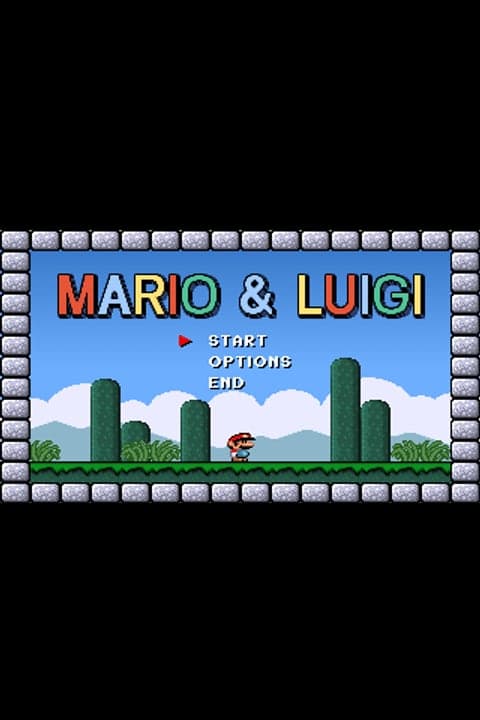
Mario and Luigi
aka Mario & Luigi
Rate this game
- Played
- All the time
If you played Mario and Luigi on an MS-DOS PC in the nineties, you were experiencing a minor technical miracle disguised as blatant copyright infringement.
Smooth VGA scrolling solved a notorious MS-DOS problem
In 1994, bringing a smooth side-scrolling platformer to the PC was a headache. While Nintendo and Sega had custom graphics hardware dedicated to moving sprites and scrolling tilemaps across television screens, standard PC hardware struggled. Writing a fast 2D action game meant fighting IBM architecture directly, wrestling with video registers, and praying your system hit 30 frames per second without severe screen tearing.
Eighteen-year-old Dutch programmer Mike Wiering built the engine behind Mario and Luigi in Turbo Pascal specifically to prove smooth 2D parallax scrolling was possible on a modest 486 PC running at 25 MHz. He did not build it for commercial distribution or retail shelves. It was a private coding experiment, created to refine the underlying tech he would later use for original titles like Charlie the Duck. To test the momentum, sprite collisions, and scrolling routines, he recreated the mechanics of Nintendo's flagship platformer down to the floaty jump height and brick-shattering physics.
How a stolen beta and Chaos Software created PC shareware chaos
Before Wiering finished his test engine, an unfinished four-level alpha build was stolen from his computer. Shortly after, a shadowy outfit calling itself Chaos Software renamed the executable to Mario!!!, slapped a $15 registration fee on the title screen, and distributed it as commercial shareware. This bootleg version spread like wildfire across bulletin board systems and cheap shareware compilation CDs.
The pirated release was notoriously broken. Because the stolen build cut off at level 4, the bootleg forced an infinite level loop that made the game impossible to clear. Despite the game-breaking bug and illegal distribution, it became a staple on home PCs across the world. The bootleg reached such bizarre pop-culture height that golfer Tiger Woods was even caught on camera playing it on a laptop during a televised segment. To salvage his code and set the record straight, Wiering completed the full six-level game and released the finished game alongside its complete Turbo Pascal source code for free on the web, where it eventually earned its formal catalog entry through Wiering Software.
The mechanics directly mirror Super Mario Bros. with surprising accuracy
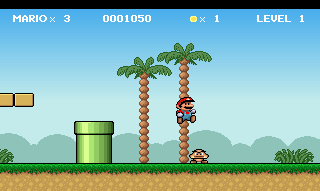
Booting up the 2001 free release puts you instantly in familiar territory. You run, jump, smash overhead question-mark blocks, collect gold coins, and stomp on familiar enemies. The weight of the jump feels surprisingly accurate to the 8-bit original, allowing you to build up momentum before launching across wide chasms.
The standard array of power-ups returns in exact order:
- Super Mushroom: Doubles Mario's height, enabling him to absorb an extra hit and break brown brick blocks from underneath.
- Fire Flower: Gives Mario the power to throw bouncing fireballs that clear ground-based enemies from a safe distance.
- Starman: Grants brief invincibility, allowing you to sprint directly through hazards and enemies.
- Gold Coins: Gather 100 scattered throughout the level layout to earn an extra life.
Six short levels lead straight into a punishing second quest
If you come into this expecting a full console-sized adventure, the level count might feel thin. The main campaign consists of just six stages. A skilled player who knows where the hidden blocks sit can sprint through the primary campaign in under fifteen minutes. However, finishing level 6 unlocks the 2nd Quest, which reshuffles the level layouts, strips away forgiving item placements, and introduces trickier enemy placements that demand tight platforming discipline.
What makes the controls distinct from official console releases is the keyboard interface. Trudging through precise platforming with arrow keys and keyboard modifiers takes adjustments, especially when trying to hold a run key while timing a tight leap onto a moving platform. The engine itself feels solid, avoiding the sluggish input lag that plagued many commercial PC action games, but blind jumps occasionally force trial-and-error deaths on your first run.
Play Mario and Luigi free right now in your web browser
While modern players might chuckle at a six-level fan creation, Wiering's engine is a clever piece of PC programming. The engine achieved fluid VGA scrolling when major publishers were struggling to make PC platformers feel responsive, making it an MS-DOS project worth trying for ten minutes just to feel how tight those jump controls really were.
You can play Mario and Luigi online right here in your browser with zero installation required. Fire it up, jump into level 1, and grab your first Fire Flower to see how an eighteen-year-old developer solved smooth MS-DOS platforming thirty years ago.
How Mario and Luigi is played — the keys the game listens to, grouped by what they do.
- Movement
- Action
- Interface
Highlighted keys are mapped — hover or tap one to see what it does.
Joystick support can be enabled by running the command mario -j.
Players' controls
Touch and gamepad controls
The on-screen keyboard and gamepad mapping the browser player uses on a phone, a tablet or a controller, as opposed to the real keys above. $PRO members make their own in the player and share them here; anyone can pick one to play with.
Make your own touch controlsPRO
- 1Open the editorSign in below, then pick what to make. The game starts with the editor open over it.
- 2Place your keysAdd keys and drag them where your thumbs rest, or map a controller's buttons. Test plays the game with them; Save keeps them, and you play with them from then on.
- 3Share themShare them right after saving in the game, or name and share them here. Players vote, and the best become this game's controls for everyone.
Go PROSee how it worksSign in+20 XP for sharing · +50 XP if yours become the game's own
- The game's own controlsKeyboardGamepadWhat every player starts with.In use
2 screenshots
From the archive
No gameplay video yet
No gameplay video for Mario and Luigi yet. Sign in to add one.
No reviews yet
Tell the community what you think of Mario and Luigi. Reviews are public and tied to your username.
No archived manuals for Mario and Luigi yet
No manuals archived for this title yet. Sign in to upload the first scan.
Cheat codes, console commands and memory pokes for Mario and Luigi — each one verified and attributed.
Sign in to submitNo cheats yet for this title
Know a working cheat, poke or trainer? Add it with the button above. Moderators check every entry before it goes live.
No archived soundtrack for Mario and Luigi yet
No soundtrack archived for this title yet. Sign in to upload the first rip.
No save states for Mario and Luigi yet
No save states for this title yet. Sign in to share one.
Discussions
Sign in to post- Threads0
- Total posts0
- Online now6
Community · Mario and Luigi
Who's contributing, and what's new
- Reviews0
- Threads0
- Uploadsapproved0
- Contributors0
Recent activity
Nothing here yet
Reviews, discussion threads and approved uploads appear here as members add them.