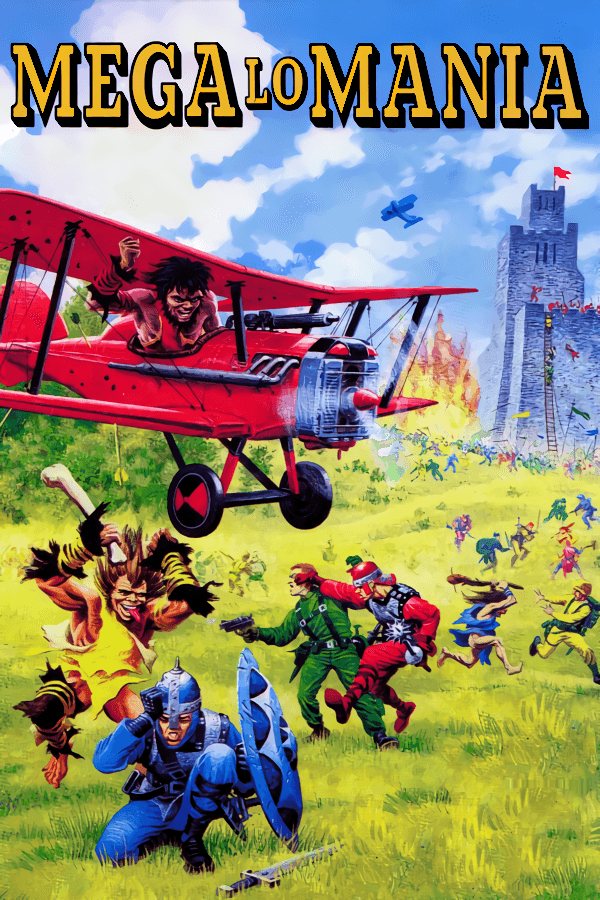

Mega lo Mania
aka Mega-lo-Mania · Tyrants: Fight Through Time · Mega lo Mania: Jikū Daisenryaku
Rate this game
- Played
- All the time
In Mega lo Mania, Sensible Software took the divine oversight of classic god games and turned it into an urgent, multi-era race for military survival.
Mega lo Mania turned god games into a real-time race against time
Most strategy titles in 1991 and 1992 gave you time to deliberate, but Sensible Software threw that out the window. Designed by Jon Hare and Chris Yates, this game beat Dune II to the punch with real-time sector control and tech trees. You choose one of four divine commanders: Scarlet in red, Caesar in green, Oberon in yellow, or Madcap in blue.
Your goal is total domination across 28 islands divided into ten chronological epochs. You receive a pool of 100 men at the start of each epoch. Every island requires you to drop a portion of that pool onto the map to build an army. Spend too many men on an easy island and you will starve for manpower on the next two.
The top-down viewport keeps the entire territory in view. You spawn a headquarters, assign men to design weapons, and split remaining workers between gathering raw elements and manufacturing arms. Leave men unassigned and they automatically fortify your sector HQ, but sitting idle drops your technological edge.
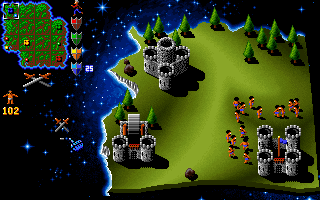
Research, build, and conquer from rocks to nuclear warheads
Tech progression is the core loop that makes this strategy setup click. When you direct men to research, a distinct digitized voice shouts "Ergonomically Designed!" through your speakers. Sound Blaster 2.0 or Sound Blaster Pro 1.0 setup modes give those speech bites crisp clarity alongside Richard Joseph's score.
The arms race escalates rapidly as you progress through history across the map:
- Early epochs rely on stone clubs, spears, boomerangs, and primitive catapults.
- Middle epochs introduce archery towers, boiling oil pourers, and factory-produced defensive structures.
- Late epochs unleash jet fighters, laser turrets, nuclear warheads, and flying saucers.
To build advanced weaponry, your workers must mine specific elements from rich ground deposits in each sector. Unarmed conscripts can fight off enemy soldiers, but only armed troops can breach a rival fort. If you fall behind in tech, a high-level defensive structure will shred your low-tech invaders before they reach the door.
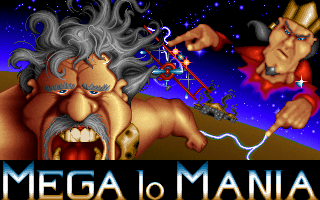
Where the computer AI collapses and the late-game grind begins
While the initial learning curve feels rewarding, the cracks show after a few hours of play. Period reviews in magazine outlets like Computer Gaming World pointed out that the computer opponents rely on unfair spawns rather than genuine tactical intellect. The AI rarely adjusts to player tactics and often throws armies forward without proper tech backing.
The repetitive mission cycle also grinds away at your patience across 28 sectors. Every map resets your immediate tech level, forcing you to redesign basic gear repeatedly before advancing to current gear. The static battle logic means you end up executing the exact same expansion sequence on nearly every map.
A brutal difficulty wall hits during the later epochs if you wasted recruits early on. The system allows you to freeze surviving men after a sector win to carry them toward the final level. If you arrive at the tenth epoch, titled the "Mother of All Battles," without a massive reserve of frozen men, victory becomes nearly impossible.
Why this early RTS experiment is still worth your time
Despite its weak AI, the underlying design decisions set up mechanics that modern strategy tactics games still rely on. Published across Europe by Ubi Soft, it showed how resource management and tactical combat could work together on home computers. North American audiences knew it under the title Tyrants: Fight Through Time, but the clever balance of risk and reward is the same either way.
It balances frantic micro-management against broad macro decisions better than many games that followed it. Deciding whether to send fifty men out to mine ore or hold them back for defense creates constant tension. That core dilemma keeps a full campaign interesting to anyone digging into early real-time strategy.
You can play Mega lo Mania online right now, free in your browser with zero installation needed. Jump straight into the first epoch, assign your starting pool of 100 men to research stone clubs, and experience how this unique DOS game shaped real-time strategy design.
How Mega lo Mania is played — the keys the game listens to, grouped by what they do.
- Interface
- Left click — Decrease allocations
- Right click — Increase allocations
- Move mouse — Point and select
Highlighted keys are mapped — hover or tap one to see what it does.
Players' controls
Touch and gamepad controls
The on-screen keyboard and gamepad mapping the browser player uses on a phone, a tablet or a controller, as opposed to the real keys above. $PRO members make their own in the player and share them here; anyone can pick one to play with.
Make your own touch controlsPRO
- 1Open the editorSign in below, then pick what to make. The game starts with the editor open over it.
- 2Place your keysAdd keys and drag them where your thumbs rest, or map a controller's buttons. Test plays the game with them; Save keeps them, and you play with them from then on.
- 3Share themShare them right after saving in the game, or name and share them here. Players vote, and the best become this game's controls for everyone.
Go PROSee how it worksSign in+20 XP for sharing · +50 XP if yours become the game's own
- The game's own controlsKeyboardGamepadWhat every player starts with.In use
2 screenshots
From the archive
No gameplay video yet
No gameplay video for Mega lo Mania yet. Sign in to add one.
No reviews yet
Tell the community what you think of Mega lo Mania. Reviews are public and tied to your username.
No archived manuals for Mega lo Mania yet
No manuals archived for this title yet. Sign in to upload the first scan.
Cheat codes, console commands and memory pokes for Mega lo Mania — each one verified and attributed.
Sign in to submitNo cheats yet for this title
Know a working cheat, poke or trainer? Add it with the button above. Moderators check every entry before it goes live.
No archived soundtrack for Mega lo Mania yet
No soundtrack archived for this title yet. Sign in to upload the first rip.
No save states for Mega lo Mania yet
No save states for this title yet. Sign in to share one.
Discussions
Sign in to post- Threads0
- Total posts0
- Online now6
Community · Mega lo Mania
Who's contributing, and what's new
- Reviews0
- Threads0
- Uploadsapproved0
- Contributors0
Recent activity
Nothing here yet
Reviews, discussion threads and approved uploads appear here as members add them.