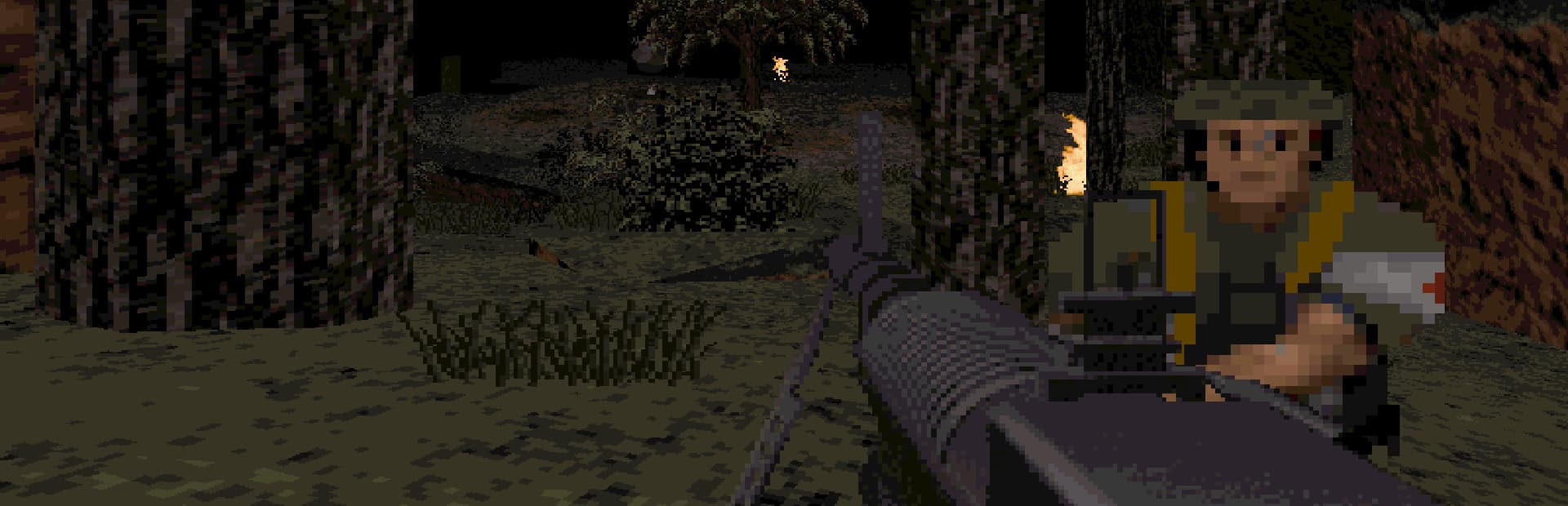
In NAM, you spend less time playing a heroic shooter protagonist and more time dying instantly to an invisible sniper hidden inside a clump of five green pixels.
Tactical realism destroys the fun of the Build engine in NAM
The core problem with NAM is that it tries to build a brutal tactical simulation inside an engine designed for exaggerated arcade chaos. Developers TNT Team, who originally created the popular Platoon mod for Duke Nukem 3D, took 3D Realms' Build technology and tried to turn it into a gritty tour of the Vietnam War. Publisher GT Interactive put it on store shelves in action racks in 1998, while Walmart received copies under the title Napalm. The combination of hyper-lethal military realism and mid-nineties raycasting math creates a uniquely grueling shooter where caution barely saves you.
You play as Sergeant Alan "The Bear" Westmoreland, a US Marine dropped into Vietnam in 1966. To explain why your health bar can survive bursts of gunfire that would stop a squad, the game gives Westmoreland a backstory involving an experimental CIA painkiller serum. That stimulant cocktail is the only narrative cover for why you can take a bullet at all, because almost everything in these jungles kills you in seconds. Even on the lowest difficulty setting, the combat feels as punishing as high-level play in Blood.
I found out quickly that running into a new clearing is a guaranteed death sentence. Enemies do not broadcast their presence with glowing outlines or distinct silhouettes. Instead, Viet Cong and NVA soldiers vanish directly into blocky foliage textures, crouching in bushes or camping inside dark tree lines where you physically cannot see them until they open fire.
How Vietnam combat breaks standard shooter logic
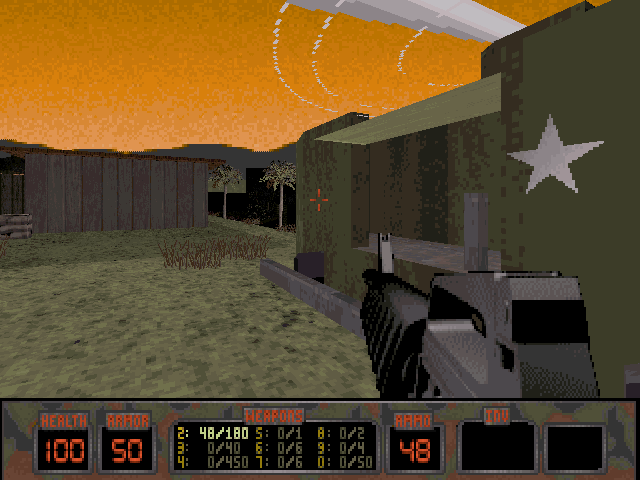
Traditional nineties shooters rewarded fast movement, quick circle-strafing, and aggressive pushed pushes into enemy rooms. If you try that here, you trigger an anti-personnel landmine buried in the grass or walk straight into an invisible sniper's field of fire. Progress requires creeping forward while staring at the mud, using the mine detector item, and spraying blind M16 bursts into every suspicious patch of leaves.
The structural layout spans 34 total levels spread across four distinct episodes. Single-player mode gives you 15 levels divided between operations like "Tour of Duty I", taking you from thick jungle brush to underground tunnel networks and ruined city streets. The remaining 19 levels are reserved for multiplayer modes like Gruntmatch, Capture-the-Flag, and Fireteam, where players pick specific soldier classes for joint combat.
Friendly AI Marines occasionally fight by your side during single-player missions, shooting at incoming targets and drawing fire. While having AI allies in a Build engine game was an interesting idea for 1998, their pathfinding is basic. They tend to walk directly into minefields or get stuck against terrain geometry, leaving you to clear out entrenched positions on your own.
Military hardware and lethal jungle hazards in NAM
Your arsenal sticks strictly to real-world infantry weapons rather than sci-fi gadgetry or fantasy explosives. You start with a combat knife and a sidearm before collecting standard military gear across the map:
- M16 Assault Rifle: Your primary workhorse for mid-range firefights, capable of controlled burst fire.
- M60 Machine Gun: Heavy automatic firepower that chews through light cover and enemy groups at the cost of ammo efficiency.
- M79 Grenade Launcher: Ideal for clearing out blind corners, dug-in bunkers, and groups hiding behind ridges.
- M72 LAW: An anti-tank rocket launcher built to take out heavily armored threats like enemy armor units.
- Airstrike Call-in Radios: Consumable radio items that let you command heavy artillery strikes on exposed open areas.
Alongside the guns, support items like medical kits and night-vision goggles are essential for surviving underground tunnel complexes. However, managing this inventory while under fire from unseen enemies creates constant friction. If you get caught off guard without your radio or rocket launcher equipped when a tank rounds a corner, you die before the select animation finishes.
Build engine limits on the battlefields of 1966
When TNT Team programmed the game using 3D Realms' engine code and CON script language, they were pushing technology built for urban corridors into wide outdoor environments. Programmers Matt Saettler and artists Lado Crnologar, Heikki Korva, and Tuomo Korva tried to construct organic forests out of flat sprite trees and angular sector floor heights. The result is visual noise where enemy sprites pixelate into the green backdrop, making tactical scanning almost impossible on a standard 486 or Pentium PC.
Sound design fares better, delivering authentic weapon cracks and metallic thuds over a Sound Blaster card. Hearing an unseen sniper rifle discharge somewhere in the treeline behind you creates legitimate panic. Unfortunately, hearing where a bullet came from rarely saves you, as two hits are usually enough to end your run.
Because of this unforgiving difficulty, typing cheat codes became standard practice for most players who bought the original release. The game uses the standard Build console entry system prefixed with `NVA`. Typing `NVAGOD` or `NVACALEB` grants invincibility, `NVABLOOD` refills all ammunition and weapons, `NVACLIP` lets you walk through walls, and `NVASHOWMAP` reveals the entire level layout.
Play NAM free in your browser today
The team later reused this exact mechanical foundation for a 1999 sequel titled World War II GI, as noted on its Wikipedia entry. Reviewers at the time tore into the blocky outdoor graphics and unfair ambush placement, yet the gritty military focus still appeals to players who want a shooter that refuses to hold their hand.
If you want to experience this unforgiving retro shooter yourself, you can play NAM free in your browser right now with no setup needed. Jump straight into the first mission of Tour of Duty, keep your eyes glued to the muddy ground for landmine tripwires, and hit the crouching key the moment you hear gunfire in the trees.