
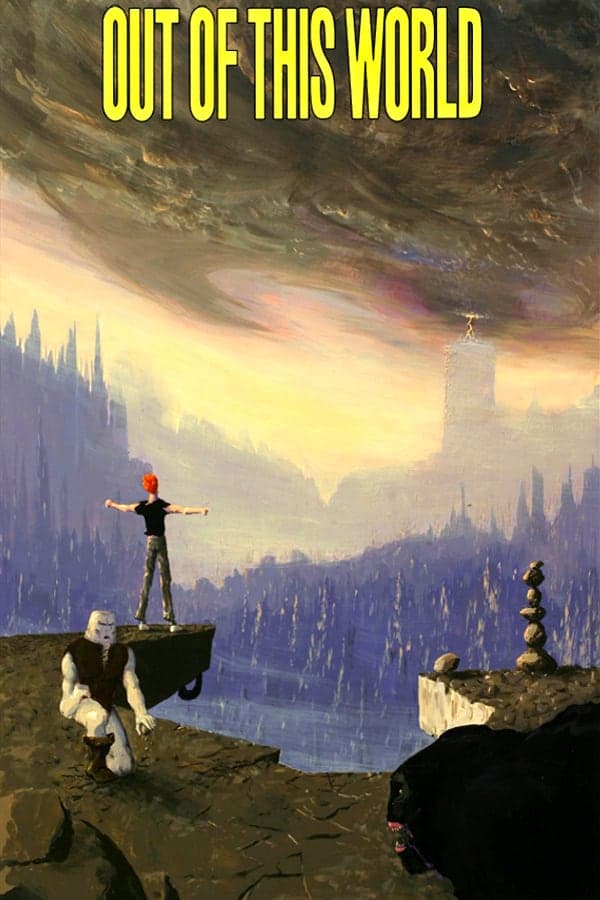

Out of this World
aka Another World · Outer World
Rate this game
- Played
- A lot
Playing Out of this World for the first time meant dying within five seconds because you did not know you had to swim upward immediately after a lightning strike wrecked your particle accelerator.
Trial by laser fire in a world with no HUD
You play as Lester Knight Chaykin, a young physicist wearing a red sweater who steps into his underground laboratory during a thunderstorm. He taps at a computer terminal, drinks a soda, and fires up a high-energy particle experiment. A lightning stroke hits the building outside, arcs into the machine, and blasts Lester across dimensions into a deep underwater pool on an unknown alien planet.
There are no health bars, no ammo counters, and zero lines of text on screen to guide you. When you reach the surface of that pool, poisonous tentacle arms reach down from the top of the frame to drown you if you linger. Climb out onto the rocky shore, and deadly black slugs start creeping toward your feet. Kick them or they bite, instantly killing Lester with a sharp hiss. Walk two screens to the right without stopping, and a massive black alien beast with red eyes chases you back to the edge of a cliff.
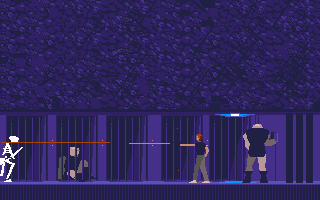
The entire opening sequence forces you to learn by dying. You do not get a firearm until you are captured, hung upside down in a suspended cage with another alien prisoner, and force the cage to swing until it crushes a guard below. Snagging that fallen alien pistol fundamentally changes how you interact with the environment.
Mastering the alien pistol in Out of this World
The alien sidearm is a clever piece of design, operated entirely with a single action button. Tap the button quickly to fire a standard laser bolt that vaporizes basic guards. Hold the button for a brief moment, and Lester projects a temporary green force field in front of himself that blocks incoming energy fire. Hold it down longer until a plasma sphere forms at the barrel, and releasing it sends out a wall-breaker shot capable of disintegrating enemy shields and blowing open sealed doors.
Combat revolves around managing these three functions in real time under heavy fire. An enemy guard will drop his own shield, and you must charge a high-powered blast to destroy his barrier before he blows away yours. If you miss your timing by half a second, the guard's laser disintegrates Lester into a pile of charred bones. Near the very end of the adventure, Lester can even pick up and throw a plasma ball to break through security hazards.
You spend a large portion of the game paired with the alien prisoner you freed from the cage. While you do not control your companion directly, he helps you clear obstacles, pulls you up through vents, and covers your retreat. This dynamic keeps the fixed-screen platforming grounded in a shared survival story told entirely through action.
Why the brutal trial and error made people rage
Reviewers in 1992 praised the fluid animation and sharp presentation, but players quickly discovered how punishing the momentum could be. The game demands absolute memorization. You will step onto a platform only to have a boulder crush you from off-screen, or run into a cavern hallway right into a sniper shot you could not possibly have anticipated.
Because checkpoints are sparse, dying means repeating entire screen transitions over and over. A single mistake with a jump distance or a late force field spawn sends you straight back to the start of the sequence. Once you know the exact order of button inputs and timing windows, you can sprint through the entire adventure in under thirty minutes, but figuring out those solutions on your first run takes hours of painful death animations.

The mechanical puzzles rely on strict environmental logic. You might need to flood an entire section of underground caverns to wash away hazards, or shoot out a support pillar above an oblivious guard. If you miss a timing window by a fraction of a second during a shoot-out, the game offers no room for recovery.
An MS-DOS classic built with flat polygon vectors
French developer Éric Chahi created the title almost entirely on his own over two years, working out of his home studio while Jean-François Freitas composed the dramatic musical score. To save system memory on floppy disks, Chahi chose custom polygon vector graphics rather than traditional hand-drawn bitmap sprites. This technical decision allowed for large cinematic camera angles, smooth character rotoscoping, and massive visual set pieces that fit comfortably within modest hardware specs.
The game was originally released in Europe on the Amiga and Atari ST under the title Another World. When brought to North America as an action release by Interplay Productions, Inc., the title was changed to Out of this World to avoid trademark confusion with the popular television soap opera Another World.
The 1992 Delphine Software International release on PC adapted the original design for standard desktop monitors. Running an Out of this World MS-DOS game disk back then was a test of sound card setups, but the punchy energy sound effects on a Sound Blaster board gave the alien sidearm serious impact compared to basic PC speaker chirps.
Out of this World gives you an evening of tension
The strict timing requirements and instant deaths can get frustrating, but the atmosphere carries the game through. The minimalist visual storytelling, force field mechanics, and urgent pacing build a tense cinematic adventure if you have the patience to handle sudden failure.
If you want to experience Lester's escape without managing disk images or dosbox configs, you can play Out of this World online right inside your Web browser. When you launch Out of this World free in your browser, you can jump straight into the lab cutscene and test your reflexes against the deadly alien wildlife instantly. Pay close attention to the charge levels on your laser pistol, because learning when to drop a force field and when to power up a heavy shot is the only thing standing between Lester and a very quick trip back to the checkpoint.
How Out of this World is played — the keys the game listens to, grouped by what they do.
- Movement
- Action
- Interface
Highlighted keys are mapped — hover or tap one to see what it does.
Analog joystick calibration is available via the -C command-line parameter. Hardware settings can be configured using SETUP.
Players' controls
Touch and gamepad controls
The on-screen keyboard and gamepad mapping the browser player uses on a phone, a tablet or a controller, as opposed to the real keys above. $PRO members make their own in the player and share them here; anyone can pick one to play with.
Make your own touch controlsPRO
- 1Open the editorSign in below, then pick what to make. The game starts with the editor open over it.
- 2Place your keysAdd keys and drag them where your thumbs rest, or map a controller's buttons. Test plays the game with them; Save keeps them, and you play with them from then on.
- 3Share themShare them right after saving in the game, or name and share them here. Players vote, and the best become this game's controls for everyone.
Go PROSee how it worksSign in+20 XP for sharing · +50 XP if yours become the game's own
- The game's own controlsKeyboardGamepadWhat every player starts with.In use
2 screenshots
From the archive
No gameplay video yet
No gameplay video for Out of this World yet. Sign in to add one.
No reviews yet
Tell the community what you think of Out of this World. Reviews are public and tied to your username.
No archived manuals for Out of this World yet
No manuals archived for this title yet. Sign in to upload the first scan.
Cheat codes, console commands and memory pokes for Out of this World — each one verified and attributed.
Sign in to submitNo cheats yet for this title
Know a working cheat, poke or trainer? Add it with the button above. Moderators check every entry before it goes live.
No archived soundtrack for Out of this World yet
No soundtrack archived for this title yet. Sign in to upload the first rip.
No save states for Out of this World yet
No save states for this title yet. Sign in to share one.
Discussions
Sign in to post- Threads0
- Total posts0
- Online now6
Community · Out of this World
Who's contributing, and what's new
- Reviews0
- Threads0
- Uploadsapproved0
- Contributors0
Recent activity