
If you played Primal Rage in 1995, your left hand probably still remembers the muscle strain of holding down two attack buttons before trying to execute a quarter-circle motion on a PC keyboard.
Most mid-nineties arcade fighters asked you to roll the joystick from down to forward and tap a punch key at the end of the arc. Atari Games Corporation inverted that logic completely for their prehistoric fighter. You had to press and hold your designated punch or kick buttons first, sweep the directional pad while keeping them pinned, and release them only when the motion finished.
That input design meant you could not buffer special attacks while walking normally across the screen. Every move required a deliberate setup that froze your dinosaur in place for a fraction of a second. If you were playing on a standard DOS keyboard rather than an arcade stick, executing Vertigo's venom spit or Diablo's fireballs meant wrestling against key rollover limits that dropped half your inputs.
The unusual controls gave combat an awkward, heavy cadence that set it apart from Mortal Kombat. Wins came down to controlling space with massive hitboxes, punishing jumped-in attacks, and trapping opponents in the corners of the arena.
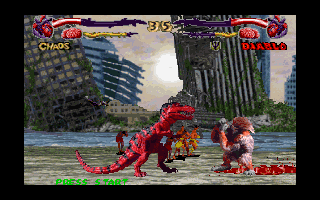
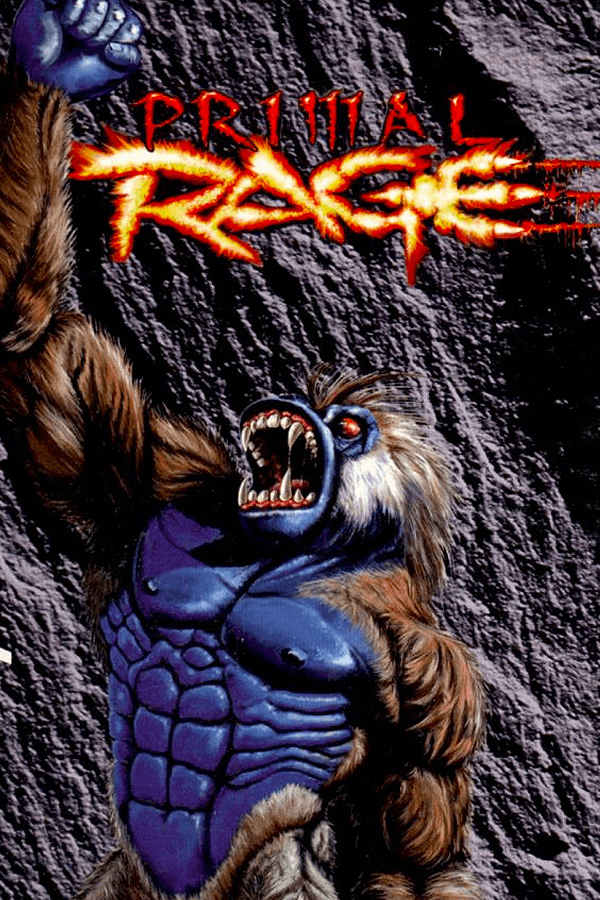
The story throws seven ancient deities onto a post-apocalyptic Earth renamed Urth after a catastrophic meteor strike. The roster splits between giant apes and prehistoric reptiles: Armadon, Blizzard, Chaos, Diablo, Sauron, Talon, and Vertigo. Each god controls a distinct domain, from volcanic ash fields to frozen glaciers.
Tiny human worshippers run along the bottom of the screen during every match, cheering for their chosen god. You can walk over, scoop up an opponent's follower, and eat them mid-fight to recover a slice of your health bar. If you hit a worshipper by mistake during a combo, you lose that healing chance entirely, making crowd management a real tactic when both health bars run low.
Matches finish with violent Domination Moves, similar to the gore sequences popular in the 1995 arcade scene. Chaos, a giant ape god, gained notoriety during release for a finishing move where he urinates on a defeated rival to melt their flesh, prompting retail complaints and censorship debates across several console ports.
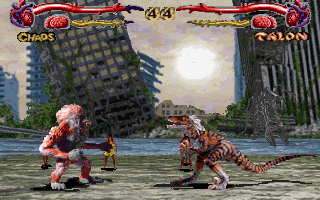
Designers Frank Kuan and J. Cameron Petty built the original arcade game around stop-motion animation produced by Pete Kleinow and Jason Leong. Every monster started as an articulated clay model, posed frame by frame, filmed, and digitized into sprite sheets. The resulting motion possessed a distinct weight and jerkiness that looked completely different from traditional drawn sprites.
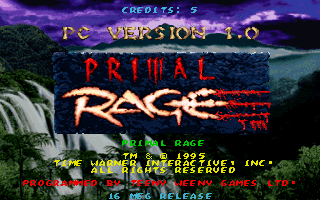
Porting studio Teeny Weeny Games brought the arcade hit to home PCs for publisher Time Warner Interactive. As an action game port, the PC version rendered high-resolution sprites that matched the visual fidelity of expensive console hardware like the 3DO and Saturn. Reviewers at period outlets like Game Play noted that it was among the best-looking home conversions available, even if pulling off complex attacks remained a struggle.
Sound support relies on standard Sound Blaster cards for thumping sound effects and heavy monster roars. While the digitized screeching hits hard through a PC speaker setup, player feedback often notes that the background music tracks feel thin compared to the original arcade cabinet's sound chip.
Developer Atari Games Corporation hid several easter eggs inside the code to reward curious players. Entering a specific input sequence during a match transforms the human worshippers into a bouncing game of volleyball, where the two giant beasts hit a worshipper back and forth across the arena screen for points.
The arcade board also featured a custom protection system designed to stop unauthorized copies, which stumped hardware emulators for years after the machine left arcades. Despite those technical hurdles and retail controversies, the franchise sold over 1.5 million copies across various formats.
A full arcade sequel titled Primal Rage II entered active development with new human avatar mechanics, but the project was pulled before reaching full production. That cancellation left this original title as the single major entry in the series.
The backwards control scheme still trips up new players, and the DOS soundtrack lacks the bass punch of the cabinet. Yet the digitized stop-motion animation holds a tactile punch that full 3D models rarely replicate, and the worshipper-eating mechanic adds genuine tension to late-round scrambles.
You can play Primal Rage online right now, free in your browser, with no setup required. Pick Sauron or Blizzard, get used to holding attack keys before tapping the arrow keys, and see how many worshippers you can swallow before your rival lands a Domination Move.
If you played Primal Rage in 1995, your left hand probably still remembers the muscle strain of holding down two attack buttons before trying to execute a quarter-circle motion on a PC keyboard.
Most mid-nineties arcade fighters asked you to roll the joystick from down to forward and tap a punch key at the end of the arc. Atari Games Corporation inverted that logic completely for their prehistoric fighter. You had to press and hold your designated punch or kick buttons first, sweep the directional pad while keeping them pinned, and release them only when the motion finished.
That input design meant you could not buffer special attacks while walking normally across the screen. Every move required a deliberate setup that froze your dinosaur in place for a fraction of a second. If you were playing on a standard DOS keyboard rather than an arcade stick, executing Vertigo's venom spit or Diablo's fireballs meant wrestling against key rollover limits that dropped half your inputs.
The unusual controls gave combat an awkward, heavy cadence that set it apart from Mortal Kombat. Wins came down to controlling space with massive hitboxes, punishing jumped-in attacks, and trapping opponents in the corners of the arena.
The story throws seven ancient deities onto a post-apocalyptic Earth renamed Urth after a catastrophic meteor strike. The roster splits between giant apes and prehistoric reptiles: Armadon, Blizzard, Chaos, Diablo, Sauron, Talon, and Vertigo. Each god controls a distinct domain, from volcanic ash fields to frozen glaciers.
Tiny human worshippers run along the bottom of the screen during every match, cheering for their chosen god. You can walk over, scoop up an opponent's follower, and eat them mid-fight to recover a slice of your health bar. If you hit a worshipper by mistake during a combo, you lose that healing chance entirely, making crowd management a real tactic when both health bars run low.
Matches finish with violent Domination Moves, similar to the gore sequences popular in the 1995 arcade scene. Chaos, a giant ape god, gained notoriety during release for a finishing move where he urinates on a defeated rival to melt their flesh, prompting retail complaints and censorship debates across several console ports.
Designers Frank Kuan and J. Cameron Petty built the original arcade game around stop-motion animation produced by Pete Kleinow and Jason Leong. Every monster started as an articulated clay model, posed frame by frame, filmed, and digitized into sprite sheets. The resulting motion possessed a distinct weight and jerkiness that looked completely different from traditional drawn sprites.
Porting studio Teeny Weeny Games brought the arcade hit to home PCs for publisher Time Warner Interactive. As an action game port, the PC version rendered high-resolution sprites that matched the visual fidelity of expensive console hardware like the 3DO and Saturn. Reviewers at period outlets like Game Play noted that it was among the best-looking home conversions available, even if pulling off complex attacks remained a struggle.
Sound support relies on standard Sound Blaster cards for thumping sound effects and heavy monster roars. While the digitized screeching hits hard through a PC speaker setup, player feedback often notes that the background music tracks feel thin compared to the original arcade cabinet's sound chip.
Developer Atari Games Corporation hid several easter eggs inside the code to reward curious players. Entering a specific input sequence during a match transforms the human worshippers into a bouncing game of volleyball, where the two giant beasts hit a worshipper back and forth across the arena screen for points.
The arcade board also featured a custom protection system designed to stop unauthorized copies, which stumped hardware emulators for years after the machine left arcades. Despite those technical hurdles and retail controversies, the franchise sold over 1.5 million copies across various formats.
A full arcade sequel titled Primal Rage II entered active development with new human avatar mechanics, but the project was pulled before reaching full production. That cancellation left this original title as the single major entry in the series.
The backwards control scheme still trips up new players, and the DOS soundtrack lacks the bass punch of the cabinet. Yet the digitized stop-motion animation holds a tactile punch that full 3D models rarely replicate, and the worshipper-eating mechanic adds genuine tension to late-round scrambles.
You can play Primal Rage online right now, free in your browser, with no setup required. Pick Sauron or Blizzard, get used to holding attack keys before tapping the arrow keys, and see how many worshippers you can swallow before your rival lands a Domination Move.
The on-screen keyboard and gamepad mapping the browser player uses on a phone, a tablet or a controller, as opposed to the real keys above. $PRO members make their own in the player and share them here; anyone can pick one to play with.
Cheat codes, console commands and memory pokes for Primal Rage — each one verified and attributed.
Sign in to submitThe on-screen keyboard and gamepad mapping the browser player uses on a phone, a tablet or a controller, as opposed to the real keys above. $PRO members make their own in the player and share them here; anyone can pick one to play with.
Cheat codes, console commands and memory pokes for Primal Rage — each one verified and attributed.
Sign in to submit