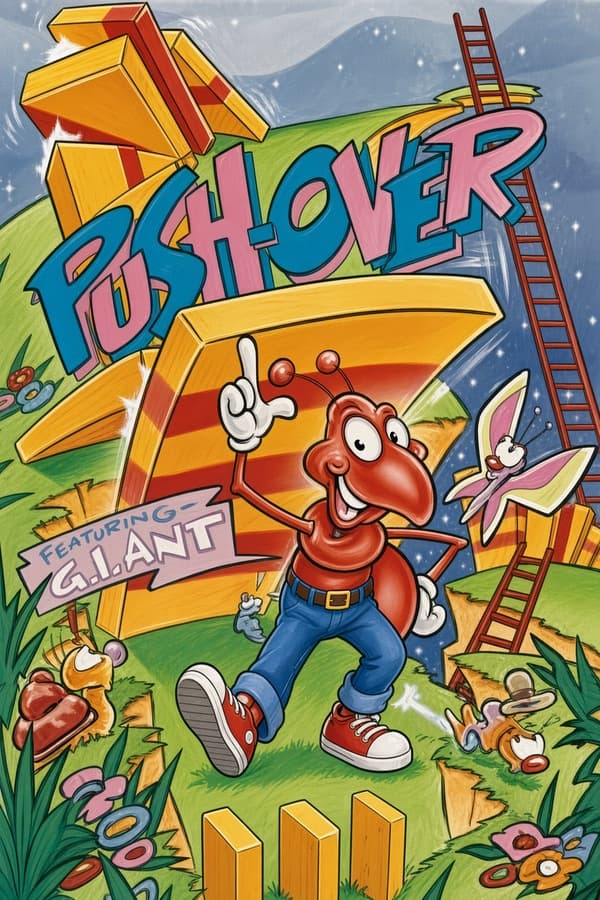
aka Push-Over
Pushover turns a bag of lost potato chips and a set of unstable dominoes into one of the most clever, agonizing puzzle designs on DOS.
Red Rat Software took a simple idea and made it surprisingly ruthless. You play G.I. Ant, a large soldier ant navigating a side-view maze of ledges and ladders to recover snack packets. The objective for every level relies on setting off a single, uninterrupted chain reaction.
You can pick up and move almost every domino block on the board, but you only get one shove. The regular yellow-and-red patterns will fall in sequence, but success requires triggering the designated three-striped Exit block last. If that trigger falls too early, or if any standard domino is left standing, the exit door stays locked and you fail.
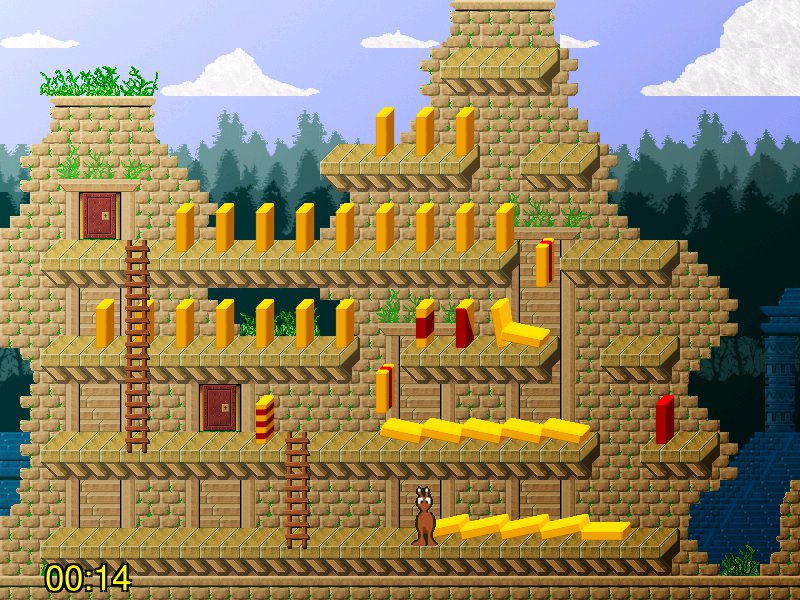
The variety of special blocks keeps the basic mechanic from getting repetitive. You have to account for several distinct behaviors across the board:
What makes the design so demanding is that G.I. Ant is fragile. Dropping from a ledge that is slightly too high causes you to splatter instantly. Leaving a single pile of rubble in front of a pathway can lock the stage. Worst of all, the tight time limit forces you to sprint toward the open door the second you knock the first tile down.
The team at Red Rat Software, led by concept creator Charles Partington, engineered 100 levels spanning nine visual themes. Designers Helen Elcock, Harry Nadler, Avril Rigby, Don Rigby, and Chris Waterworth constructed these puzzles using a custom internal editor. Ocean Software published the title in 1992 with cross-promotional snack branding in the UK, though international releases replaced the chips with cash dropped by Captain Rat.
At the time, gaming magazines drew immediate comparisons to Lemmings. *Computer Gaming World* highlighted its addictive puzzle philosophy, while *ST Format* noted that planning mattered far more than raw reflexes. The game relied on deliberate spatial logic rather than quick trigger fingers, which made the strict countdown timer feel like an odd contrast to the thoughtful core design.
On PC, the presentation held up well thanks to colorful backgrounds and expressive character animations. G.I. Ant balances nervously on ledges or covers his ears when explosives go off. The audio side scored high marks too, featuring dynamic soundtracks from Jonathan Dunn, Dean Evans, and Keith Tinman that sounded punchy through an AdLib or Sound Blaster card.
For all its clever logic, the mechanics suffer from a few mechanical flaws. Placing dominoes requires exact alignment, and the keyboard controls can feel slightly sluggish when you try to turn around quickly. Accidental drops or misplaced tiles happen often, forcing you to use the built-in stage undo feature or retype level passwords.
The extreme difficulty spikes later in the run turn trial-and-error into a test of patience. Figuring out how gravity-reversing blocks interact with splitters is satisfying, but executing the solution under a five-second exit window is not. Reviewers noted that younger players would likely bounce off the strict execution long before reaching the final world.
This classic puzzle title holds up because its core mechanics are clear, punishing, and immensely rewarding to solve. The satisfaction of watching a massive domino chain execute perfectly after twenty failed attempts remains unbeatable.
If you want to try this MS-DOS game without hunting down floppy disks, you can play Pushover online right now. It runs free in your browser with zero installation needed, so you can test your puzzle-solving skills against G.I. Ant's timer today.
Pushover turns a bag of lost potato chips and a set of unstable dominoes into one of the most clever, agonizing puzzle designs on DOS.
Red Rat Software took a simple idea and made it surprisingly ruthless. You play G.I. Ant, a large soldier ant navigating a side-view maze of ledges and ladders to recover snack packets. The objective for every level relies on setting off a single, uninterrupted chain reaction.
You can pick up and move almost every domino block on the board, but you only get one shove. The regular yellow-and-red patterns will fall in sequence, but success requires triggering the designated three-striped Exit block last. If that trigger falls too early, or if any standard domino is left standing, the exit door stays locked and you fail.

The variety of special blocks keeps the basic mechanic from getting repetitive. You have to account for several distinct behaviors across the board:
What makes the design so demanding is that G.I. Ant is fragile. Dropping from a ledge that is slightly too high causes you to splatter instantly. Leaving a single pile of rubble in front of a pathway can lock the stage. Worst of all, the tight time limit forces you to sprint toward the open door the second you knock the first tile down.
The team at Red Rat Software, led by concept creator Charles Partington, engineered 100 levels spanning nine visual themes. Designers Helen Elcock, Harry Nadler, Avril Rigby, Don Rigby, and Chris Waterworth constructed these puzzles using a custom internal editor. Ocean Software published the title in 1992 with cross-promotional snack branding in the UK, though international releases replaced the chips with cash dropped by Captain Rat.
At the time, gaming magazines drew immediate comparisons to Lemmings. *Computer Gaming World* highlighted its addictive puzzle philosophy, while *ST Format* noted that planning mattered far more than raw reflexes. The game relied on deliberate spatial logic rather than quick trigger fingers, which made the strict countdown timer feel like an odd contrast to the thoughtful core design.

On PC, the presentation held up well thanks to colorful backgrounds and expressive character animations. G.I. Ant balances nervously on ledges or covers his ears when explosives go off. The audio side scored high marks too, featuring dynamic soundtracks from Jonathan Dunn, Dean Evans, and Keith Tinman that sounded punchy through an AdLib or Sound Blaster card.
For all its clever logic, the mechanics suffer from a few mechanical flaws. Placing dominoes requires exact alignment, and the keyboard controls can feel slightly sluggish when you try to turn around quickly. Accidental drops or misplaced tiles happen often, forcing you to use the built-in stage undo feature or retype level passwords.
The extreme difficulty spikes later in the run turn trial-and-error into a test of patience. Figuring out how gravity-reversing blocks interact with splitters is satisfying, but executing the solution under a five-second exit window is not. Reviewers noted that younger players would likely bounce off the strict execution long before reaching the final world.
This classic puzzle title holds up because its core mechanics are clear, punishing, and immensely rewarding to solve. The satisfaction of watching a massive domino chain execute perfectly after twenty failed attempts remains unbeatable.
If you want to try this MS-DOS game without hunting down floppy disks, you can play Pushover online right now. It runs free in your browser with zero installation needed, so you can test your puzzle-solving skills against G.I. Ant's timer today.
How Pushover is played — the keys the game listens to, grouped by what they do.
Highlighted keys are mapped — hover or tap one to see what it does.
Level passcodes are typed directly using the numeric keypad. Controls support either keyboard or joystick.
The on-screen keyboard and gamepad mapping the browser player uses on a phone, a tablet or a controller, as opposed to the real keys above. $PRO members make their own in the player and share them here; anyone can pick one to play with.
Cheat codes, console commands and memory pokes for Pushover — each one verified and attributed.
Sign in to submitHow Pushover is played — the keys the game listens to, grouped by what they do.
Highlighted keys are mapped — hover or tap one to see what it does.
Level passcodes are typed directly using the numeric keypad. Controls support either keyboard or joystick.
The on-screen keyboard and gamepad mapping the browser player uses on a phone, a tablet or a controller, as opposed to the real keys above. $PRO members make their own in the player and share them here; anyone can pick one to play with.
Cheat codes, console commands and memory pokes for Pushover — each one verified and attributed.
Sign in to submit