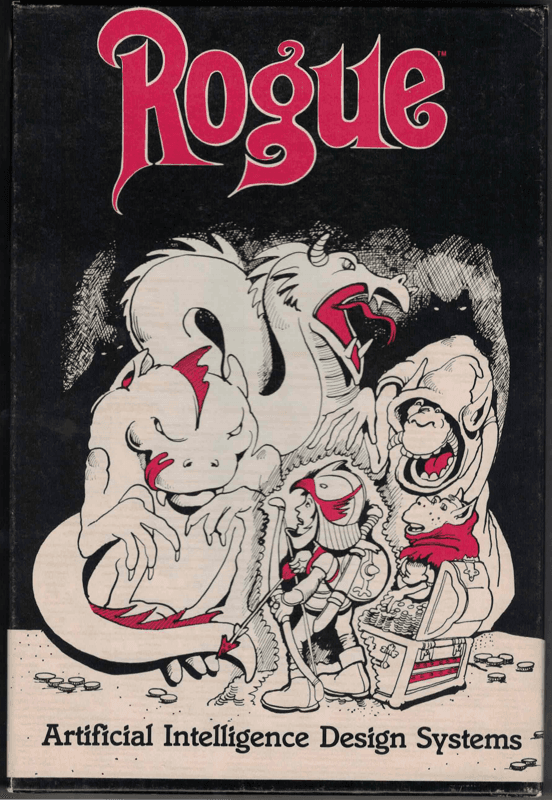
aka AGB_Rogue · ClassicRogue · Rogue: Exploring the Dungeons of Doom · Rogue: The Adventure Game
In Rogue, you enter the dark depths of the Dungeon of Doom armed with nothing more than a simple weapon, an unidentified potion, and text characters representing your surroundings. Your goal is to descend to the 26th floor, snatch the Amulet of Yendor, and survive the long trek back up to the surface.
Every level in this top-down dungeon crawler divides the screen into a neat three-by-three grid of rooms connected by narrow corridors. You move one step at a time in a turn-based system where taking a step, searching a wall for hidden doors, or swinging a sword ticks the clock for every creature in the dungeon. The game represents all thirty-two square feet of a room using standard ASCII characters, turning simple letter keys into an entire menagerie of threats.
There are 26 monster types patrolling these floors, conveniently indexed from A to Z. A capital L marks a Leprechaun that wants to swipe your gold and vanish, while a T is a Troll ready to turn your expedition into a quick splatter on the tile floor. Because combat relies on hidden dice rolls modified by your current weapon and armor stats, stepping into melee with an unfamiliar creature is always a tense calculation. You might clear a room without taking a scratch, or you might watch your health bar dissolve in two bad rounds of combat.
To make matters more unpredictable, the equipment you collect arrives completely unidentified. A red potion could be a life-saving healing draught or a deadly poison that strips your strength, and you will not know until you drink it or read a scroll of identify. This system forces you to manage risks constantly, deciding whether to gulp down a blue liquid in the middle of a fight or save it until you can test it in a empty hallway.
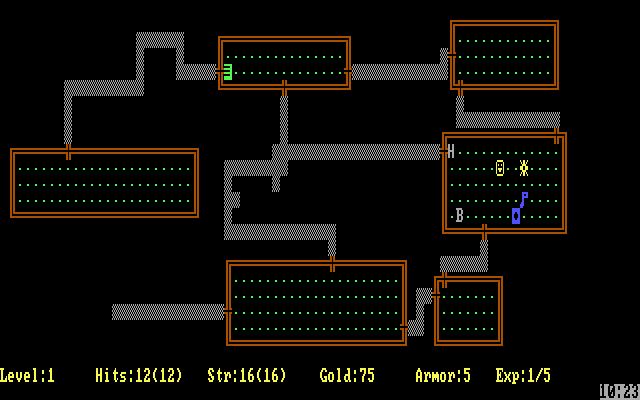
What makes a run so terrifying is the absolute finality of death. There are no secondary chances, no mid-dungeon saves to reload after a blunder, and no safety net if you fall in battle. When your health hits zero, your character is erased completely, leaving behind only a spot on the local high-score list alongside the cause of your death.
Because the floors generate procedurally every time you descend a staircase, you can never rely on memorized maps or fixed item spawns. A lucky early drop like a enchanted longsword or ring of protection can propel you through ten levels with minimal effort, while a run starved for food will see your hero collapse from hunger before even meeting a dragon. Random chance plays a massive role in whether a run succeeds, which creates moments of incredible triumph alongside bursts of sharp frustration.
The control scheme adds its own special layer of danger. Controlling your movement directly via keyboard means a single misclick or frantic key press can instantly end an hour of hard work. Mistyping a key can cause you to throw your primary weapon across the room instead of swinging it, leaving you bare-handed in front of an aggressive foe. Fans who spent evenings with the 1984 PC release learned early on that slow, deliberate typing was just as critical as high character stats.
The original concept came from programmers Michael Toy and Glenn Wichman around 1980 while working on Unix minicomputers. They wanted to create a graphic role-playing experience on terminals that could only render plain text, taking advantage of the curses software library to update specific screen coordinates without redrawing the entire display. Ken Arnold later joined the effort to refine the computer algorithms behind dungeon creation and monster movement.
When the team set out to bring the title to microcomputers, developer Jon Lane helped form A.I. Design to port the code over to IBM compatibles. The studio self-published early MS-DOS versions in 1983 and 1984 before signing a distribution agreement with Epyx to put boxes on shop shelves. It was a massive leap, translating terminal software into a polished commercial product that defined a new subgenre of role-playing games.
Hardware constraints shaped nearly every design choice on display. The IBM PC release offered no dedicated audio tracks or rich sound effects, relying strictly on silent execution or basic PC speaker clicks to notify you of actions. Because the developers kept the original source code private during its retail run, other programmers in the early eighties were forced to build their own similar projects from scratch, spawning famous offshoots like Moria, Larn, and Hack.
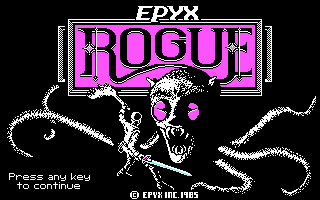
Critical reaction to this text-based adventure spanned two extreme ends of the spectrum. PC World Magazine famously placed it sixth on their list of the best PC games of all time, celebrating its endless replay capability and mechanical depth despite graphics consisting purely of text symbols. Later retrospectives praised its underlying mechanics as practically flawless, awarding top scores for how much tension it squeezed out of basic character sets.
Yet the modern player will quickly spot where the original DOS code strains under pressure. Beyond the complete absence of sound, modern emulation environments can sometimes freeze during fast-paced combat routines if key inputs overflow the buffer. Furthermore, the random number generator can occasionally hand you a floor layout that is mathematically impossible to clear without dying, such as spawning you in a closed room surrounded by high-level monsters before you find a single weapon upgrade.
The difficulty is uncompromising, but that strict punishment is exactly why the game attracted such a dedicated technical following. Researchers in the 1980s even wrote automated artificial intelligence software like Rog-O-Matic specifically to study how algorithm-driven agents could navigate the dungeon layout, optimize item identification, and retrieve the amulet without human intervention.
If you want to understand where modern procedural dungeon crawlers got their start, loading up the original keyboard adventure is essential gaming homework. Watching a cluster of simple text symbols transform into a desperate, life-or-death battle for survival is a trip every retro enthusiast needs to experience firsthand. You can play Rogue free in your browser right here, with no extra setup or software installation required.
Jump in tonight and test your luck against the random generator on floor one. Try to survive long enough to identify your first magic wand or outsmart an aggressive K before your hunger bar runs out. It only takes five minutes to feel the tension that started an entire genre.
In Rogue, you enter the dark depths of the Dungeon of Doom armed with nothing more than a simple weapon, an unidentified potion, and text characters representing your surroundings. Your goal is to descend to the 26th floor, snatch the Amulet of Yendor, and survive the long trek back up to the surface.
Every level in this top-down dungeon crawler divides the screen into a neat three-by-three grid of rooms connected by narrow corridors. You move one step at a time in a turn-based system where taking a step, searching a wall for hidden doors, or swinging a sword ticks the clock for every creature in the dungeon. The game represents all thirty-two square feet of a room using standard ASCII characters, turning simple letter keys into an entire menagerie of threats.
There are 26 monster types patrolling these floors, conveniently indexed from A to Z. A capital L marks a Leprechaun that wants to swipe your gold and vanish, while a T is a Troll ready to turn your expedition into a quick splatter on the tile floor. Because combat relies on hidden dice rolls modified by your current weapon and armor stats, stepping into melee with an unfamiliar creature is always a tense calculation. You might clear a room without taking a scratch, or you might watch your health bar dissolve in two bad rounds of combat.
To make matters more unpredictable, the equipment you collect arrives completely unidentified. A red potion could be a life-saving healing draught or a deadly poison that strips your strength, and you will not know until you drink it or read a scroll of identify. This system forces you to manage risks constantly, deciding whether to gulp down a blue liquid in the middle of a fight or save it until you can test it in a empty hallway.
What makes a run so terrifying is the absolute finality of death. There are no secondary chances, no mid-dungeon saves to reload after a blunder, and no safety net if you fall in battle. When your health hits zero, your character is erased completely, leaving behind only a spot on the local high-score list alongside the cause of your death.
Because the floors generate procedurally every time you descend a staircase, you can never rely on memorized maps or fixed item spawns. A lucky early drop like a enchanted longsword or ring of protection can propel you through ten levels with minimal effort, while a run starved for food will see your hero collapse from hunger before even meeting a dragon. Random chance plays a massive role in whether a run succeeds, which creates moments of incredible triumph alongside bursts of sharp frustration.
The control scheme adds its own special layer of danger. Controlling your movement directly via keyboard means a single misclick or frantic key press can instantly end an hour of hard work. Mistyping a key can cause you to throw your primary weapon across the room instead of swinging it, leaving you bare-handed in front of an aggressive foe. Fans who spent evenings with the 1984 PC release learned early on that slow, deliberate typing was just as critical as high character stats.
The original concept came from programmers Michael Toy and Glenn Wichman around 1980 while working on Unix minicomputers. They wanted to create a graphic role-playing experience on terminals that could only render plain text, taking advantage of the curses software library to update specific screen coordinates without redrawing the entire display. Ken Arnold later joined the effort to refine the computer algorithms behind dungeon creation and monster movement.
When the team set out to bring the title to microcomputers, developer Jon Lane helped form A.I. Design to port the code over to IBM compatibles. The studio self-published early MS-DOS versions in 1983 and 1984 before signing a distribution agreement with Epyx to put boxes on shop shelves. It was a massive leap, translating terminal software into a polished commercial product that defined a new subgenre of role-playing games.
Hardware constraints shaped nearly every design choice on display. The IBM PC release offered no dedicated audio tracks or rich sound effects, relying strictly on silent execution or basic PC speaker clicks to notify you of actions. Because the developers kept the original source code private during its retail run, other programmers in the early eighties were forced to build their own similar projects from scratch, spawning famous offshoots like Moria, Larn, and Hack.
Critical reaction to this text-based adventure spanned two extreme ends of the spectrum. PC World Magazine famously placed it sixth on their list of the best PC games of all time, celebrating its endless replay capability and mechanical depth despite graphics consisting purely of text symbols. Later retrospectives praised its underlying mechanics as practically flawless, awarding top scores for how much tension it squeezed out of basic character sets.
Yet the modern player will quickly spot where the original DOS code strains under pressure. Beyond the complete absence of sound, modern emulation environments can sometimes freeze during fast-paced combat routines if key inputs overflow the buffer. Furthermore, the random number generator can occasionally hand you a floor layout that is mathematically impossible to clear without dying, such as spawning you in a closed room surrounded by high-level monsters before you find a single weapon upgrade.
The difficulty is uncompromising, but that strict punishment is exactly why the game attracted such a dedicated technical following. Researchers in the 1980s even wrote automated artificial intelligence software like Rog-O-Matic specifically to study how algorithm-driven agents could navigate the dungeon layout, optimize item identification, and retrieve the amulet without human intervention.
If you want to understand where modern procedural dungeon crawlers got their start, loading up the original keyboard adventure is essential gaming homework. Watching a cluster of simple text symbols transform into a desperate, life-or-death battle for survival is a trip every retro enthusiast needs to experience firsthand. You can play Rogue free in your browser right here, with no extra setup or software installation required.
Jump in tonight and test your luck against the random generator on floor one. Try to survive long enough to identify your first magic wand or outsmart an aggressive K before your hunger bar runs out. It only takes five minutes to feel the tension that started an entire genre.
How Rogue is played — the keys the game listens to, grouped by what they do.
Highlighted keys are mapped — hover or tap one to see what it does.
The on-screen keyboard and gamepad mapping the browser player uses on a phone, a tablet or a controller, as opposed to the real keys above. $PRO members make their own in the player and share them here; anyone can pick one to play with.
Cheat codes, console commands and memory pokes for Rogue — each one verified and attributed.
Sign in to submitHow Rogue is played — the keys the game listens to, grouped by what they do.
Highlighted keys are mapped — hover or tap one to see what it does.
The on-screen keyboard and gamepad mapping the browser player uses on a phone, a tablet or a controller, as opposed to the real keys above. $PRO members make their own in the player and share them here; anyone can pick one to play with.
Cheat codes, console commands and memory pokes for Rogue — each one verified and attributed.
Sign in to submit