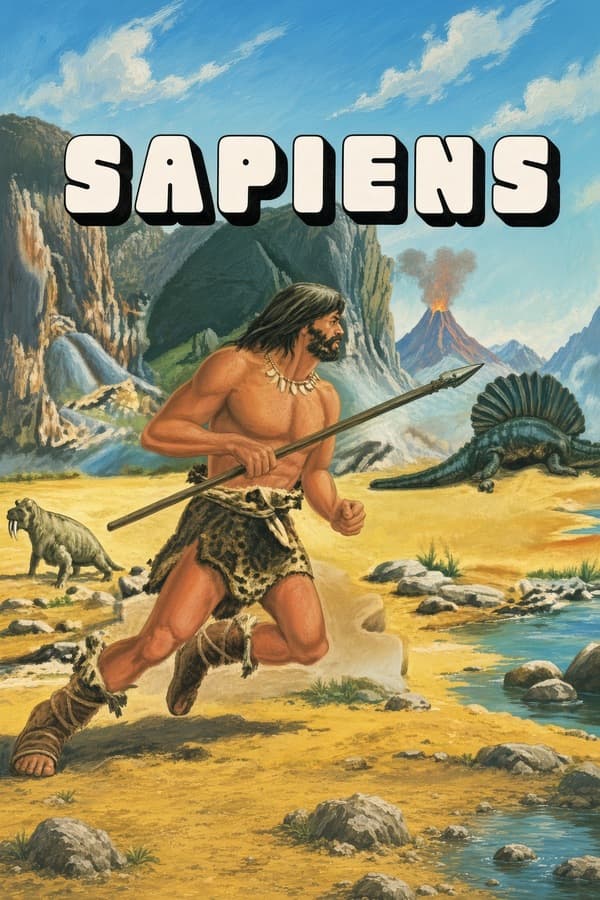
In Sapiens, you walk the pre-Ice Age wilderness as a Neanderthal hunter, balancing toolmaking and trade against the constant threat of rival tribes and starvation. It is a slow, unforgiving survival simulation from 1987 that trades standard arcade shooting for knapping flint and managing tribal diplomacy.
Back in the late eighties, most action titles asked you to do little more than jump over hazards or shoot everything on screen. Brothers Didier and Olivier Guillion took a different approach under their development group Myriad. After building an initial release for French home computers in 1986, they spent seven months rewriting the code in C to bring the title to PC compatibles, where publisher Loriciels brought it to standard CGA screens.
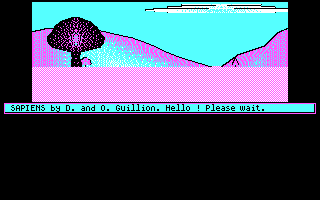
The core setup places you in the skin of Torgan, a young hunter belonging to the Light-Footed tribe. Your chieftain, Hognor, gives you a clear directive: range out into procedurally generated wilderness to secure food, water, and alliances. Instead of following a linear path, you navigate open terrain using a combination of first-person view mode for movement and side-view screens when interacting with objects, animals, or fellow humans.
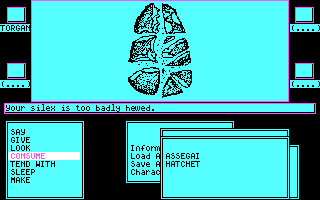
Survival in this world depends heavily on how well you understand your surroundings and prepare your inventory. You cannot simply sprint endlessly through the landscape; Torgan gets tired, grows thirsty, and succumbs to injuries if you push him too hard without rest or herbal remedies. To keep your tribe fed and your inventory stocked, you will need to master a handful of essential wilderness skills:
Interaction with other humans is surprisingly open-ended. When you meet another hunter, you can initiate dialogue, attempt to trade items, or resort to violence. Friendly encounters help you stock up on raw materials, but wandering into territory held by hostile factions like the Mad Hyenas tribe usually leads to immediate conflict. The combat runs in real time, forcing you to time your spear throws and strikes carefully while keeping your spacing intact.
While the overall design was years ahead of typical 1987 releases, playing the original action adventure today reveals some distinct friction points. The real-time combat controls feel heavy and stubborn, leading many players to struggle when a wolf closes the distance before Torgan can bring a weapon to bear. The crafting mini-game for shaping assegai heads also demands exact precision, and failing a knapping attempt wastes valuable flint that took minutes to find.
Sound design was handled by Gilles Soulet, whose audio work translates to sparse PC speaker beeps and chirps on standard hardware. If you ever tried to run the original executable on a fast 386 or 486 without slowing down your CPU clock, you likely ran straight into a hardware Divide Error crash. The code expected a very specific instruction speed, making slowdown utilities mandatory for PC gamers throughout the nineties.
Despite the steep presentation curves and rigid combat inputs, the overall loop of exploring unknown lands, managing Torgan's physical limits, and bartering for survival holds up surprisingly well. It remains a fascinating take on open-ended survival from a period when few studios were willing to attempt system-heavy simulations. Anyone interested in early computer games from 1987 will find plenty of clever ideas under its stark CGA palette.
You can play Sapiens online for free in your browser right now, with nothing to install and no setup required. Take your time learning how to knap your first flint spear before venturing north into Mad Hyena territory, and remember to track down water streams before Torgan runs out of energy.
In Sapiens, you walk the pre-Ice Age wilderness as a Neanderthal hunter, balancing toolmaking and trade against the constant threat of rival tribes and starvation. It is a slow, unforgiving survival simulation from 1987 that trades standard arcade shooting for knapping flint and managing tribal diplomacy.
Back in the late eighties, most action titles asked you to do little more than jump over hazards or shoot everything on screen. Brothers Didier and Olivier Guillion took a different approach under their development group Myriad. After building an initial release for French home computers in 1986, they spent seven months rewriting the code in C to bring the title to PC compatibles, where publisher Loriciels brought it to standard CGA screens.
The core setup places you in the skin of Torgan, a young hunter belonging to the Light-Footed tribe. Your chieftain, Hognor, gives you a clear directive: range out into procedurally generated wilderness to secure food, water, and alliances. Instead of following a linear path, you navigate open terrain using a combination of first-person view mode for movement and side-view screens when interacting with objects, animals, or fellow humans.

Survival in this world depends heavily on how well you understand your surroundings and prepare your inventory. You cannot simply sprint endlessly through the landscape; Torgan gets tired, grows thirsty, and succumbs to injuries if you push him too hard without rest or herbal remedies. To keep your tribe fed and your inventory stocked, you will need to master a handful of essential wilderness skills:
Interaction with other humans is surprisingly open-ended. When you meet another hunter, you can initiate dialogue, attempt to trade items, or resort to violence. Friendly encounters help you stock up on raw materials, but wandering into territory held by hostile factions like the Mad Hyenas tribe usually leads to immediate conflict. The combat runs in real time, forcing you to time your spear throws and strikes carefully while keeping your spacing intact.

While the overall design was years ahead of typical 1987 releases, playing the original action adventure today reveals some distinct friction points. The real-time combat controls feel heavy and stubborn, leading many players to struggle when a wolf closes the distance before Torgan can bring a weapon to bear. The crafting mini-game for shaping assegai heads also demands exact precision, and failing a knapping attempt wastes valuable flint that took minutes to find.
Sound design was handled by Gilles Soulet, whose audio work translates to sparse PC speaker beeps and chirps on standard hardware. If you ever tried to run the original executable on a fast 386 or 486 without slowing down your CPU clock, you likely ran straight into a hardware Divide Error crash. The code expected a very specific instruction speed, making slowdown utilities mandatory for PC gamers throughout the nineties.
Despite the steep presentation curves and rigid combat inputs, the overall loop of exploring unknown lands, managing Torgan's physical limits, and bartering for survival holds up surprisingly well. It remains a fascinating take on open-ended survival from a period when few studios were willing to attempt system-heavy simulations. Anyone interested in early computer games from 1987 will find plenty of clever ideas under its stark CGA palette.
You can play Sapiens online for free in your browser right now, with nothing to install and no setup required. Take your time learning how to knap your first flint spear before venturing north into Mad Hyena territory, and remember to track down water streams before Torgan runs out of energy.
How Sapiens is played — the keys the game listens to, grouped by what they do.
Highlighted keys are mapped — hover or tap one to see what it does.
Key mapping is incomplete as comprehensive mappings from the original IBM PC MS-DOS manual could not be fully retrieved.
The on-screen keyboard and gamepad mapping the browser player uses on a phone, a tablet or a controller, as opposed to the real keys above. $PRO members make their own in the player and share them here; anyone can pick one to play with.
Cheat codes, console commands and memory pokes for Sapiens — each one verified and attributed.
Sign in to submitHow Sapiens is played — the keys the game listens to, grouped by what they do.
Highlighted keys are mapped — hover or tap one to see what it does.
Key mapping is incomplete as comprehensive mappings from the original IBM PC MS-DOS manual could not be fully retrieved.
The on-screen keyboard and gamepad mapping the browser player uses on a phone, a tablet or a controller, as opposed to the real keys above. $PRO members make their own in the player and share them here; anyone can pick one to play with.
Cheat codes, console commands and memory pokes for Sapiens — each one verified and attributed.
Sign in to submit