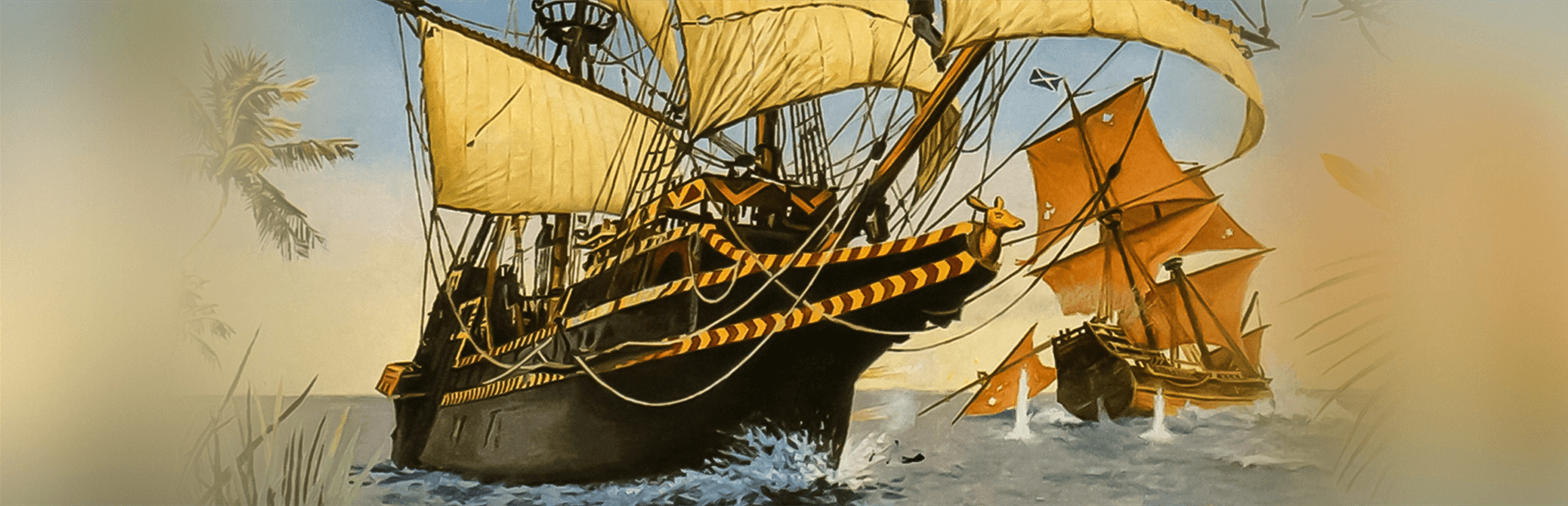

Playing Sid Meier's Pirates! begins with a quiz straight out of a printed manual before you ever weigh anchor. Once you verify the arrival time of a Spanish treasure fleet, the entire Caribbean opens up before your bow.
You start by picking a starting era like "The Silver Empire" or "War For Profit" along with a allegiance to England, France, Spain, or the Dutch Republic. You also choose a specific skill, such as fencing or navigation, to give your captain an edge. From that moment on, you steer a lone vessel across a top-down Caribbean map that spans from Bermuda down to the Spanish Main.
There is no fixed line of quests dictating your next turn. You can hunt down dynamic targets like famous evil pirates, search for buried hoards using map fragments, or try to rescue your missing family members. Alternatively, you can spend your time raiding ports and taking enemy merchant ships. Success is measured by how much wealth, land, and nobility you acquire before old age forces you to retire.
Navigating the open water requires real attention to geography and wind direction. Sailing east against the prevailing trade winds takes patience, as your ship crawls across the water. Spotting an enemy banner on the horizon instantly shifts the pace from careful navigation to quick tactical maneuvering.
When two ships meet, the view stays top-down for real-time naval combat. You turn your ship to line up cannon broadsides while watching your crew count and sail damage. Ramming the enemy ship transitions the game into a side-view fencing duel against the rival captain.
Duels give you a choice of three weapons: the quick rapier, the balanced longsword, or the heavy cutlass. You dodge, parry, and thrust using the numeric keypad. Winning a duel lets you take the enemy ship and loot its cargo without losing more men.
Defeat in combat does not mean a game over screen. Instead of dying, you are captured or marooned on a desolate island, losing years of game time and much of your gold. That kind of mercy was rare for an action game from 1987. However, time itself is your real enemy. As your character grows old, your fencing reaction speeds drop, making late-career duels noticeably harder.
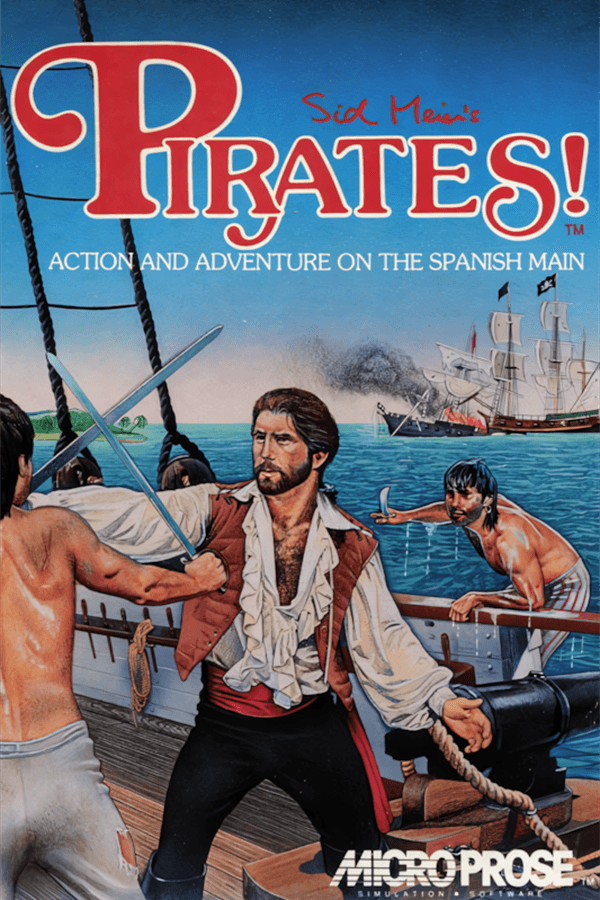
Designed primarily by Sid Meier with art by Michael Haire and music by Ken Lagace, the game pushed the limits of PC hardware. MicroProse co-founder Bill Stealey insisted on putting Meier's name on the box. The goal was to build prestige and signal a pivot away from the military flight simulators the studio was known for.
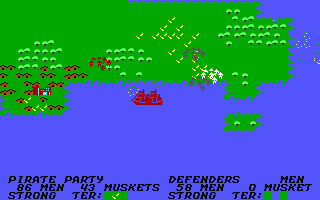
Fitting an entire interactive Caribbean onto a standard 360KB floppy disk required clever data compression and tile design. Players who ran the DOS version on basic hardware had to listen to PC speaker beeps during combat and contend with four-color CGA graphics mode. Despite the hardware limits, the title became a major success for its publisher.
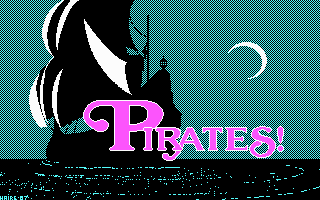
For all its flexibility, the game has clear rough spots that show up during longer play sessions. Sailing directly into the trade winds to reach eastern ports can feel like a crawl. Fencing with the numeric keypad can also feel clumsy if you are used to direct control remapping.
The copy protection is another hurdle that slows down the opening minutes. The game forces you to look up historic ship arrival dates in the manual before setting sail. Later in a long career, capturing towns and tracking down maps can also start to feel repetitive.
The core routines of sea combat, trading, and dueling still hold up well. Here are the core actions you balance during every voyage:
When you finally choose to end your career, the game calculates your total accomplishments. Your gold, land, titles, and rescued family members dictate your ultimate retirement score. You can end up as anything from a penniless beggar to a honored King's Advisor.
The constant tension between building your fortune and watching your captain age holds every run together. Even when an expedition ends in disaster, pulling off a comeback after being marooned makes for a great story. It is a sharp piece of design published by MicroProse.
You can play Sid Meier's Pirates! free in your browser right now with nothing to install. It only takes a minute to board your first vessel, pick a blade, and see if you can capture a Spanish galleon before your captain grows too old to fence.
Playing Sid Meier's Pirates! begins with a quiz straight out of a printed manual before you ever weigh anchor. Once you verify the arrival time of a Spanish treasure fleet, the entire Caribbean opens up before your bow.
You start by picking a starting era like "The Silver Empire" or "War For Profit" along with a allegiance to England, France, Spain, or the Dutch Republic. You also choose a specific skill, such as fencing or navigation, to give your captain an edge. From that moment on, you steer a lone vessel across a top-down Caribbean map that spans from Bermuda down to the Spanish Main.
There is no fixed line of quests dictating your next turn. You can hunt down dynamic targets like famous evil pirates, search for buried hoards using map fragments, or try to rescue your missing family members. Alternatively, you can spend your time raiding ports and taking enemy merchant ships. Success is measured by how much wealth, land, and nobility you acquire before old age forces you to retire.
Navigating the open water requires real attention to geography and wind direction. Sailing east against the prevailing trade winds takes patience, as your ship crawls across the water. Spotting an enemy banner on the horizon instantly shifts the pace from careful navigation to quick tactical maneuvering.
When two ships meet, the view stays top-down for real-time naval combat. You turn your ship to line up cannon broadsides while watching your crew count and sail damage. Ramming the enemy ship transitions the game into a side-view fencing duel against the rival captain.
Duels give you a choice of three weapons: the quick rapier, the balanced longsword, or the heavy cutlass. You dodge, parry, and thrust using the numeric keypad. Winning a duel lets you take the enemy ship and loot its cargo without losing more men.
Defeat in combat does not mean a game over screen. Instead of dying, you are captured or marooned on a desolate island, losing years of game time and much of your gold. That kind of mercy was rare for an action game from 1987. However, time itself is your real enemy. As your character grows old, your fencing reaction speeds drop, making late-career duels noticeably harder.

Designed primarily by Sid Meier with art by Michael Haire and music by Ken Lagace, the game pushed the limits of PC hardware. MicroProse co-founder Bill Stealey insisted on putting Meier's name on the box. The goal was to build prestige and signal a pivot away from the military flight simulators the studio was known for.
Fitting an entire interactive Caribbean onto a standard 360KB floppy disk required clever data compression and tile design. Players who ran the DOS version on basic hardware had to listen to PC speaker beeps during combat and contend with four-color CGA graphics mode. Despite the hardware limits, the title became a major success for its publisher.

For all its flexibility, the game has clear rough spots that show up during longer play sessions. Sailing directly into the trade winds to reach eastern ports can feel like a crawl. Fencing with the numeric keypad can also feel clumsy if you are used to direct control remapping.
The copy protection is another hurdle that slows down the opening minutes. The game forces you to look up historic ship arrival dates in the manual before setting sail. Later in a long career, capturing towns and tracking down maps can also start to feel repetitive.
The core routines of sea combat, trading, and dueling still hold up well. Here are the core actions you balance during every voyage:
When you finally choose to end your career, the game calculates your total accomplishments. Your gold, land, titles, and rescued family members dictate your ultimate retirement score. You can end up as anything from a penniless beggar to a honored King's Advisor.
The constant tension between building your fortune and watching your captain age holds every run together. Even when an expedition ends in disaster, pulling off a comeback after being marooned makes for a great story. It is a sharp piece of design published by MicroProse.
You can play Sid Meier's Pirates! free in your browser right now with nothing to install. It only takes a minute to board your first vessel, pick a blade, and see if you can capture a Spanish galleon before your captain grows too old to fence.
How Sid Meier's Pirates! is played — the keys the game listens to, grouped by what they do.
Highlighted keys are mapped — hover or tap one to see what it does.
Control configurations are loaded at startup with no SETUP.EXE remapping mentioned. Full key bindings for fencing and land combat sub-modes are incomplete in the available manual excerpts.
The on-screen keyboard and gamepad mapping the browser player uses on a phone, a tablet or a controller, as opposed to the real keys above. $PRO members make their own in the player and share them here; anyone can pick one to play with.
Cheat codes, console commands and memory pokes for Sid Meier's Pirates! — each one verified and attributed.
Sign in to submitaka Pirates! · Sid Meier's Pirates!: Action and Adventure on the Spanish Main · Xide Meier de Haidao
How Sid Meier's Pirates! is played — the keys the game listens to, grouped by what they do.
Highlighted keys are mapped — hover or tap one to see what it does.
Control configurations are loaded at startup with no SETUP.EXE remapping mentioned. Full key bindings for fencing and land combat sub-modes are incomplete in the available manual excerpts.
The on-screen keyboard and gamepad mapping the browser player uses on a phone, a tablet or a controller, as opposed to the real keys above. $PRO members make their own in the player and share them here; anyone can pick one to play with.
Cheat codes, console commands and memory pokes for Sid Meier's Pirates! — each one verified and attributed.
Sign in to submit