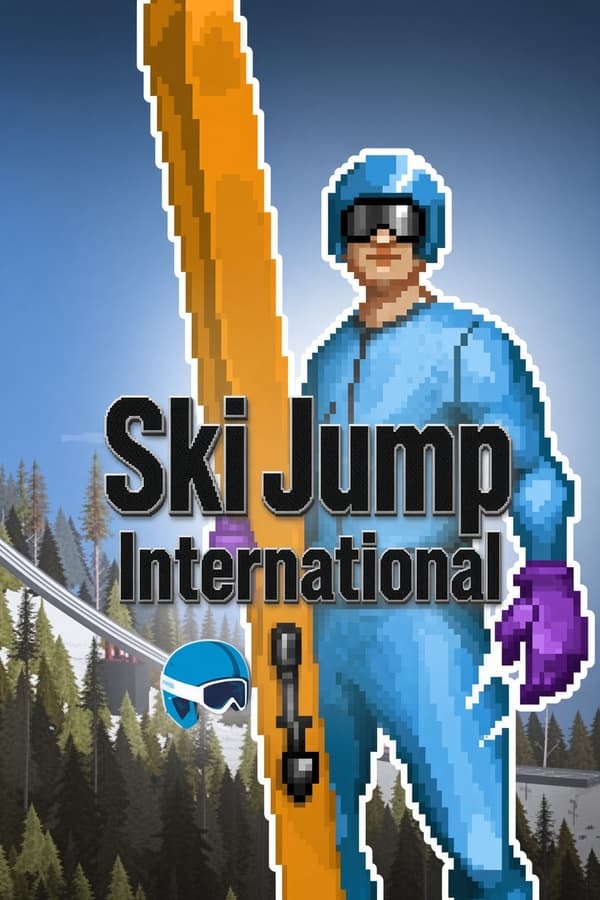
Ski Jump International
aka Lartzan Skijump · SJ3 · Ski Jump International v3
Rate this game
- Played
- A lot
Ski Jump International turned a minimalist side-view wireframe slope into one of the most agonizingly tight reflex games to ever grace an MS-DOS monitor.
Taking off in Ski Jump International takes brutal split-second precision
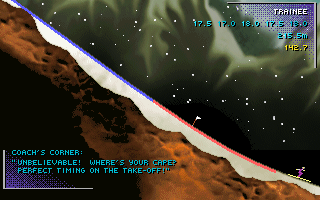
You start at the top of an icy ramp, leaning forward into the drop with nothing on screen except a bare stick-figure athlete and a simple gradient hill. As your speed builds down the track, your entire focus shifts to the lip of the jump. Press the takeoff key a millisecond too early and your jumper clears barely half the hill; hit it too late and you crash headlong into the snow before even taking flight.
Once you are airborne, the real work begins. You use the keyboard arrow keys to nudge the body angle forward or back, fighting wind meters to capture maximum lift without stalling into a tailspin. If you balance the flight angle correctly, you sail past the K-point marker for maximum distance. Throwing down a clean telemark landing requires centering your pitch just before impact, or the judges will gut your style points with agonizing scores.
Why a Finnish high school student built a better ski jump simulator
In the early nineties, Finnish teenager Ville Könönen grew tired of multi-sport titles like The Games: Winter Challenge, which treated ski jumping as an afterthought with floaty, unrealistic physics. He wanted a dedicated simulator that captured the precise aerodynamics and timing of real competitions. Working alongside graphics contributors Janne Heinonen and Mikko Aalto, he wrote the initial 1993 build for basic hardware, requiring just a 286 processor, 512 KB of RAM, and a standard VGA screen.
When the first version hit Finnish bulletin boards as freeware in 1994 under the local name Lartzan Skijump, it became an immediate hit in Finnish and Polish computer labs. The visual presentation was barebones, but that low footprint meant it could run quietly on school PCs without a dedicated sound card. Finnish tech magazine Mikrobiitti captured its weird charm perfectly at the time, calling it an astonishingly ugly game that somehow embedded incredible playability deep inside its simple code.
From single-hill jumps to World Cups and high-score wars
The original release focused on a single hill, but subsequent shareware releases expanded the scope dramatically. By the time version 3 arrived, players could compete across realistic venues modelled after the famous Four Hills Tournament, including Oberstdorf, Garmisch-Partenkirchen, Innsbruck, and Bischofshofen. The calculations converted distance directly into points based on real K-point distances, penalizing injuries and forcing athletes to miss consecutive rounds in longer tournaments.
Beyond single practice runs, the game expanded into multi-event structures:
- World Cup: A full 50-jumper field following standard qualification rules across original hills.
- King of the Hill: A high-stakes survival mode where the lowest scoring jumper gets eliminated after every round.
- Team Cup: A squad mode featuring four jumpers per national team.
- Custom World Cup: Player-curated tours featuring custom user-made hills and offline replay sharing.
The competitive scene surrounding the shareware releases grew so intense that players routinely traded replay files online to prove record distances. A security flaw in version 3.11 eventually allowed clever users to edit replay data for high-score tournaments, prompting Könönen to publish a emergency 3.12 update specifically to secure tournament integrity. He later released version 3 under the GPL open-source license in December 2013, opening up its custom hill construction tools to everyone.
Fine tuning mid-air tilt is where casual jumpers face-plant
The primary barrier in this sports title is its absolute refusal to offer forgiveness. Keyboard inputs require tiny, rhythmic taps rather than holding down directional arrows. Holding down an arrow key for even a fraction of a second too long tilts your jumper into an unrecoverable dive, sending them tumbling down the slope to zero points. For beginners, the early learning curve feels less like flying and more like an endless reel of violent crashes.
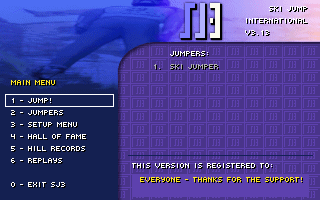
Sound design is practically non-existent, featuring little more than basic system audio ticks for landings and ramps. Yet as a pure test of motor control and timing, the core mechanics still hold up. It strips away cinematic fluff to focus entirely on the physical satisfaction of executing a flawless flight line.
Launch down the ramp right now
You do not need to hunt down ancient floppy images or fiddle with DOS emulators to test your reflexes on the slope. You can play Ski Jump International free in your browser right now, complete with instant keyboard response. Give Garmisch-Partenkirchen a try, tap the spacebar right at the lip of the hill, and see if you can land a clean telemark without face-planting into the snow.
How Ski Jump International is played — the keys the game listens to, grouped by what they do.
- Movement
- Action
- Interface
Highlighted keys are mapped — hover or tap one to see what it does.
Keys can be customized in the Setup menu.
Players' controls
Touch and gamepad controls
The on-screen keyboard and gamepad mapping the browser player uses on a phone, a tablet or a controller, as opposed to the real keys above. $PRO members make their own in the player and share them here; anyone can pick one to play with.
Make your own touch controlsPRO
- 1Open the editorSign in below, then pick what to make. The game starts with the editor open over it.
- 2Place your keysAdd keys and drag them where your thumbs rest, or map a controller's buttons. Test plays the game with them; Save keeps them, and you play with them from then on.
- 3Share themShare them right after saving in the game, or name and share them here. Players vote, and the best become this game's controls for everyone.
Go PROSee how it worksSign in+20 XP for sharing · +50 XP if yours become the game's own
- The game's own controlsKeyboardGamepadWhat every player starts with.In use
2 screenshots
From the archive
No gameplay video yet
No gameplay video for Ski Jump International yet. Sign in to add one.
No reviews yet
Tell the community what you think of Ski Jump International. Reviews are public and tied to your username.
No archived manuals for Ski Jump International yet
No manuals archived for this title yet. Sign in to upload the first scan.
Cheat codes, console commands and memory pokes for Ski Jump International — each one verified and attributed.
Sign in to submitNo cheats yet for this title
Know a working cheat, poke or trainer? Add it with the button above. Moderators check every entry before it goes live.
No archived soundtrack for Ski Jump International yet
No soundtrack archived for this title yet. Sign in to upload the first rip.
No save states for Ski Jump International yet
No save states for this title yet. Sign in to share one.
Discussions
Sign in to post- Threads0
- Total posts0
- Online now6
Community · Ski Jump International
Who's contributing, and what's new
- Reviews0
- Threads0
- Uploadsapproved0
- Contributors0
Recent activity
Nothing here yet
Reviews, discussion threads and approved uploads appear here as members add them.