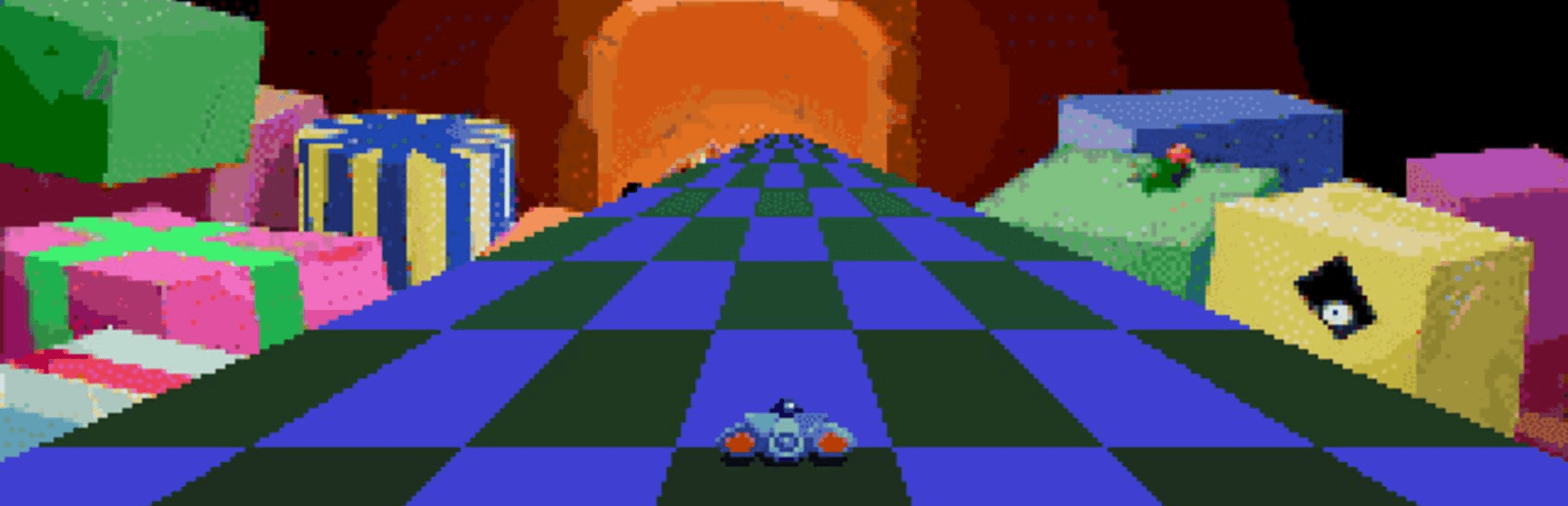

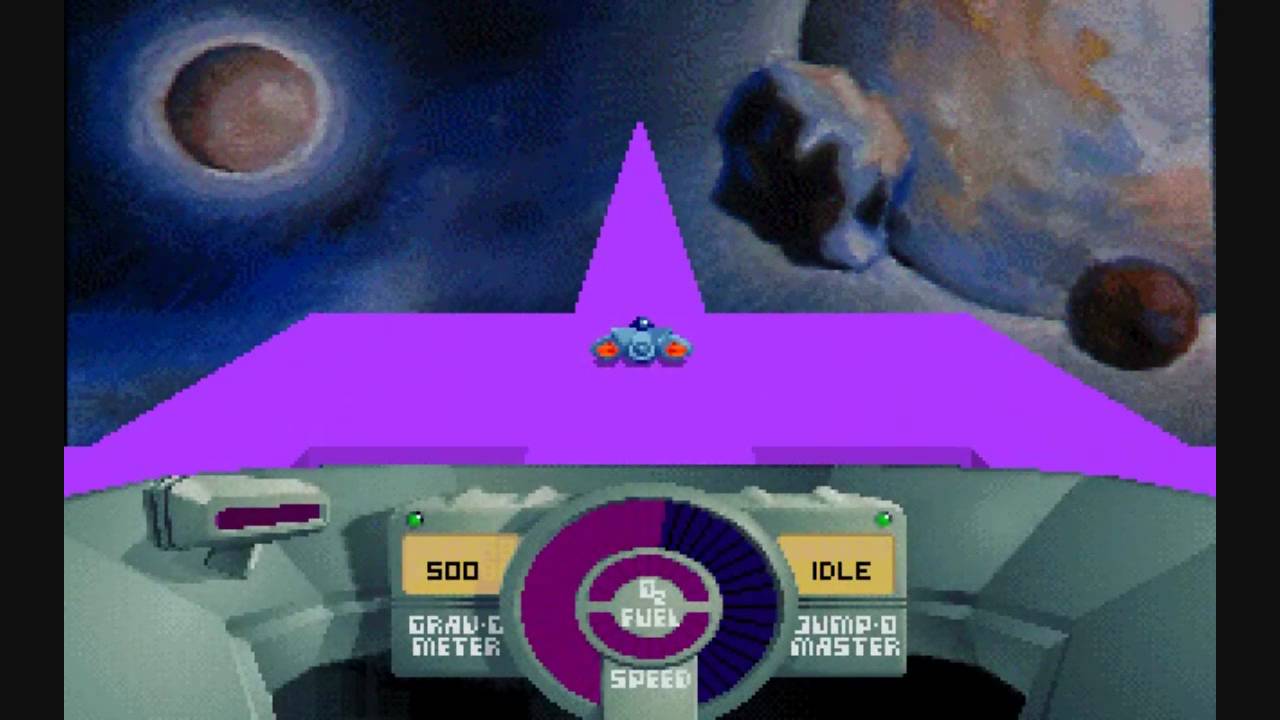
You line up your ship on a floating grey structure in deep space, tap the up arrow, and pray you clear the next void in SkyRoads before your oxygen runs out.
The first thing that hits you when starting this 1993 MS-DOS game is how fast it moves. Built by Estonian studio Bluemoon Software and published by Creative Dimensions, the game tosses you straight into a tiny ship skimming over tracks suspended against starry backdrops. You steer left or right across distinct lanes, punch the accelerator to clear massive pits, and slam the brake when a wall appears out of nowhere. There are no laser cannons, enemy craft, or hidden shortcuts here; the entire challenge comes down to reading the course and keeping your craft on the solid ground.
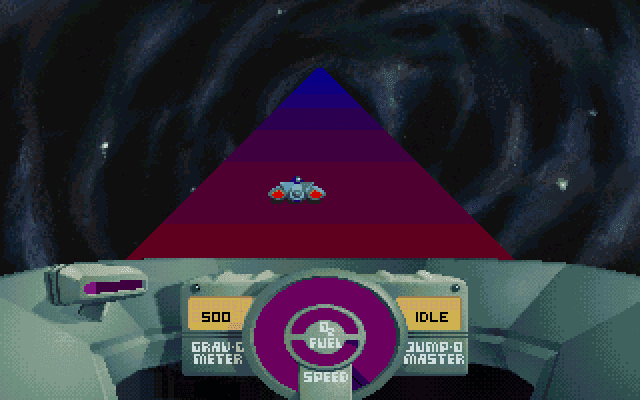
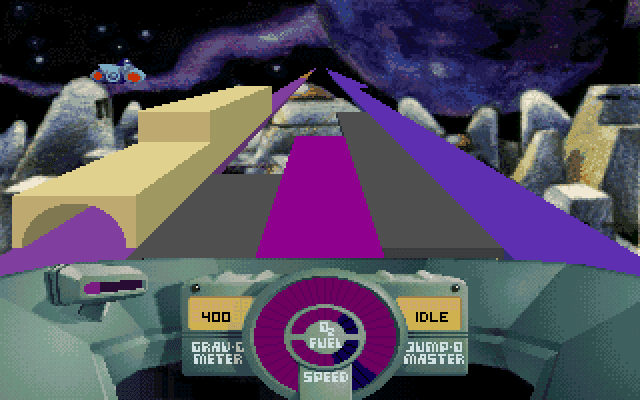
Every course consists of floating tiles, and learning their color coding is the only way to survive. Light green tiles give you a sudden boost of speed, while dark green ones feel like driving through thick mud and drag your speed down instantly. Dark grey tiles strip away your steering entirely, leaving you sliding helpless toward the edge if you enter them at the wrong angle. Light red tiles explode your vessel on contact, and blue tiles refill your precious oxygen and fuel meters. If either gauge hits zero, your run ends on the spot.
Gravity adds another layer of trouble to your jump timing. A grav-o-meter on the side of the cockpit dashboard tracks the local pull, ranging from a light 100 up to a crushing 1700. On low-gravity worlds, a single tap of the jump key floats your ship gracefully across massive gaps, giving you plenty of time to set up your landing. High-gravity stages yank you back down to Earth almost immediately, demanding pixel-perfect precision on every leap if you want to avoid slamming directly into the front face of an upper platform.
The campaign packs 30 levels split across 10 distinct celestial bodies, including regions like Red Heat, Into the Sun, Blue Planet, Satellite, and Misty. Early tracks feel forgiving enough, offering wide roads and generous supplies of fuel, but the difficulty curve turns steep very quickly. Later levels demand near-flawless memorization rather than pure instinct. You will hit a light red tile concealed behind an obstacle, plunge through an unseen gap, or misjudge a leap on high-gravity terrain and watch your ship vaporize into tiny fragments.
When you fail, there are no checkpoints to save you. Crashing or running out of supplies sends you straight back to the level select menu, forcing a total reset of that track. It relies heavily on brutal old-school trial and error, where you slowly map out a route across dozens of failed attempts. I spent hours cursing specific jumps on late stages, only to restart immediately because the snappy restarts make it far too easy to say "just one more try."
The developers were well aware of how mean their layout design could be. In the official documentation provided with the game, they included a blunt note for angry players: "There IS a solution for every stage! There are NO bugs!". It was their cheeky way of telling us that whenever a jump felt physically impossible, our timing was simply off.
The game came together in just three months. Programmers Ahti Heinla, Priit Kasesalu, and Jaan Tallinn built it as an overhaul of their 1990 title Kosmonaut. To keep frame rates smooth on early 386 computers, the team combined simple 2D sprite art for the ship dashboard and space backdrops with custom 3D math routines to draw the track platforms. The result was a clean perspective that felt fast and responsive on older PCs.
Sound design was another area where it punched well above its weight. Composers Ott Aaloe and Hasso Brück originally wrote the soundtrack as Amiga MOD files before converting them into punchy AdLib and Sound Blaster tunes. Hearing those bouncy synth tracks blare through an expansion card was a huge step up from the squeaky PC speaker mode, giving the space-faring action a energetic rhythm that stuck in your head long after you turned off the computer.
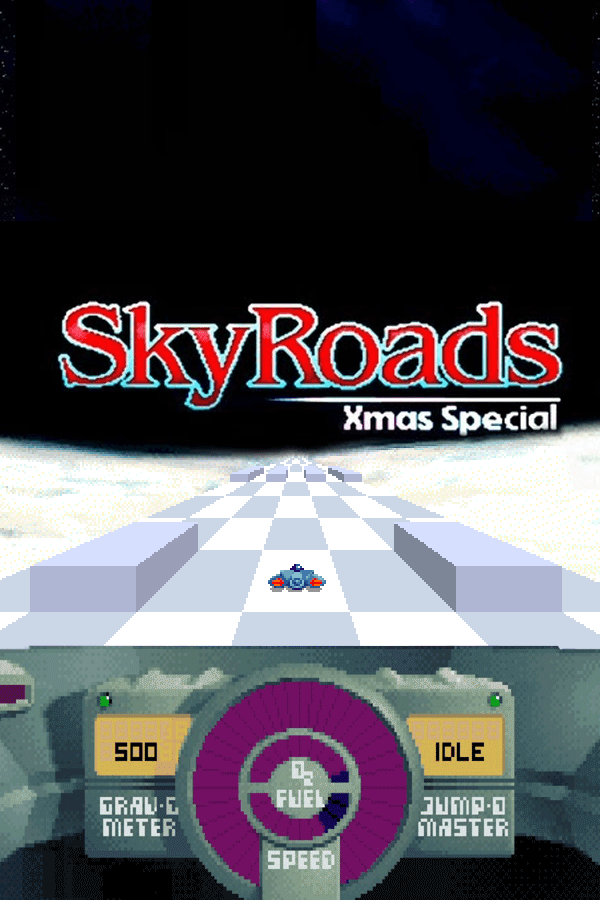
The studio behind it has a fascinating history that goes well beyond early PC software. Years after releasing this title and its harder 1994 holiday follow-up, SkyRoads: Xmas Special, key members of the team used their software expertise to help build file-sharing tool Kazaa and online communications giant Skype. It is wild to think that the same group who built one of the most frustrating space platformers on DOS eventually transformed how the world chatted online.
Looking back at the crowded market of 1993 games, few arcade titles managed to combine such simple mechanics with such addictive pacing. Many releases from that year leaned heavily on complex menus, but this one stuck to pure muscle memory. It feels much like a predecessor to modern mobile platformers: you pick a track, try to survive for forty seconds, crash, and hit retry. The absence of combat keeps the focus entirely on movement and route planning.
That is not to say the game is immune to criticism. The late-game difficulty spikes feel genuinely maddening, and some jumps force you to blind-leap onto platforms you cannot see until it is too late to adjust your speed. The sheer reliance on layout memorization can turn off anyone who hates repeating the exact same sequence ten times in a row. Yet when you finally nail a difficult track without touching a single burning tile, the sense of relief is unbeatable.
The developers later released the complete title as freeware on their official site, so anyone looking for a tight, reflex-driven challenge can grab it without fuss. If you enjoy precision platforming or want a fast obstacle course among classic racing and driving games, give it a run.
You can play SkyRoads free in your browser right now, with zero installation required. Load up the original classic SkyRoads MS-DOS game, pick your first world, and see how long your fuel lasts when you take on the tracks today. If you want to play SkyRoads online, just fire it up and test your reflexes on the floating platforms.
You line up your ship on a floating grey structure in deep space, tap the up arrow, and pray you clear the next void in SkyRoads before your oxygen runs out.
The first thing that hits you when starting this 1993 MS-DOS game is how fast it moves. Built by Estonian studio Bluemoon Software and published by Creative Dimensions, the game tosses you straight into a tiny ship skimming over tracks suspended against starry backdrops. You steer left or right across distinct lanes, punch the accelerator to clear massive pits, and slam the brake when a wall appears out of nowhere. There are no laser cannons, enemy craft, or hidden shortcuts here; the entire challenge comes down to reading the course and keeping your craft on the solid ground.
Every course consists of floating tiles, and learning their color coding is the only way to survive. Light green tiles give you a sudden boost of speed, while dark green ones feel like driving through thick mud and drag your speed down instantly. Dark grey tiles strip away your steering entirely, leaving you sliding helpless toward the edge if you enter them at the wrong angle. Light red tiles explode your vessel on contact, and blue tiles refill your precious oxygen and fuel meters. If either gauge hits zero, your run ends on the spot.
Gravity adds another layer of trouble to your jump timing. A grav-o-meter on the side of the cockpit dashboard tracks the local pull, ranging from a light 100 up to a crushing 1700. On low-gravity worlds, a single tap of the jump key floats your ship gracefully across massive gaps, giving you plenty of time to set up your landing. High-gravity stages yank you back down to Earth almost immediately, demanding pixel-perfect precision on every leap if you want to avoid slamming directly into the front face of an upper platform.
The campaign packs 30 levels split across 10 distinct celestial bodies, including regions like Red Heat, Into the Sun, Blue Planet, Satellite, and Misty. Early tracks feel forgiving enough, offering wide roads and generous supplies of fuel, but the difficulty curve turns steep very quickly. Later levels demand near-flawless memorization rather than pure instinct. You will hit a light red tile concealed behind an obstacle, plunge through an unseen gap, or misjudge a leap on high-gravity terrain and watch your ship vaporize into tiny fragments.
When you fail, there are no checkpoints to save you. Crashing or running out of supplies sends you straight back to the level select menu, forcing a total reset of that track. It relies heavily on brutal old-school trial and error, where you slowly map out a route across dozens of failed attempts. I spent hours cursing specific jumps on late stages, only to restart immediately because the snappy restarts make it far too easy to say "just one more try."
The developers were well aware of how mean their layout design could be. In the official documentation provided with the game, they included a blunt note for angry players: "There IS a solution for every stage! There are NO bugs!". It was their cheeky way of telling us that whenever a jump felt physically impossible, our timing was simply off.
The game came together in just three months. Programmers Ahti Heinla, Priit Kasesalu, and Jaan Tallinn built it as an overhaul of their 1990 title Kosmonaut. To keep frame rates smooth on early 386 computers, the team combined simple 2D sprite art for the ship dashboard and space backdrops with custom 3D math routines to draw the track platforms. The result was a clean perspective that felt fast and responsive on older PCs.
Sound design was another area where it punched well above its weight. Composers Ott Aaloe and Hasso Brück originally wrote the soundtrack as Amiga MOD files before converting them into punchy AdLib and Sound Blaster tunes. Hearing those bouncy synth tracks blare through an expansion card was a huge step up from the squeaky PC speaker mode, giving the space-faring action a energetic rhythm that stuck in your head long after you turned off the computer.
The studio behind it has a fascinating history that goes well beyond early PC software. Years after releasing this title and its harder 1994 holiday follow-up, SkyRoads: Xmas Special, key members of the team used their software expertise to help build file-sharing tool Kazaa and online communications giant Skype. It is wild to think that the same group who built one of the most frustrating space platformers on DOS eventually transformed how the world chatted online.
Looking back at the crowded market of 1993 games, few arcade titles managed to combine such simple mechanics with such addictive pacing. Many releases from that year leaned heavily on complex menus, but this one stuck to pure muscle memory. It feels much like a predecessor to modern mobile platformers: you pick a track, try to survive for forty seconds, crash, and hit retry. The absence of combat keeps the focus entirely on movement and route planning.
That is not to say the game is immune to criticism. The late-game difficulty spikes feel genuinely maddening, and some jumps force you to blind-leap onto platforms you cannot see until it is too late to adjust your speed. The sheer reliance on layout memorization can turn off anyone who hates repeating the exact same sequence ten times in a row. Yet when you finally nail a difficult track without touching a single burning tile, the sense of relief is unbeatable.
The developers later released the complete title as freeware on their official site, so anyone looking for a tight, reflex-driven challenge can grab it without fuss. If you enjoy precision platforming or want a fast obstacle course among classic racing and driving games, give it a run.
You can play SkyRoads free in your browser right now, with zero installation required. Load up the original classic SkyRoads MS-DOS game, pick your first world, and see how long your fuel lasts when you take on the tracks today. If you want to play SkyRoads online, just fire it up and test your reflexes on the floating platforms.
How SkyRoads is played — the keys the game listens to, grouped by what they do.
Highlighted keys are mapped — hover or tap one to see what it does.
The on-screen keyboard and gamepad mapping the browser player uses on a phone, a tablet or a controller, as opposed to the real keys above. $PRO members make their own in the player and share them here; anyone can pick one to play with.
Cheat codes, console commands and memory pokes for SkyRoads — each one verified and attributed.
Sign in to submitHow SkyRoads is played — the keys the game listens to, grouped by what they do.
Highlighted keys are mapped — hover or tap one to see what it does.
The on-screen keyboard and gamepad mapping the browser player uses on a phone, a tablet or a controller, as opposed to the real keys above. $PRO members make their own in the player and share them here; anyone can pick one to play with.
Cheat codes, console commands and memory pokes for SkyRoads — each one verified and attributed.
Sign in to submit