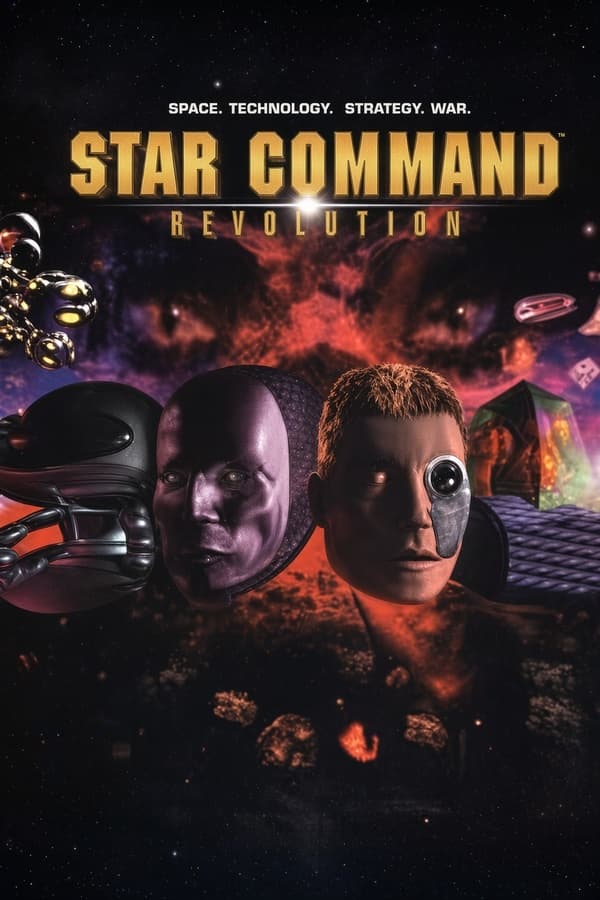
In Star Command: Revolution, losing your base is not a setback; it is an immediate game over screen because your base is an irreplaceable hijacked Mothership that must personally lead every jump across a non-linear galaxy.
Most real-time strategy games in the late nineties had you build a main hall, park it in a safe corner, and pump out units while hiding behind static walls. Metropolis Digital flipped that structure completely in 1997. Your central hub in Star Command: Revolution is a single flagship stolen from Warlord Narvek, and it does everything: mines resources, builds structures, researches tech upgrades, and jumps between sectors across a thirty-to-forty-stage star map. If it blows up, your campaign ends right there on the spot.
That design choice turns every resource run into a nerve-wracking escort mission. Instead of expanding outward from a secure home sector, your Mothership acts as a mobile factory operating directly on the front lines. To learn new ship designs or tech upgrades, you cannot just click a menu and wait on a timer; you have to pilot this massive, vulnerable hull right next to specialized enemy structures known as Universities - such as Academies or Eduplexes - and hold position while downloading data. Building units adjacent to these structures even ranks them up to level four experience right out of the gate.
The economy relies heavily on Solinite as a baseline energy source, but each of the four playable factions - Terrans, Computrons, Nomads, and Triumverites - requires secondary materials ranging from plasma and asteroids to anomalies and crystals. Because harvesting requires shuttles and droids tethered directly to your Mothership, denying your opponent access to a single resource node completely breaks their production tree. It creates a volatile cat-and-mouse game where dynamic tactical skirmishes replace static base building.
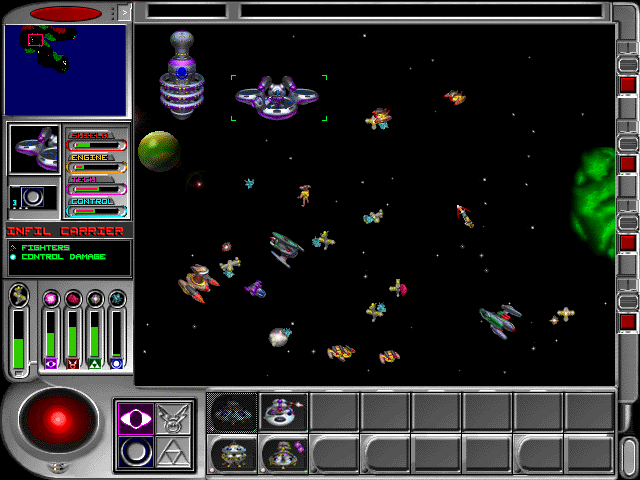
While the high-concept fleet management sounds brilliant on paper, the moment-to-moment combat often collapses under interface friction and cramped level design. The game uses a diagonal-down isometric view, but the actual battlefields frequently resemble enclosed cave systems rather than deep space. Navigating large strike forces through narrow asteroid corridors creates severe pathfinding traffic jams, leaving your fragile shuttles exposed while capital ships struggle to turn around.
The game also suffers from a notoriously steep onboarding curve. The tutorial sector, "Star Command HQ", drops you into complex multi-resource management with almost no visual feedback, leaving anyone who skipped the physical manual thoroughly lost. To add to the frustration, the original MS-DOS game required players to look up manual codes just to save campaign progress. Toss in a user interface that feels clunky compared to its contemporaries, and it becomes obvious why many strategy fans bounced off it early on.
Combat tactics do feature clever mechanics if you can get past the interface hurdles. Take the Terran Switcher ship: it can instantly swap places with an established missile base, allowing you to teleport heavy firepower across physical walls or pull a damaged unit out of a crossfire. Defeating Narvek's four roaming Dreadnaughts across the sector map also rewards your fleet with permanent operational perks, including automatic Mothership hull regeneration.
Metropolis Digital packed fun visual easter eggs into the engine that fans passed around online forums for years. If you wait for the end credits to roll and type specific key combos, you can transform the default Mothership into other faction models, complete with unique audio prompts:
F1 F1 F1 F10: Changes your hull to the Computron Mothership skin.F3 F2 F3 F10: Switches to the Nomad Mothership design.F2 F3 F3 F10: Applies the Triumverite Mothership visual.F4 F4 F1 F10: Unlocks a hidden skin that replaces the resource bay icon with a smiling face during harvesting runs.When publisher GT Interactive released the title in 1997, it had the misfortune of landing right before giant blockbusters redefined sci-fi real-time strategy. Metropolis Digital later released an updated Windows version called Star Command Deluxe in 1998. While the credits tease for a direct sequel titled Star Command X: Armada never materialized into a real strategy follow-up, the studio reused many of its assets, music tracks, and sound effects for their 1999 Dreamcast game Armada.
If you enjoy strategy / tactics games with unconventional mechanics, this title is well worth exploring for its aggressive mobile-base dynamic. The graphics have that distinct mid-nineties pre-rendered visual style, and managing a single flagship while conquering sectors provides a refreshing alternative to traditional base builders.
You can play Star Command: Revolution online free in your browser right here, without setting up old hardware or installing anything. Jump into the first sector, pilot your Mothership close to an enemy Eduplex to hijack their tech tree, and see how long your mobile headquarters survives against Narvek's fleet.
In Star Command: Revolution, losing your base is not a setback; it is an immediate game over screen because your base is an irreplaceable hijacked Mothership that must personally lead every jump across a non-linear galaxy.
Most real-time strategy games in the late nineties had you build a main hall, park it in a safe corner, and pump out units while hiding behind static walls. Metropolis Digital flipped that structure completely in 1997. Your central hub in Star Command: Revolution is a single flagship stolen from Warlord Narvek, and it does everything: mines resources, builds structures, researches tech upgrades, and jumps between sectors across a thirty-to-forty-stage star map. If it blows up, your campaign ends right there on the spot.
That design choice turns every resource run into a nerve-wracking escort mission. Instead of expanding outward from a secure home sector, your Mothership acts as a mobile factory operating directly on the front lines. To learn new ship designs or tech upgrades, you cannot just click a menu and wait on a timer; you have to pilot this massive, vulnerable hull right next to specialized enemy structures known as Universities - such as Academies or Eduplexes - and hold position while downloading data. Building units adjacent to these structures even ranks them up to level four experience right out of the gate.
The economy relies heavily on Solinite as a baseline energy source, but each of the four playable factions - Terrans, Computrons, Nomads, and Triumverites - requires secondary materials ranging from plasma and asteroids to anomalies and crystals. Because harvesting requires shuttles and droids tethered directly to your Mothership, denying your opponent access to a single resource node completely breaks their production tree. It creates a volatile cat-and-mouse game where dynamic tactical skirmishes replace static base building.

While the high-concept fleet management sounds brilliant on paper, the moment-to-moment combat often collapses under interface friction and cramped level design. The game uses a diagonal-down isometric view, but the actual battlefields frequently resemble enclosed cave systems rather than deep space. Navigating large strike forces through narrow asteroid corridors creates severe pathfinding traffic jams, leaving your fragile shuttles exposed while capital ships struggle to turn around.
The game also suffers from a notoriously steep onboarding curve. The tutorial sector, "Star Command HQ", drops you into complex multi-resource management with almost no visual feedback, leaving anyone who skipped the physical manual thoroughly lost. To add to the frustration, the original MS-DOS game required players to look up manual codes just to save campaign progress. Toss in a user interface that feels clunky compared to its contemporaries, and it becomes obvious why many strategy fans bounced off it early on.
Combat tactics do feature clever mechanics if you can get past the interface hurdles. Take the Terran Switcher ship: it can instantly swap places with an established missile base, allowing you to teleport heavy firepower across physical walls or pull a damaged unit out of a crossfire. Defeating Narvek's four roaming Dreadnaughts across the sector map also rewards your fleet with permanent operational perks, including automatic Mothership hull regeneration.

Metropolis Digital packed fun visual easter eggs into the engine that fans passed around online forums for years. If you wait for the end credits to roll and type specific key combos, you can transform the default Mothership into other faction models, complete with unique audio prompts:
F1 F1 F1 F10: Changes your hull to the Computron Mothership skin.F3 F2 F3 F10: Switches to the Nomad Mothership design.F2 F3 F3 F10: Applies the Triumverite Mothership visual.F4 F4 F1 F10: Unlocks a hidden skin that replaces the resource bay icon with a smiling face during harvesting runs.When publisher GT Interactive released the title in 1997, it had the misfortune of landing right before giant blockbusters redefined sci-fi real-time strategy. Metropolis Digital later released an updated Windows version called Star Command Deluxe in 1998. While the credits tease for a direct sequel titled Star Command X: Armada never materialized into a real strategy follow-up, the studio reused many of its assets, music tracks, and sound effects for their 1999 Dreamcast game Armada.
If you enjoy strategy / tactics games with unconventional mechanics, this title is well worth exploring for its aggressive mobile-base dynamic. The graphics have that distinct mid-nineties pre-rendered visual style, and managing a single flagship while conquering sectors provides a refreshing alternative to traditional base builders.
You can play Star Command: Revolution online free in your browser right here, without setting up old hardware or installing anything. Jump into the first sector, pilot your Mothership close to an enemy Eduplex to hijack their tech tree, and see how long your mobile headquarters survives against Narvek's fleet.
How Star Command: Revolution is played — the keys the game listens to, grouped by what they do.
Highlighted keys are mapped — hover or tap one to see what it does.
Star Command: Revolution is primarily controlled via a mouse-driven interface. Typing is used for player names and real-time chat messages during multiplayer lobby screens.
The on-screen keyboard and gamepad mapping the browser player uses on a phone, a tablet or a controller, as opposed to the real keys above. $PRO members make their own in the player and share them here; anyone can pick one to play with.
Cheat codes, console commands and memory pokes for Star Command: Revolution — each one verified and attributed.
Sign in to submitaka Star Command Deluxe
How Star Command: Revolution is played — the keys the game listens to, grouped by what they do.
Highlighted keys are mapped — hover or tap one to see what it does.
Star Command: Revolution is primarily controlled via a mouse-driven interface. Typing is used for player names and real-time chat messages during multiplayer lobby screens.
The on-screen keyboard and gamepad mapping the browser player uses on a phone, a tablet or a controller, as opposed to the real keys above. $PRO members make their own in the player and share them here; anyone can pick one to play with.
Cheat codes, console commands and memory pokes for Star Command: Revolution — each one verified and attributed.
Sign in to submit