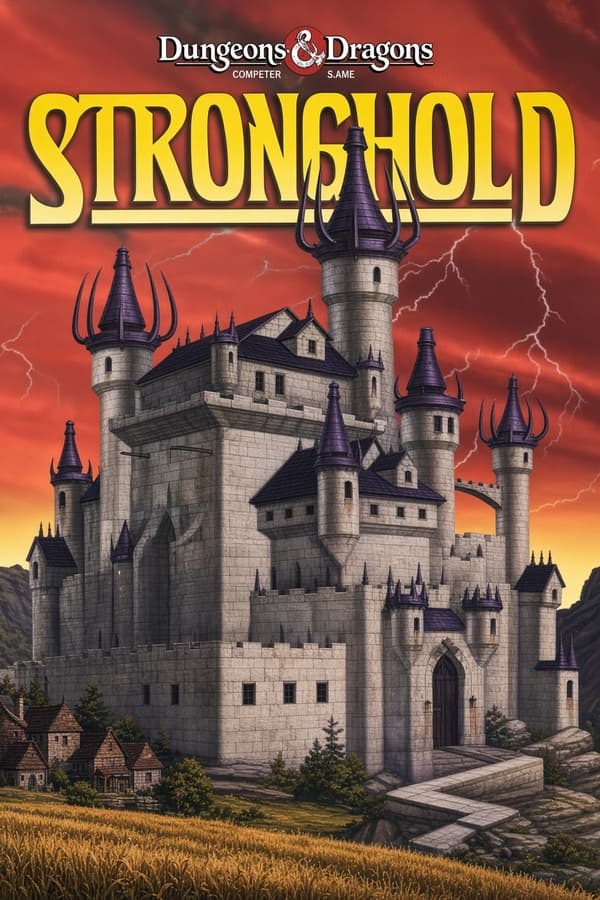
aka D&D Stronghold: Kingdom Simulator · Stronghold: Kingdom Simulator · Stronghold: Kōtei no Yōsai
Building a castle in Stronghold goes beyond placing walls: you are giving high-level D&D heroes a place to settle down and manage a kingdom before the local monster population tears it to pieces.
Most AD&D adaptations in the early nineties sent you down dark corridors in first-person view, but director Don Daglow took a different path with Stormfront Studios. Instead of another dungeon crawl, Stronghold focuses on the high-level tabletop rulebooks where retired level-10 heroes build keeps and handle domain politics. Strategic Simulations, Inc. published this strategy hybrid right at the end of their exclusive TSR licensing deal, turning domain management into a real-time simulation.
You start on a 3D wireframe terrain map made of triangular tiles that divide the land into plains, hills, and mountains. Your main task is to layout specialized neighborhoods tailored to different character classes. Fighters need training grounds, Mages require magic schools, and Thieves demand markets. As your population grows, your citizens gain levels, equip tier-based gear produced by your shops, and join the workforce to farm, mine, or clear out hostile monsters invading your borders.
Up to four named vassals settle the surrounding areas with their own keeps, leaving you to balance resources while keeping everybody alive. The visual style uses a high-angled perspective, giving you a top-down view of your sprawling medieval settlement as it expands tile by tile across the countryside.
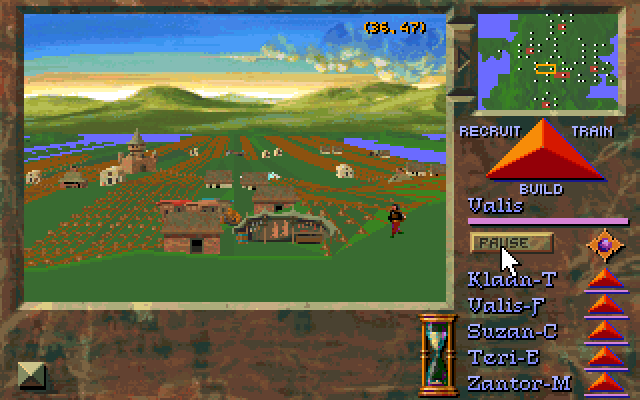
Unlike standard city builders, your end goal changes depending on the ethical alignment you pick at the start of a map. Lawful players must earn the title of Emperor through civic expansion and economic management. Chaotic leaders are tasked with total destruction, requiring you to wipe out every enemy base on the board. Neutral rulers have to achieve both feats before claiming victory.
Your main threat across these campaigns is an enemy force led by the evil Mindark. To beat him, you deploy your leveled units across the overland map to secure mines and clear monster dens. The trouble is that you lack direct control over individual troops on the field. You set priorities and assign units to tasks, but you cannot select a soldier and micro-manage their movement during a skirmish.
The vision behind the game was ambitious, but the actual execution hits a few serious hitches. Early on, the game moves at a slow pace while you wait for your first basic structures to generate resources. White Wolf magazine highlighted this downtime in a 1994 review, calling it a long game that can grow tedious during the years before major combat starts. German publications like PC Joker rated the game at 87%, praising the concept while admitting the early hours drag.
The interface brings its own share of headaches. You cannot stack units, mass-unassign workers from jobs, or command individual fighters directly. The digitized sound effects also hit a wall early on, as the audio loop of busy townspeople repeating through your Sound Blaster gets grating after twenty minutes of construction. Computer Gaming World noted back in 1993 that once you figure out unit strengths, the game loses much of its late-game challenge.
Despite those quirks, the title occupies a unique space in the 1993 MS-DOS catalog. It was later ported to Japanese systems like the FM Towns and PC-98, though it remained a bit of a commercial flop in Western markets. It bears no relationship to the later 2001 castle sim series by Firefly Studios, remaining a standalone experiment in tabletop domain management.
Programmer Cathryn Mataga and artist David Bunnett created a mechanics-heavy hybrid that rewards players who like tinkering with economic spreadsheets and city layouts. If you enjoy games where high-level planning matters more than fast reaction times, managing these fantasy fiefdoms still delivers a satisfying puzzle.
You can run this MS-DOS game standard in your web browser right now without downloading extra tools. It handles the original tile rendering directly in your browser tab, letting you test your domain strategy within seconds.
Once you jump into the match, start by setting up basic farms and fighter quarters right away. Managing worker assignments without direct controls takes a few minutes to get used to, but building up your first high-level stronghold remains satisfying once the resource chain gets moving.
Building a castle in Stronghold goes beyond placing walls: you are giving high-level D&D heroes a place to settle down and manage a kingdom before the local monster population tears it to pieces.
Most AD&D adaptations in the early nineties sent you down dark corridors in first-person view, but director Don Daglow took a different path with Stormfront Studios. Instead of another dungeon crawl, Stronghold focuses on the high-level tabletop rulebooks where retired level-10 heroes build keeps and handle domain politics. Strategic Simulations, Inc. published this strategy hybrid right at the end of their exclusive TSR licensing deal, turning domain management into a real-time simulation.
You start on a 3D wireframe terrain map made of triangular tiles that divide the land into plains, hills, and mountains. Your main task is to layout specialized neighborhoods tailored to different character classes. Fighters need training grounds, Mages require magic schools, and Thieves demand markets. As your population grows, your citizens gain levels, equip tier-based gear produced by your shops, and join the workforce to farm, mine, or clear out hostile monsters invading your borders.
Up to four named vassals settle the surrounding areas with their own keeps, leaving you to balance resources while keeping everybody alive. The visual style uses a high-angled perspective, giving you a top-down view of your sprawling medieval settlement as it expands tile by tile across the countryside.

Unlike standard city builders, your end goal changes depending on the ethical alignment you pick at the start of a map. Lawful players must earn the title of Emperor through civic expansion and economic management. Chaotic leaders are tasked with total destruction, requiring you to wipe out every enemy base on the board. Neutral rulers have to achieve both feats before claiming victory.
Your main threat across these campaigns is an enemy force led by the evil Mindark. To beat him, you deploy your leveled units across the overland map to secure mines and clear monster dens. The trouble is that you lack direct control over individual troops on the field. You set priorities and assign units to tasks, but you cannot select a soldier and micro-manage their movement during a skirmish.
The vision behind the game was ambitious, but the actual execution hits a few serious hitches. Early on, the game moves at a slow pace while you wait for your first basic structures to generate resources. White Wolf magazine highlighted this downtime in a 1994 review, calling it a long game that can grow tedious during the years before major combat starts. German publications like PC Joker rated the game at 87%, praising the concept while admitting the early hours drag.
The interface brings its own share of headaches. You cannot stack units, mass-unassign workers from jobs, or command individual fighters directly. The digitized sound effects also hit a wall early on, as the audio loop of busy townspeople repeating through your Sound Blaster gets grating after twenty minutes of construction. Computer Gaming World noted back in 1993 that once you figure out unit strengths, the game loses much of its late-game challenge.

Despite those quirks, the title occupies a unique space in the 1993 MS-DOS catalog. It was later ported to Japanese systems like the FM Towns and PC-98, though it remained a bit of a commercial flop in Western markets. It bears no relationship to the later 2001 castle sim series by Firefly Studios, remaining a standalone experiment in tabletop domain management.
Programmer Cathryn Mataga and artist David Bunnett created a mechanics-heavy hybrid that rewards players who like tinkering with economic spreadsheets and city layouts. If you enjoy games where high-level planning matters more than fast reaction times, managing these fantasy fiefdoms still delivers a satisfying puzzle.
You can run this MS-DOS game standard in your web browser right now without downloading extra tools. It handles the original tile rendering directly in your browser tab, letting you test your domain strategy within seconds.
Once you jump into the match, start by setting up basic farms and fighter quarters right away. Managing worker assignments without direct controls takes a few minutes to get used to, but building up your first high-level stronghold remains satisfying once the resource chain gets moving.
How Stronghold is played — the keys the game listens to, grouped by what they do.
Highlighted keys are mapped — hover or tap one to see what it does.
A mouse is required to play Stronghold. Keyboard controls complement mouse usage for map navigation and pyramid shortcuts.
The on-screen keyboard and gamepad mapping the browser player uses on a phone, a tablet or a controller, as opposed to the real keys above. $PRO members make their own in the player and share them here; anyone can pick one to play with.
Cheat codes, console commands and memory pokes for Stronghold — each one verified and attributed.
Sign in to submitHow Stronghold is played — the keys the game listens to, grouped by what they do.
Highlighted keys are mapped — hover or tap one to see what it does.
A mouse is required to play Stronghold. Keyboard controls complement mouse usage for map navigation and pyramid shortcuts.
The on-screen keyboard and gamepad mapping the browser player uses on a phone, a tablet or a controller, as opposed to the real keys above. $PRO members make their own in the player and share them here; anyone can pick one to play with.
Cheat codes, console commands and memory pokes for Stronghold — each one verified and attributed.
Sign in to submit