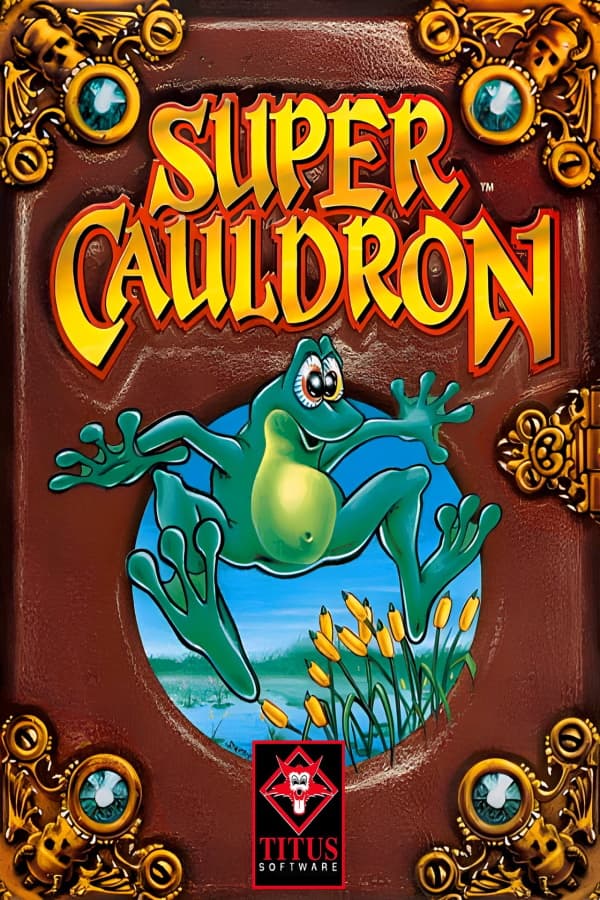

Super Cauldron puts you in control of Zmira, a surprisingly square-jawed young witch hopping across platforms and lobbing rocks at persistent bats while searching for lost spell ingredients. It looks like a friendly mascot platformer, but behind the bright pixel art lies a notoriously stubborn exercise in early nineties computer gaming precision.
Boot up the 1992 MS-DOS release and the first thing you notice is how floating and twitchy Zmira feels to move. Designed by Vincent Berthelot, the game sends you through four distinct worlds (a forest, a plain, a village, and a dark cathedral leading to the sorcerer Marl's castle) that are each broken into compact level sections. Your starting attack is a weak thrown stone with an awkward arc, which makes early enemy encounters much tense than they look. Bats, trolls, snakes, and vultures do not just float in simple patterns, because once they acquire you, they will follow you clear across the screen boundary into the next area.
Progression through each section relies on hunting down specific enemies carrying keys required to unlock the exit door. You end up constantly managing screen space, baiting aggressive trolls off high ledges so you can slip past without taking damage. A broomstick power-up occasionally grants temporary flight to reach high ledges or secret rooms, but normal movement demands absolute precision. Miss a jump over a pit by two pixels and you are back to the start of the section, often with half your health bar drained by a persistent vulture that refused to give up the chase.
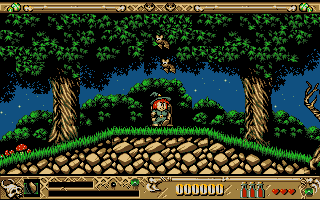
What sets the game apart from basic run and jump titles is its magical arsenal. Beyond your default pebble throw, you can discover and cast up to 12 distinct spells by hitting function keys or selection commands. Some spells serve as heavy offensive upgrades like fire bolts and lightning, while utility magic lets you melt metal barriers or build invisible staircases and bridges over bottomless gaps. This spell system turns later levels into light puzzles, requiring you to conserve your casting power for the exact obstacle blocking your path.
Environmental tricks keep you on your toes, though not always fairly. Water hazards present one of the oddest design choices: certain pools of water kill Zmira instantly on contact, while other identical pools act as secret passages leading to hidden item caches. The game offers no visual clue to distinguish a deadly drop from a secret room, meaning player progress often relies on brute force trial and error. The physical manual brought its own quirks to the original release, famously instructing players to press F11 and F12 on Amiga keyboards, despite standard Amiga hardware only featuring function keys up to F10.
Development began around 1990 under French studio Titus France SA, taking roughly two years to reach store shelves. When Titus released the title for MS-DOS, Atari ST, Amiga, and Amstrad CPC, critical reception split wildly down the middle. European magazines gave vastly different verdicts. Amstrad Action awarded it a massive 96% score in issue 93, while CU Amiga slammed it with a 27% score in July 1993, with reviewer John Mather calling the gameplay "dull and tedious." Amiga Power went even lower with 26%, whereas Amiga Computing gave it a warm 80% and Amiga Format settled on 70%.
Much of the praise went to the technical polish on home computers. The Amstrad CPC version, programmed by Elmar Krieger (who also worked on Prehistorik 2), pushed the 8-bit machine hard with smooth animation and title graphics by artist Harris Kladis. The music by Christian Lier and Thorsten Mitschele stood out as well. Instead of relying on crude PC speaker bleeps, the DOS edition included custom tracker soundtrack routines that played multi-channel digital audio through compatible sound cards, giving the adventure a surprisingly rich audio backdrop for 1992.
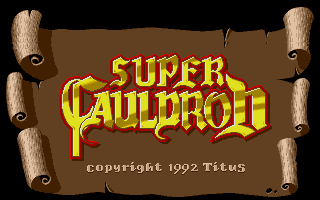
Decades later, players looking back at this action platformer hit the exact same wall that divided reviewers in 1993. The cute graphics and cheerful spell effects disguise a punishment-heavy design philosophy. Enemy placement often forces you into taking damage unless you know exactly when an enemy will spawn from off-screen, and the inertia on Zmira's jump makes tight landing spots a nerve-wracking exercise. If you lack the patience for early nineties computer platformer quirks, the constant resetting will wear you down fast.
Yet for fans of Titus platformers, the variety of spells and inventive secret placement offer genuine reward. Successfully melting a barrier to reveal a hidden bridge feels satisfying because the game makes you earn every spell drop. If you enjoy tough side-scrollers where learning level layouts by heart is half the battle, there is a rewarding challenge tucked inside this box.
You can play Super Cauldron online for free right here, running direct in your web browser with no setup or hardware configuration needed. It gives you immediate access to the full experience, letting you test your reflexes against Marl's minions within seconds.
When you start your run, practice switching to your newly acquired spells immediately using your standard number and function keys rather than relying on the slow basic rock throw. The tricky momentum of Zmira's jump is something you only get a real feel for once your fingers are on the keys, so take a minute in the opening forest area to master landing on small platforms before you plunge into the deep cathedral levels.
Super Cauldron puts you in control of Zmira, a surprisingly square-jawed young witch hopping across platforms and lobbing rocks at persistent bats while searching for lost spell ingredients. It looks like a friendly mascot platformer, but behind the bright pixel art lies a notoriously stubborn exercise in early nineties computer gaming precision.
Boot up the 1992 MS-DOS release and the first thing you notice is how floating and twitchy Zmira feels to move. Designed by Vincent Berthelot, the game sends you through four distinct worlds (a forest, a plain, a village, and a dark cathedral leading to the sorcerer Marl's castle) that are each broken into compact level sections. Your starting attack is a weak thrown stone with an awkward arc, which makes early enemy encounters much tense than they look. Bats, trolls, snakes, and vultures do not just float in simple patterns, because once they acquire you, they will follow you clear across the screen boundary into the next area.
Progression through each section relies on hunting down specific enemies carrying keys required to unlock the exit door. You end up constantly managing screen space, baiting aggressive trolls off high ledges so you can slip past without taking damage. A broomstick power-up occasionally grants temporary flight to reach high ledges or secret rooms, but normal movement demands absolute precision. Miss a jump over a pit by two pixels and you are back to the start of the section, often with half your health bar drained by a persistent vulture that refused to give up the chase.
What sets the game apart from basic run and jump titles is its magical arsenal. Beyond your default pebble throw, you can discover and cast up to 12 distinct spells by hitting function keys or selection commands. Some spells serve as heavy offensive upgrades like fire bolts and lightning, while utility magic lets you melt metal barriers or build invisible staircases and bridges over bottomless gaps. This spell system turns later levels into light puzzles, requiring you to conserve your casting power for the exact obstacle blocking your path.
Environmental tricks keep you on your toes, though not always fairly. Water hazards present one of the oddest design choices: certain pools of water kill Zmira instantly on contact, while other identical pools act as secret passages leading to hidden item caches. The game offers no visual clue to distinguish a deadly drop from a secret room, meaning player progress often relies on brute force trial and error. The physical manual brought its own quirks to the original release, famously instructing players to press F11 and F12 on Amiga keyboards, despite standard Amiga hardware only featuring function keys up to F10.
Development began around 1990 under French studio Titus France SA, taking roughly two years to reach store shelves. When Titus released the title for MS-DOS, Atari ST, Amiga, and Amstrad CPC, critical reception split wildly down the middle. European magazines gave vastly different verdicts. Amstrad Action awarded it a massive 96% score in issue 93, while CU Amiga slammed it with a 27% score in July 1993, with reviewer John Mather calling the gameplay "dull and tedious." Amiga Power went even lower with 26%, whereas Amiga Computing gave it a warm 80% and Amiga Format settled on 70%.
Much of the praise went to the technical polish on home computers. The Amstrad CPC version, programmed by Elmar Krieger (who also worked on Prehistorik 2), pushed the 8-bit machine hard with smooth animation and title graphics by artist Harris Kladis. The music by Christian Lier and Thorsten Mitschele stood out as well. Instead of relying on crude PC speaker bleeps, the DOS edition included custom tracker soundtrack routines that played multi-channel digital audio through compatible sound cards, giving the adventure a surprisingly rich audio backdrop for 1992.
Decades later, players looking back at this action platformer hit the exact same wall that divided reviewers in 1993. The cute graphics and cheerful spell effects disguise a punishment-heavy design philosophy. Enemy placement often forces you into taking damage unless you know exactly when an enemy will spawn from off-screen, and the inertia on Zmira's jump makes tight landing spots a nerve-wracking exercise. If you lack the patience for early nineties computer platformer quirks, the constant resetting will wear you down fast.
Yet for fans of Titus platformers, the variety of spells and inventive secret placement offer genuine reward. Successfully melting a barrier to reveal a hidden bridge feels satisfying because the game makes you earn every spell drop. If you enjoy tough side-scrollers where learning level layouts by heart is half the battle, there is a rewarding challenge tucked inside this box.
You can play Super Cauldron online for free right here, running direct in your web browser with no setup or hardware configuration needed. It gives you immediate access to the full experience, letting you test your reflexes against Marl's minions within seconds.
When you start your run, practice switching to your newly acquired spells immediately using your standard number and function keys rather than relying on the slow basic rock throw. The tricky momentum of Zmira's jump is something you only get a real feel for once your fingers are on the keys, so take a minute in the opening forest area to master landing on small platforms before you plunge into the deep cathedral levels.
The on-screen keyboard and gamepad mapping the browser player uses on a phone, a tablet or a controller, as opposed to the real keys above. $PRO members make their own in the player and share them here; anyone can pick one to play with.
Cheat codes, console commands and memory pokes for Super Cauldron — each one verified and attributed.
Sign in to submitThe on-screen keyboard and gamepad mapping the browser player uses on a phone, a tablet or a controller, as opposed to the real keys above. $PRO members make their own in the player and share them here; anyone can pick one to play with.
Cheat codes, console commands and memory pokes for Super Cauldron — each one verified and attributed.
Sign in to submit