

aka SWIV 3D Assault
Playing SWIV 3D means wrestling with a brutal 3D voxel engine that gives you vast open terrain to destroy, but leaves you completely exposed to enemy fire the moment you tip your helicopter's nose down to attack.
When Sales Curve Interactive shifted their top-down shooter series into full 3D in 1996, they threw out the tight, screen-by-screen enemy patterns of old top-down shooters and replaced them with sprawling, open-ended battlefields. Built on a custom voxel engine programmed by James Sharman, the game renders rolling hills and mountain ranges without requiring a 3D accelerator card. The trade-off is a heavy, claustrophobic horizon fog that hides anti-aircraft guns until you are almost on top of them, running at an unusual 320x400 VGA video mode.
The core loop sounds straightforward: you take control of a helicopter or an armored jeep to hunt down missile sites, radar dishes, and enemy military convoys across 18 missions. But the transition to a free-roaming engine fundamentally changes how you fight. Instead of dodging static bullet patterns, you spend your time constantly checking a radar compass to track incoming jet fighters and boats while trying to keep your altitude high enough to avoid ground fire.
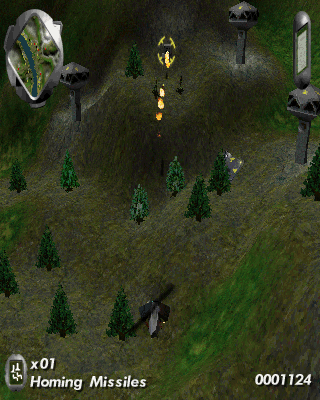
The single biggest issue you meet in SWIV 3D is the physical mechanic of aiming downward in the chopper. To hit a ground turret or a tank with your standard guns, you have to tilt the nose of the helicopter down, which automatically pushes your vehicle forward and drops your line of sight. While you are staring at the ground trying to clear a heavily fortified base, enemy helicopters and jets spawn behind you and chip away at your shield.
To make matters worse, auto-targeting frequently locks onto irrelevant scenery like trees and shrubs instead of the rocket launcher firing directly at your cockpit. Your starting weapons feel weak, power-ups and health drops are rare, and the ground jeep shares the exact same shield pool as your helicopter during vehicle swap points. If you take heavy damage while driving through a canyon, you start the next air sequence on the brink of death.

The engine development was genuinely ambitious for an 1996 release. While the 3D models were crafted on Silicon Graphics Indigo 2 workstations, the engine ran smoothly on standard Pentium CPUs, prompting early reviews to note that even a Pentium 133 handled screens full of enemy craft without severe slowdown. The audio design had its own strange history: SCi tried to license electronic tracks from Simon Posford (Hallucinogen) and Louis Nicastro for the official soundtrack, but royalty clearance snags meant the full licensing deal fell through right before launch, leaving a mix of electronic tracks behind.
The game demands patience that borders on punishing. A single mission in late-game alien or arctic environments can take over half an hour to clear, and dying near the end means restarting the entire map from scratch. If you want to test your reflexes against a tough mid-nineties PC shooter, you can play action games right in your browser, but be ready for a steep climb.
SWIV 3D does not hold your hand, and its high difficulty will turn off anyone expecting a simple arcade flight model. What makes it worth playing now is its scale and the distinct feel of mid-nineties voxel flight, which plays completely differently from polygon-based simulators. It was a stubborn experiment in pushing software rendering as far as a standard CPU could take it.
You can play SWIV 3D online, free in your browser, with nothing to install and no complex setup required. Jump into the cockpit, keep your eye on the radar compass, and remember to circle ground installations from high altitude rather than diving straight in unless you want your first run to end in under three minutes.
Playing SWIV 3D means wrestling with a brutal 3D voxel engine that gives you vast open terrain to destroy, but leaves you completely exposed to enemy fire the moment you tip your helicopter's nose down to attack.
When Sales Curve Interactive shifted their top-down shooter series into full 3D in 1996, they threw out the tight, screen-by-screen enemy patterns of old top-down shooters and replaced them with sprawling, open-ended battlefields. Built on a custom voxel engine programmed by James Sharman, the game renders rolling hills and mountain ranges without requiring a 3D accelerator card. The trade-off is a heavy, claustrophobic horizon fog that hides anti-aircraft guns until you are almost on top of them, running at an unusual 320x400 VGA video mode.
The core loop sounds straightforward: you take control of a helicopter or an armored jeep to hunt down missile sites, radar dishes, and enemy military convoys across 18 missions. But the transition to a free-roaming engine fundamentally changes how you fight. Instead of dodging static bullet patterns, you spend your time constantly checking a radar compass to track incoming jet fighters and boats while trying to keep your altitude high enough to avoid ground fire.

The single biggest issue you meet in SWIV 3D is the physical mechanic of aiming downward in the chopper. To hit a ground turret or a tank with your standard guns, you have to tilt the nose of the helicopter down, which automatically pushes your vehicle forward and drops your line of sight. While you are staring at the ground trying to clear a heavily fortified base, enemy helicopters and jets spawn behind you and chip away at your shield.
To make matters worse, auto-targeting frequently locks onto irrelevant scenery like trees and shrubs instead of the rocket launcher firing directly at your cockpit. Your starting weapons feel weak, power-ups and health drops are rare, and the ground jeep shares the exact same shield pool as your helicopter during vehicle swap points. If you take heavy damage while driving through a canyon, you start the next air sequence on the brink of death.

The engine development was genuinely ambitious for an 1996 release. While the 3D models were crafted on Silicon Graphics Indigo 2 workstations, the engine ran smoothly on standard Pentium CPUs, prompting early reviews to note that even a Pentium 133 handled screens full of enemy craft without severe slowdown. The audio design had its own strange history: SCi tried to license electronic tracks from Simon Posford (Hallucinogen) and Louis Nicastro for the official soundtrack, but royalty clearance snags meant the full licensing deal fell through right before launch, leaving a mix of electronic tracks behind.
The game demands patience that borders on punishing. A single mission in late-game alien or arctic environments can take over half an hour to clear, and dying near the end means restarting the entire map from scratch. If you want to test your reflexes against a tough mid-nineties PC shooter, you can play action games right in your browser, but be ready for a steep climb.
SWIV 3D does not hold your hand, and its high difficulty will turn off anyone expecting a simple arcade flight model. What makes it worth playing now is its scale and the distinct feel of mid-nineties voxel flight, which plays completely differently from polygon-based simulators. It was a stubborn experiment in pushing software rendering as far as a standard CPU could take it.
You can play SWIV 3D online, free in your browser, with nothing to install and no complex setup required. Jump into the cockpit, keep your eye on the radar compass, and remember to circle ground installations from high altitude rather than diving straight in unless you want your first run to end in under three minutes.
How SWIV 3D is played — the keys the game listens to, grouped by what they do.
Highlighted keys are mapped — hover or tap one to see what it does.
Specific key mappings for main weapon and missile firing are missing from available sources.
The on-screen keyboard and gamepad mapping the browser player uses on a phone, a tablet or a controller, as opposed to the real keys above. $PRO members make their own in the player and share them here; anyone can pick one to play with.
Cheat codes, console commands and memory pokes for SWIV 3D — each one verified and attributed.
Sign in to submitHow SWIV 3D is played — the keys the game listens to, grouped by what they do.
Highlighted keys are mapped — hover or tap one to see what it does.
Specific key mappings for main weapon and missile firing are missing from available sources.
The on-screen keyboard and gamepad mapping the browser player uses on a phone, a tablet or a controller, as opposed to the real keys above. $PRO members make their own in the player and share them here; anyone can pick one to play with.
Cheat codes, console commands and memory pokes for SWIV 3D — each one verified and attributed.
Sign in to submit