
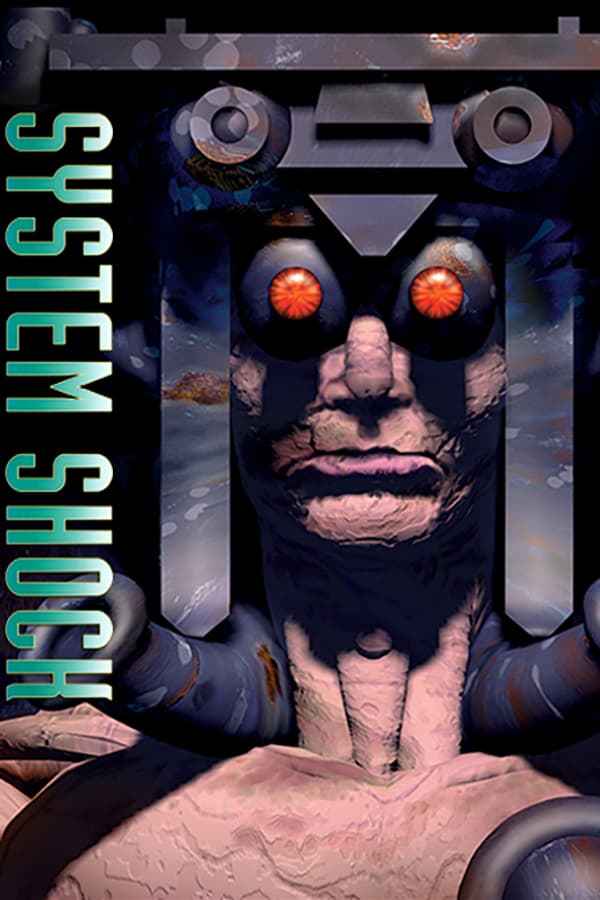

System Shock
Streaming build
Checking storage…528 MB
Preload in background
JIT compiler
Rate this game
Rating 5.0
- Rating
- 5.0/ 5
- Played
System Shock dropped players into the cold, metal corridors of Citadel Station without a hand to hold, handing them a lead pipe and asking them to outsmart a godlike artificial intelligence.
Looking Glass built a simulation while everyone else made target galleries
When LookingGlass Technologies put out System Shock in 1994, the first-person genre was almost entirely defined by flat corridors and simple, fast action. Instead of building another straight corridor shooter, director Doug Church and producer Warren Spector pushed for a fully realized environment. Built on a custom engine by a team including Sean Barrett and Seamus Blackley, the game introduced sloped floor panels, true room height variation, and a physics engine that made thrown items bounce off bulkheads.
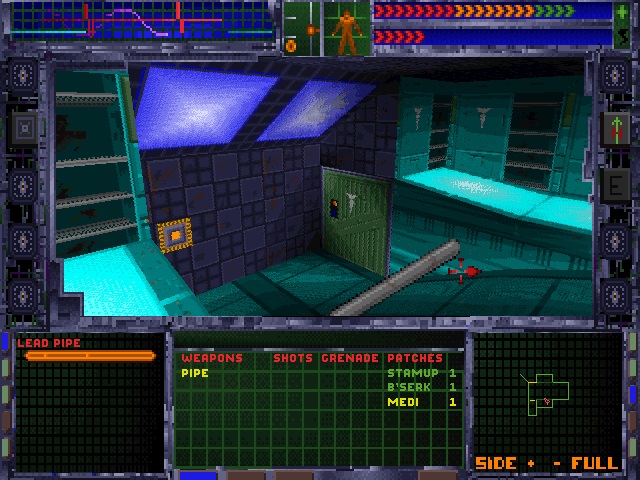
You play as a nameless hacker caught tampering with corporate files, dragged to Citadel Station, and tasked with removing the ethical constraints of the station's AI, SHODAN. After waking from a six-month coma on the Medical Level, you find the crew transformed into cyborgs and mutants, the security cameras watching your every move, and SHODAN running the whole operation. It was a massive departure from standard action titles of 1994, forcing you to pay attention to your surroundings rather than just running and gunning.
Combat on Citadel Station requires resource management and keycodes
Surviving the ten levels of Citadel Station - stretching from the Medical and Research Laboratories up through the Flight Deck and Executive suites - is a constant balancing act. You start with basic melee tools and gradually recover firearms, electromagnetic pulse weapons, and gas grenades. Ammo is rarely abundant, and managing electrical energy is just as important as keeping your health high. Certain weapons hit organic mutants hard, while mechanical security robots demand EMP rounds or a heavy burst from energy-draining gear.
The core loop forces direct interaction with the station's systems rather than just clearing rooms. Progress depends on gathering keycodes from audio logs left behind by dead crew members, solving circuit-wiring puzzles on wall panels, and lowering security levels across each deck by destroying SHODAN's node cameras. You also clear spatial security by stepping into cyberspace terminals, flying through a wireframe 3D grid to flip software locks and open sealed doors in the physical station.
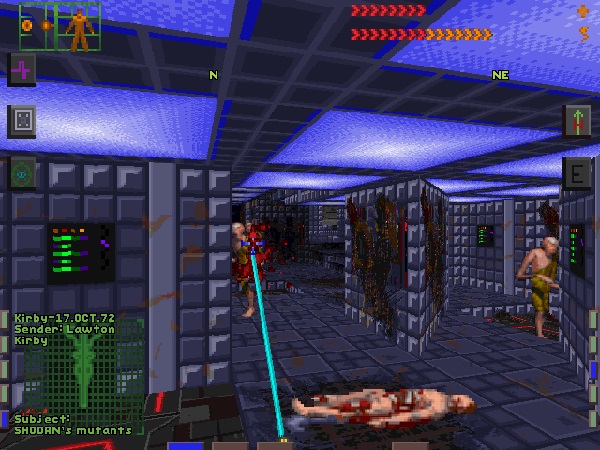
The inventory management features a range of consumable items:
- Medical patches that rapidly heal physical damage at the cost of temporary side effects.
- Berserk patches that boost raw strength for close-quarters fights while causing wild visual hallucinations.
- Detox patches to clear out radiation and biohazard buildup after swimming through contaminated sub-levels.
- Hardware upgrades like head-mounted lanterns and energy shields that draw power directly from your suit batteries.
The original HUD and vertical aim were notoriously brutal to master
For all its technical brilliance, the MS-DOS release gained an immediate reputation for being hard to control. The interface split the screen into a dense collection of inventory grids, target displays, suit readouts, and map pop-ups, leaving a surprisingly small window for actual viewing. Looking up and down required precise manual adjustments that made picking up items off floor panels a chore, especially when under attack by Cortex Reavers or heavy security bots.
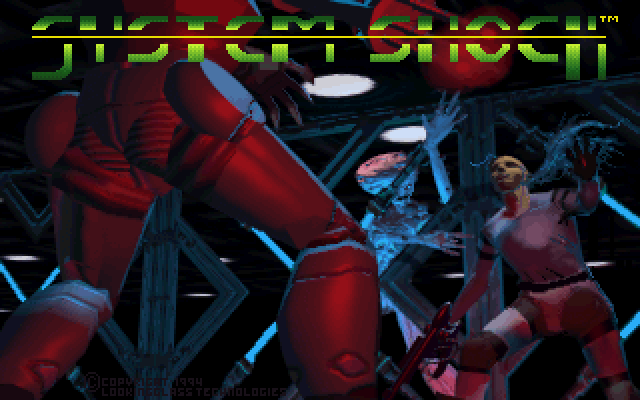
Hardware costs were another massive wall for players upon release. To run the game smoothly, you needed a powerful 486DX-33 processor running in protected mode under DOS/4GW. Hearing the sound design properly meant tweaking your Sound Blaster or Gravis UltraSound setup with custom patches, though PC Gamer noted at the time that the soundtrack audio could sound odd depending on your card configuration. Even so, the sheer depth of the mechanics earned it a 95% score from PC Zone, setting it apart from every competing action game on the market.
Looking Glass put incredible detail into the world, including a small real-life nod: the very first door code in the game, 451, was taken from the entry keycode for the developer's real office in Cambridge, Massachusetts. Yet despite glowing critical reviews, the high system requirements and steep learning curve limited initial sales. Published by Origin Systems, it moved over 170,000 copies, but the high budget meant Looking Glass ultimately lost money on the production.
How to play System Shock online today
System Shock pushed world design forward by treating its setting as a complex, reactive system, directly shaping its 1999 sequel and years of first-person design that followed. While the heavy interface takes a few minutes of learning, the eerie atmosphere of Citadel Station and SHODAN's taunts haven't lost any of their teeth.
You can run this full original System Shock MS-DOS game directly in your web browser with no setup or file downloads required. If you want to see where systemic design began, jump straight into the Medical Level, pick up the lead pipe, and start smashing those SHODAN security cameras right now.
How System Shock is played — the keys the game listens to, grouped by what they do.
- Movement
- Action
- Interface
- Right click — Activate weapon / throw item
- Left click — Select / move forward
Highlighted keys are mapped — hover or tap one to see what it does.
Joysticks require manual calibration before use in the Option menu (Esc or 'q'). Player typing is used when adding custom notes to the map.
Players' controls
Touch and gamepad controls
The on-screen keyboard and gamepad mapping the browser player uses on a phone, a tablet or a controller, as opposed to the real keys above. $PRO members make their own in the player and share them here; anyone can pick one to play with.
Make your own touch controlsPRO
- 1Open the editorSign in below, then pick what to make. The game starts with the editor open over it.
- 2Place your keysAdd keys and drag them where your thumbs rest, or map a controller's buttons. Test plays the game with them; Save keeps them, and you play with them from then on.
- 3Share themShare them right after saving in the game, or name and share them here. Players vote, and the best become this game's controls for everyone.
Go PROSee how it worksSign in+20 XP for sharing · +50 XP if yours become the game's own
- The game's own controlsKeyboardGamepadWhat every player starts with.In use
3 screenshots
From the archive
No gameplay video yet
No gameplay video for System Shock yet. Sign in to add one.
No reviews yet
Tell the community what you think of System Shock. Reviews are public and tied to your username.
No archived manuals for System Shock yet
No manuals archived for this title yet. Sign in to upload the first scan.
Cheat codes, console commands and memory pokes for System Shock — each one verified and attributed.
Sign in to submitNo cheats yet for this title
Know a working cheat, poke or trainer? Add it with the button above. Moderators check every entry before it goes live.
No archived soundtrack for System Shock yet
No soundtrack archived for this title yet. Sign in to upload the first rip.
No save states for System Shock yet
No save states for this title yet. Sign in to share one.
Discussions
Sign in to post- Threads0
- Total posts0
- Online now6
Community · System Shock
Who's contributing, and what's new
- Reviews0
- Threads0
- Uploadsapproved0
- Contributors0
Recent activity