


Playing Teenagent means stepping into a world where a fortune teller chooses a teenager to solve high-stakes bank robberies, armed with nothing more than inventory items and absurd comedic logic.
The story kicks off without taking itself seriously for a second. Mark Hopper is just an average teenager who gets drafted into espionage because a fortune teller pointed him out to the RGB intelligence agency. His mission is to solve the mysterious disappearance of gold reserves from the Mega Bank and stop the mastermind John Noty.
Before you get near the main villain, the agency sends you to a training camp. You control Mark entirely through a clean mouse interface in this adventure game from 1995. Left-clicking inspects an object or character, while right-clicking interacts with them or opens conversation. Moving your mouse to the top edge of the screen reveals your inventory belt.
To pass the training phase, you must complete three specific tasks handed down by the captain of the guard. There are no combat encounters, branching dialogue choices, or sudden player deaths. Every obstacle demands that you search every scene, pick up every loose item, and test odd combinations.
I spent far too long figuring out how to use a mug on a muddy puddle to make progress. The puzzle logic operates on odd cartoon rules rather than real-world physics. If an idea sounds completely ridiculous, it is usually the intended path forward.
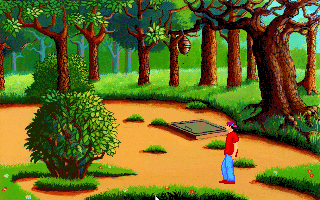
The adventure breaks down into three distinct acts, but they are far from equal in size or quality. Once you finish the training camp, you move on to explore a rural village, which eventually opens the path into the villain's hideout.
The second act contains a massive difficulty spike and takes up the vast majority of your playtime. While the first and third acts move along at a reasonable pace, the village section grinds your progress to a halt with unhelpful hints and obscure objectives.
This slowdown happens mostly because the puzzles rely on random item testing and severe pixel hunts. In the final chapter inside the mansion, you must find a tiny, pixel-sized book tucked away on a huge library wall. Finding it requires dragging your cursor across every inch of the screen until the word appears.
The bright visual palette makes key objects vanish right into the background art. Without clear clues from the dialogue, you will spend plenty of time combining items blindly from your inventory belt.
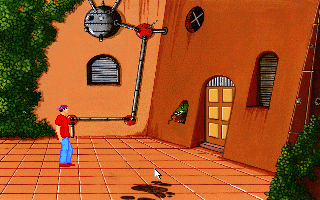
Developer Metropolis Software House created the title to build on their previous work, Tajemnica Statuetki. Co-founders Adrian Chmielarz and Grzegorz Miechowski spearheaded the project, with Chmielarz taking charge of programming and story writing.
The studio designed separate joke sets for local Polish players and international releases. The English text features peculiar phrasing and typos that make the dialogue sound like an actual teenager wrote it. Upbeat military background music loops continuously while you wander through each screen.
It carries real historical significance as the first video game ever released on CD-ROM in Poland. In 1996, a local re-release named Nowy Teenagent added full Polish voice acting recorded by gaming journalists from Gambler magazine. That CD version included updated visual tweaks, full CD-Audio music, and a bonus track containing developer interviews.
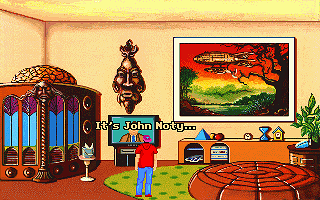
You can finish the full story in about two to three hours if you know what to do. The puzzle logic is frustrating at times and the visual translation has noticeable flaws, but the fast movement and clean interface keep it playable.
Compared to heavy point-and-click titles of the era, it feels light, goofy, and unpretentious. Metropolis Software House and GOG.com eventually made the entire original title available as freeware in 2009, cementing its spot as an easy piece of DOS history to check out.
You can play Teenagent online directly in your browser window right now. Start by testing every item on the guard captain, enjoy the bouncy soundtrack, and see how a nineties Polish point-and-click adventure comes together without downloading a thing.
Playing Teenagent means stepping into a world where a fortune teller chooses a teenager to solve high-stakes bank robberies, armed with nothing more than inventory items and absurd comedic logic.
The story kicks off without taking itself seriously for a second. Mark Hopper is just an average teenager who gets drafted into espionage because a fortune teller pointed him out to the RGB intelligence agency. His mission is to solve the mysterious disappearance of gold reserves from the Mega Bank and stop the mastermind John Noty.
Before you get near the main villain, the agency sends you to a training camp. You control Mark entirely through a clean mouse interface in this adventure game from 1995. Left-clicking inspects an object or character, while right-clicking interacts with them or opens conversation. Moving your mouse to the top edge of the screen reveals your inventory belt.
To pass the training phase, you must complete three specific tasks handed down by the captain of the guard. There are no combat encounters, branching dialogue choices, or sudden player deaths. Every obstacle demands that you search every scene, pick up every loose item, and test odd combinations.
I spent far too long figuring out how to use a mug on a muddy puddle to make progress. The puzzle logic operates on odd cartoon rules rather than real-world physics. If an idea sounds completely ridiculous, it is usually the intended path forward.
The adventure breaks down into three distinct acts, but they are far from equal in size or quality. Once you finish the training camp, you move on to explore a rural village, which eventually opens the path into the villain's hideout.
The second act contains a massive difficulty spike and takes up the vast majority of your playtime. While the first and third acts move along at a reasonable pace, the village section grinds your progress to a halt with unhelpful hints and obscure objectives.
This slowdown happens mostly because the puzzles rely on random item testing and severe pixel hunts. In the final chapter inside the mansion, you must find a tiny, pixel-sized book tucked away on a huge library wall. Finding it requires dragging your cursor across every inch of the screen until the word appears.
The bright visual palette makes key objects vanish right into the background art. Without clear clues from the dialogue, you will spend plenty of time combining items blindly from your inventory belt.
Developer Metropolis Software House created the title to build on their previous work, Tajemnica Statuetki. Co-founders Adrian Chmielarz and Grzegorz Miechowski spearheaded the project, with Chmielarz taking charge of programming and story writing.
The studio designed separate joke sets for local Polish players and international releases. The English text features peculiar phrasing and typos that make the dialogue sound like an actual teenager wrote it. Upbeat military background music loops continuously while you wander through each screen.
It carries real historical significance as the first video game ever released on CD-ROM in Poland. In 1996, a local re-release named Nowy Teenagent added full Polish voice acting recorded by gaming journalists from Gambler magazine. That CD version included updated visual tweaks, full CD-Audio music, and a bonus track containing developer interviews.
You can finish the full story in about two to three hours if you know what to do. The puzzle logic is frustrating at times and the visual translation has noticeable flaws, but the fast movement and clean interface keep it playable.
Compared to heavy point-and-click titles of the era, it feels light, goofy, and unpretentious. Metropolis Software House and GOG.com eventually made the entire original title available as freeware in 2009, cementing its spot as an easy piece of DOS history to check out.
You can play Teenagent online directly in your browser window right now. Start by testing every item on the guard captain, enjoy the bouncy soundtrack, and see how a nineties Polish point-and-click adventure comes together without downloading a thing.
How Teenagent is played — the keys the game listens to, grouped by what they do.
Highlighted keys are mapped — hover or tap one to see what it does.
Key map is based on available documentation; save and pause controls were omitted in retrieved sources.
The on-screen keyboard and gamepad mapping the browser player uses on a phone, a tablet or a controller, as opposed to the real keys above. $PRO members make their own in the player and share them here; anyone can pick one to play with.
Cheat codes, console commands and memory pokes for Teenagent — each one verified and attributed.
Sign in to submitaka Teen Agent · Agent Mlíčňák · Nowy Teenagent
How Teenagent is played — the keys the game listens to, grouped by what they do.
Highlighted keys are mapped — hover or tap one to see what it does.
Key map is based on available documentation; save and pause controls were omitted in retrieved sources.
The on-screen keyboard and gamepad mapping the browser player uses on a phone, a tablet or a controller, as opposed to the real keys above. $PRO members make their own in the player and share them here; anyone can pick one to play with.
Cheat codes, console commands and memory pokes for Teenagent — each one verified and attributed.
Sign in to submit