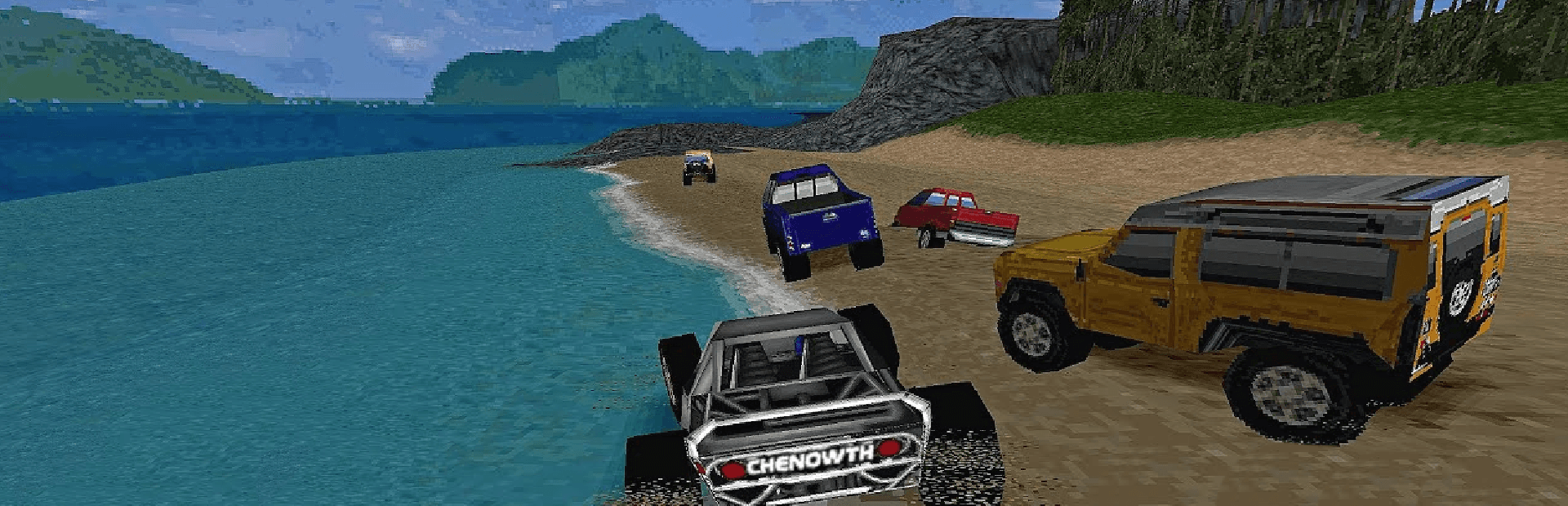
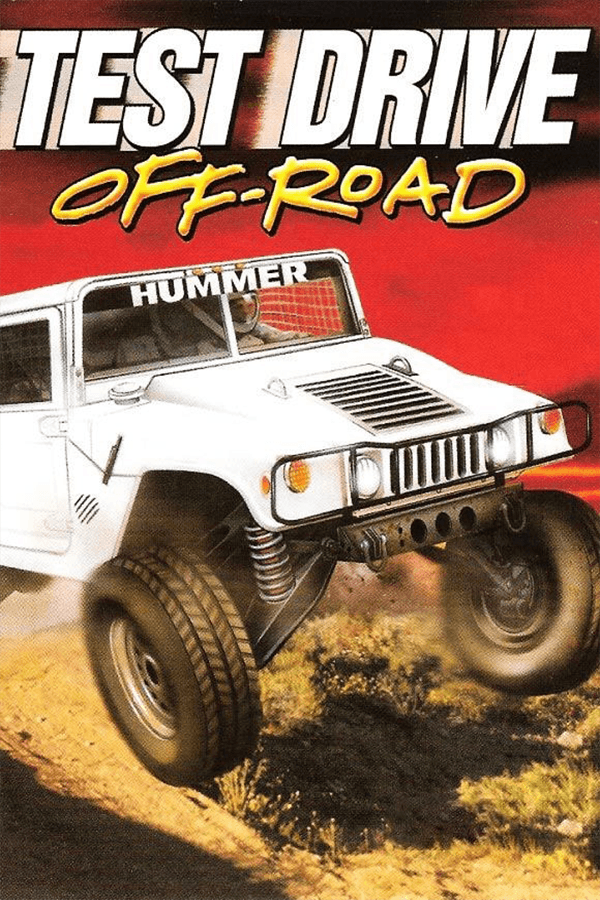

Taking the famous racing franchise away from paved highways, Test Drive: Off-Road traded sleek exotic sports cars for chunky four-wheel drives, churning through dirt, sand, and snow.
When you boot up the 1997 racing game, the shift in direction hits immediately. Instead of lined-up supercars waiting on smooth pavement, you pick from four factory four-wheel-drive trucks: a Hummer H1, a Land Rover Defender 90, a Jeep Wrangler, or a Chevy K1500 Z71. The goal is simple arcade competition against three computer opponents across 12 circuit tracks split between dirt pits, desert sand dunes, and slippery snow tracks. There are no weapon pick-ups, boss battles, or track puzzles to solve, just straightforward laps against the clock and three rival drivers.
You can jump straight into a quick exhibition in Practice Race, or take on a longer campaign in Class League and Mixed League. Class League keeps the playing field level by forcing every opponent into the same vehicle model, which turns races into a strict test of line choice and momentum. Mixed League throws all four production trucks onto the track together, letting the heavy Hummer bully lighter Jeeps through tight corners. If you prefer playing with friends, the game offers split-screen head-to-head alongside network multiplayer modes.
Whether you choose first-person bumper views or third-person chase angles, every course demands careful attention to where the road actually goes. Track boundaries can be easy to lose track of when driving through muddy banks, and missing a hidden checkpoint will instantly ruin a solid lead. The game includes basic damage modeling, so smashing your truck into rock walls or broadsiding an AI driver takes a physical toll on your rig as the laps add up.
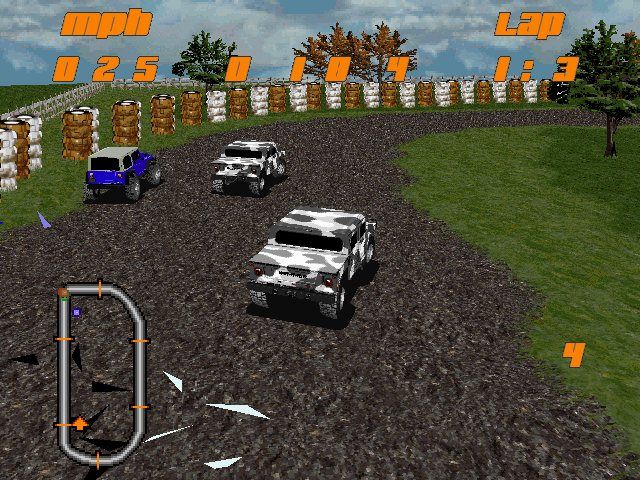
Handling is where British developer Elite Systems ran into serious trouble. Rather than building a deep physics system that simulated ground suspension or tire grip on uneven dirt, the vehicle movement feels floaty and imprecise. Stepping on the gas and turning into a corner often results in heavy slide physics that lack weight, making small steering adjustments feel overly loose. When trucks hit terrain jumps or run over opponent bumpers, collision glitches can bounce your vehicle unpredictably or lock it into strange angles.
The visual presentation received similar criticism upon release. While the vehicle models look faithful to their real-life counterparts, the environment graphics suffer from heavy pop-up where distant hills and trackside trees snap into view right in front of your front bumper. When you try to play 1997 games like this on modern setups using emulator tools, mounting both the hard drive and CD-ROM directories properly is mandatory, or the software will drop its visual textures and sound files entirely.
Where the production value shines is in the audio design. Publisher Accolade, Inc. brought in real engine recordings alongside voiceover commentary performed by announcer Bob Fitzgerald. The soundtrack relies heavily on mid-nineties industrial rock, packing three heavy tracks by the band Gravity Kills that blast over the engine noise while you power through the mud.
While the standard roster stays limited to four standard trucks, typing specific driver names into the player menu opens up a massive collection of hidden content and absurd physics tweaks. The game conceals six extra vehicles that break completely away from the off-road theme, letting you race unusual machines against standard trucks.
The full list of unlockable secret vehicles includes:
Beyond extra rides, the built-in driver cheats give you total control over how the software runs. Typing CHEAT1 unlocks all secret vehicles immediately, while CHEAT2 opens up every track in the game. If you want to view the full video library, CHEAT3 plays all built-in FMV sequences. Gameplay tweaks are even wilder: CHEAT4 turns off wall collision completely, CHEAT5 artificially increases truck speed and cornering grip, LOWGRAVY floats your vehicle into the air over small bumps, and KAHNDAWG makes your truck execute lightning-fast flips whenever you hit a ridge.
Gaming outlets delivered mixed scores when the title hit store shelves. GameSpot praised the accurate vehicle shapes and pure arcade action while giving the PC version a 6.3/10, noting that it lacked true edge-of-the-seat challenge. PC Gamer US awarded it a 64%, and Next Generation handed down a harsh 2/5 rating, pointing out that it fell short of competing racing titles on the market. Over on consoles, Electronic Gaming Monthly highlighted the complex course designs but admitted the scenery got repetitive quickly.
Despite critical complaints about loose steering and pop-in graphics, store sales told a completely different story. The title became a major commercial hit for Accolade, selling over 500,000 copies by March 1998. That commercial momentum transformed a single spinoff into an entire subseries, paving the way for Test Drive Off-Road 2 later that same year and spawning multiple sequels on home systems.
You can play Test Drive: Off-Road online free in your browser right now, with full keyboard support ready to go. The physics take some getting used to and the terrain graphics are unmistakably mid-nineties, but unlocking a Mini Cooper with cheat codes and launching it across desert sand dunes to industrial rock is still a wild piece of PC gaming history worth taking for a quick spin.
Taking the famous racing franchise away from paved highways, Test Drive: Off-Road traded sleek exotic sports cars for chunky four-wheel drives, churning through dirt, sand, and snow.
When you boot up the 1997 racing game, the shift in direction hits immediately. Instead of lined-up supercars waiting on smooth pavement, you pick from four factory four-wheel-drive trucks: a Hummer H1, a Land Rover Defender 90, a Jeep Wrangler, or a Chevy K1500 Z71. The goal is simple arcade competition against three computer opponents across 12 circuit tracks split between dirt pits, desert sand dunes, and slippery snow tracks. There are no weapon pick-ups, boss battles, or track puzzles to solve, just straightforward laps against the clock and three rival drivers.
You can jump straight into a quick exhibition in Practice Race, or take on a longer campaign in Class League and Mixed League. Class League keeps the playing field level by forcing every opponent into the same vehicle model, which turns races into a strict test of line choice and momentum. Mixed League throws all four production trucks onto the track together, letting the heavy Hummer bully lighter Jeeps through tight corners. If you prefer playing with friends, the game offers split-screen head-to-head alongside network multiplayer modes.
Whether you choose first-person bumper views or third-person chase angles, every course demands careful attention to where the road actually goes. Track boundaries can be easy to lose track of when driving through muddy banks, and missing a hidden checkpoint will instantly ruin a solid lead. The game includes basic damage modeling, so smashing your truck into rock walls or broadsiding an AI driver takes a physical toll on your rig as the laps add up.

Handling is where British developer Elite Systems ran into serious trouble. Rather than building a deep physics system that simulated ground suspension or tire grip on uneven dirt, the vehicle movement feels floaty and imprecise. Stepping on the gas and turning into a corner often results in heavy slide physics that lack weight, making small steering adjustments feel overly loose. When trucks hit terrain jumps or run over opponent bumpers, collision glitches can bounce your vehicle unpredictably or lock it into strange angles.
The visual presentation received similar criticism upon release. While the vehicle models look faithful to their real-life counterparts, the environment graphics suffer from heavy pop-up where distant hills and trackside trees snap into view right in front of your front bumper. When you try to play 1997 games like this on modern setups using emulator tools, mounting both the hard drive and CD-ROM directories properly is mandatory, or the software will drop its visual textures and sound files entirely.
Where the production value shines is in the audio design. Publisher Accolade, Inc. brought in real engine recordings alongside voiceover commentary performed by announcer Bob Fitzgerald. The soundtrack relies heavily on mid-nineties industrial rock, packing three heavy tracks by the band Gravity Kills that blast over the engine noise while you power through the mud.

While the standard roster stays limited to four standard trucks, typing specific driver names into the player menu opens up a massive collection of hidden content and absurd physics tweaks. The game conceals six extra vehicles that break completely away from the off-road theme, letting you race unusual machines against standard trucks.
The full list of unlockable secret vehicles includes:
Beyond extra rides, the built-in driver cheats give you total control over how the software runs. Typing CHEAT1 unlocks all secret vehicles immediately, while CHEAT2 opens up every track in the game. If you want to view the full video library, CHEAT3 plays all built-in FMV sequences. Gameplay tweaks are even wilder: CHEAT4 turns off wall collision completely, CHEAT5 artificially increases truck speed and cornering grip, LOWGRAVY floats your vehicle into the air over small bumps, and KAHNDAWG makes your truck execute lightning-fast flips whenever you hit a ridge.
Gaming outlets delivered mixed scores when the title hit store shelves. GameSpot praised the accurate vehicle shapes and pure arcade action while giving the PC version a 6.3/10, noting that it lacked true edge-of-the-seat challenge. PC Gamer US awarded it a 64%, and Next Generation handed down a harsh 2/5 rating, pointing out that it fell short of competing racing titles on the market. Over on consoles, Electronic Gaming Monthly highlighted the complex course designs but admitted the scenery got repetitive quickly.
Despite critical complaints about loose steering and pop-in graphics, store sales told a completely different story. The title became a major commercial hit for Accolade, selling over 500,000 copies by March 1998. That commercial momentum transformed a single spinoff into an entire subseries, paving the way for Test Drive Off-Road 2 later that same year and spawning multiple sequels on home systems.
You can play Test Drive: Off-Road online free in your browser right now, with full keyboard support ready to go. The physics take some getting used to and the terrain graphics are unmistakably mid-nineties, but unlocking a Mini Cooper with cheat codes and launching it across desert sand dunes to industrial rock is still a wild piece of PC gaming history worth taking for a quick spin.
aka Gekitotsu! Yonku Battle
How Test Drive: Off-Road is played — the keys the game listens to, grouped by what they do.
Highlighted keys are mapped — hover or tap one to see what it does.
Controls can be remapped using the Control menu within the game. Pressing the Hand Brake key repeatedly induces a power slide.
The on-screen keyboard and gamepad mapping the browser player uses on a phone, a tablet or a controller, as opposed to the real keys above. $PRO members make their own in the player and share them here; anyone can pick one to play with.
Cheat codes, console commands and memory pokes for Test Drive: Off-Road — each one verified and attributed.
Sign in to submit
Test Drive: Off-Road1997 · this pageCheat codes, console commands and memory pokes for Test Drive: Off-Road — each one verified and attributed.
Sign in to submit
Test Drive: Off-Road1997 · this page