The Dungeons of Grimlor II
aka Dungeons of Grimlor 2: The Lich
Rate this game
- Played
- A lot
In The Dungeons of Grimlor II, Sir Merdimek returns to battle a dragon resurrected as an undead lich across maze-like rooms filled with moving boulders, wizard summons, and lethal traps. Instead of standard dungeon crawling, this top-down action title tests your ammo management and puzzle skills as much as your reflexes.
QuickBASIC limits create a surprisingly tense top-down action engine
You realize fast that this is not a dark, line-of-sight crawler. The graphics run in crisp high-resolution VGA at 640x480, displaying entire rooms in single top-down screens. Developer John A. Reder built the engine in Microsoft QuickBASIC 4.5, which forced a fixed flip-screen layout rather than smooth full-screen scrolling.
That technical limit shapes the rhythm of the game. Every time you cross a doorway, the entire room shifts in an instant. Because room states persist when you leave and come back, pushed boulders and opened doors stay where you left them. That persistence lets you set up long-term tactical control over whole sections of a level.
The core campaign spans three distinct chapters. Episode 1 was distributed as shareware, while Episode 2 and Episode 3 were reserved for paying customers. The top-down view gives you complete tactical sight of each room, but reacting to sudden wizard spellcasts still requires immediate action.
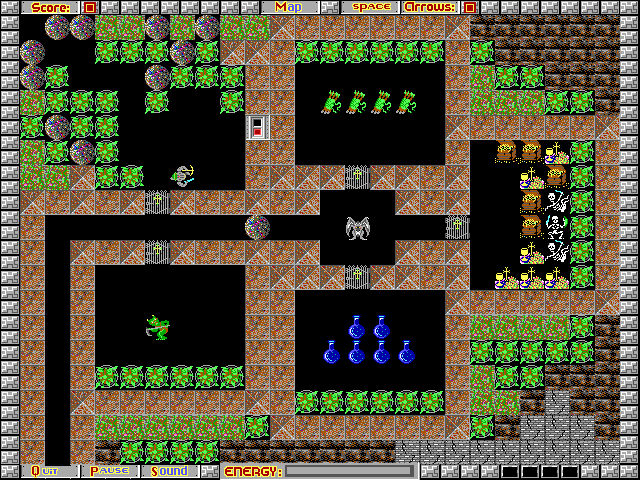
Puzzles and trapped corridors replace traditional dungeon crawling in The Dungeons of Grimlor II
combat depends entirely on positioning and resources. Sir Merdimek uses a bow as his primary weapon, but straight shooting will not carry you through every room. Certain armored monsters completely resist arrows, forcing you to rely on physical hazards to defeat them.
That design turns many encounters into active physical puzzles. You push heavy boulders across tiles to crush approaching enemies or wedge them in front of wall traps that shoot unending streams of arrows. You step on switches to open isolated gates, ride flowing river currents into hidden treasure vaults, and step into teleporters without knowing where you will land.
- Wizards can raise fallen monsters back from the dead until you target them directly.
- Keys colored to matching doors must be hunted down through branch tracks.
- Healing potions restore health, and earning every 10,000 points grants a complete health refill.
- Secret river currents hide bonus treasure rooms behind strong water flows.
Balancing aggression with careful movement is essential. Pushing a boulder into the wrong corner can block your path or shield a wizard while he raises an army of undead skeletons behind you. If you enjoy puzzle-heavy action games from 1995, learning the physics of these rooms provides genuine satisfaction.
Wasted arrows and sticky orientation bugs test your patience
Despite its clever puzzle rooms, the game features design choices that can frustrate even careful players. Ammunition management is strict, yet the shooting mechanics are unnecessarily punishing. If you press the attack button and fire an arrow into a solid wall or empty air, that arrow disappears from your quiver permanently.
An even bigger hazard comes from taking damage. When an enemy hits Sir Merdimek, a engine bug sometimes locks your character facing in one fixed direction. You can still step around the grid, but you cannot turn to aim at monsters until the movement state resets, which often costs precious health points.
The save system offers very little safety margin either. You receive only five save slots across your entire run, so saving inside a bad situation can ruin a clean play session. You have to manage those save slots with extreme discipline to avoid trapping yourself in a dead end.
Shareware distribution took Sir Merdimek across global mailboxes
Published by SumWare Software, later known as Tactical Neuronics, the title reached players through traditional shareware channels. Creator John Reder coded the game himself, getting assistance from a coworker on just two of the level layouts. Orders arrived from around the world, teaching the young developer early business lessons about insisting on payments drawn strictly in U.S. dollars.
It quickly appeared on popular shareware CD compilations, including the February 1996 Pacific HiTech Best of the Internet disc. Reder eventually released the entire trilogy as freeware, allowing players everywhere to complete Sir Merdimek's quest without sending check mailings to Texas.
Compared to heavy hit shooters of the mid-nineties, this title kept its focus on deliberate grid positioning. It demanded careful pathfinding over raw fast aiming, creating a distinct niche for puzzle action enthusiasts on DOS systems.
Fire up the classic MS-DOS action directly in your browser
While the mechanics carry real quirks, the room puzzles and persistent dungeon mechanics make this entry worth your time. The combination of boulder pushing, trap disarming, and spellcaster priority targeting gives the action a solid strategic core that still holds up.
You can play The Dungeons of Grimlor II free in your browser right here on this page, with zero installation needed. Jump into Sir Merdimek's armor, watch your arrow counts carefully, and see if you can claim the Cross of the Lich today.
How The Dungeons of Grimlor II is played — the keys the game listens to, grouped by what they do.
- Movement
- Action
- Interface
Highlighted keys are mapped — hover or tap one to see what it does.
Players' controls
Touch and gamepad controls
The on-screen keyboard and gamepad mapping the browser player uses on a phone, a tablet or a controller, as opposed to the real keys above. $PRO members make their own in the player and share them here; anyone can pick one to play with.
Make your own touch controlsPRO
- 1Open the editorSign in below, then pick what to make. The game starts with the editor open over it.
- 2Place your keysAdd keys and drag them where your thumbs rest, or map a controller's buttons. Test plays the game with them; Save keeps them, and you play with them from then on.
- 3Share themShare them right after saving in the game, or name and share them here. Players vote, and the best become this game's controls for everyone.
Go PROSee how it worksSign in+20 XP for sharing · +50 XP if yours become the game's own
- The game's own controlsKeyboardGamepadWhat every player starts with.In use
2 screenshots
From the archive
No gameplay video yet
No gameplay video for The Dungeons of Grimlor II yet. Sign in to add one.
No reviews yet
Tell the community what you think of The Dungeons of Grimlor II. Reviews are public and tied to your username.
No archived manuals for The Dungeons of Grimlor II yet
No manuals archived for this title yet. Sign in to upload the first scan.
Cheat codes, console commands and memory pokes for The Dungeons of Grimlor II — each one verified and attributed.
Sign in to submitNo cheats yet for this title
Know a working cheat, poke or trainer? Add it with the button above. Moderators check every entry before it goes live.
No archived soundtrack for The Dungeons of Grimlor II yet
No soundtrack archived for this title yet. Sign in to upload the first rip.
No save states for The Dungeons of Grimlor II yet
No save states for this title yet. Sign in to share one.
Discussions
Sign in to post- Threads0
- Total posts0
- Online now6
Community · The Dungeons of Grimlor II
Who's contributing, and what's new
- Reviews0
- Threads0
- Uploadsapproved0
- Contributors0
Recent activity
Nothing here yet
Reviews, discussion threads and approved uploads appear here as members add them.