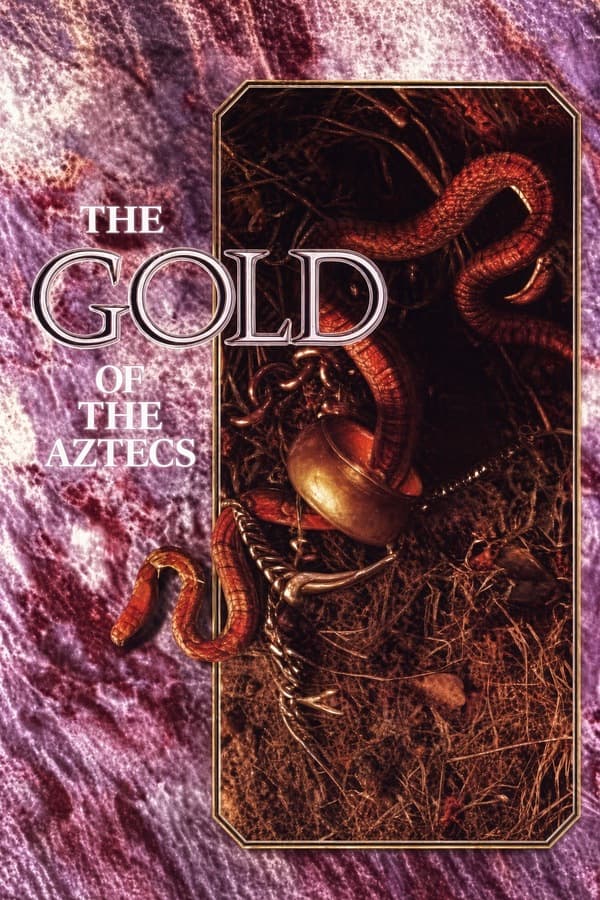
In The Gold of the Aztecs, you step into the boots of Vietnam veteran Bret Conrad to hunt down a ancient treasure hidden deep inside an underground ruin, but you will spend most of your time dying seconds after your parachute lands.
You drop straight into the South American jungle with a machete, a handgun, and almost no margin for error. Within three screens of landing, you learn exactly what kind of project Kinetica Software built: a game where every step forward is a trap. Headhunters fire blowpipes from the tree line, cannibals charge you on sight, and if you stand around trying to figure out the timing, an elephant stampedes across the screen to crush you flat.
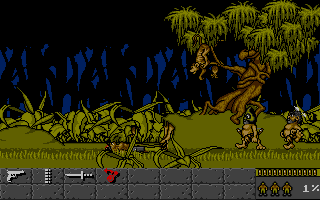
The screen-by-screen progression demands brutal precision. Every screen is effectively an execution puzzle where Conrad must perform an exact sequence of movements to survive. You cannot simply react to enemies on the fly. You have to memorize their patrol loops, track their attack patterns, and commit your inputs before the animation cycles catch up with you. If you miss a jump, you start over. If you swing your blade half a second late, you take a blowpipe dart to the neck.
The manual famously listed massive claims about the work behind the game, citing 27,000 man-hours of development, 7,000 frames of animation, and 140 distinct hero actions. To generate all those frames, the team built a network of seven Apple Macintosh computers, six Commodore Amigas for art, and seven Atari STs hooked up as peripherals. They ran the entire pipeline through a custom engine called GDS to squeeze 18 megabytes of raw art down into 3 megabytes across two floppy disks.
That heavy visual focus paid off in the graphics department, but it wrecked the controls. Critics in 1990 were intensely divided over the trade-off. Computer Gaming World praised the detailed animation and music, while Info magazine handed it a 38% rating, calling the character handling lethargic. On the PC speaker and early sound hardware, David Whittaker supplied a dedicated sound driver loaded with over 600KB of audio data, giving the environment a heavy, atmospheric backdrop that stood out for an action game from 1990.
The real issue isn't the difficulty itself, but how sluggishly Bret Conrad responds to your commands. Movement has an agonizing lag because the game insists on drawing every intermediate frame of animation before acknowledging your next keypress. If you tell Conrad to turn around, duck, and draw his pistol, he will finish his complete walking cycle before he even thinks about touching his holster. In an engine where a single hit kills you, that delay makes survival feel like luck rather than skill.
Navigating the sprawling underground tomb passages requires solving item puzzles while managing your tiny inventory, but the save system barely cuts you any slack. While publisher U.S. Gold Ltd. made sure a save option was present in the manual, restoring a position does not relieve the pressure of having to replay punishing sequences until your movements align perfectly with the game engine's strict rhythm.
If you want to experience this piece of PC history, you can play The Gold of the Aztecs online right now. The artwork, atmospheric sound, and odd pop-culture nods (including a brief visual appearance by Indiana Jones) make it worth looking at, even if the sluggish movement keeps it from being a fluid action title.
You can run The Gold of the Aztecs free in your browser without setting up extra software or tracking down an old code wheel. Fire up the MS-DOS game version, watch out for the elephant on the early jungle screens, and see how many screens you can clear before the input lag gets the better of you.
In The Gold of the Aztecs, you step into the boots of Vietnam veteran Bret Conrad to hunt down a ancient treasure hidden deep inside an underground ruin, but you will spend most of your time dying seconds after your parachute lands.
You drop straight into the South American jungle with a machete, a handgun, and almost no margin for error. Within three screens of landing, you learn exactly what kind of project Kinetica Software built: a game where every step forward is a trap. Headhunters fire blowpipes from the tree line, cannibals charge you on sight, and if you stand around trying to figure out the timing, an elephant stampedes across the screen to crush you flat.

The screen-by-screen progression demands brutal precision. Every screen is effectively an execution puzzle where Conrad must perform an exact sequence of movements to survive. You cannot simply react to enemies on the fly. You have to memorize their patrol loops, track their attack patterns, and commit your inputs before the animation cycles catch up with you. If you miss a jump, you start over. If you swing your blade half a second late, you take a blowpipe dart to the neck.
The manual famously listed massive claims about the work behind the game, citing 27,000 man-hours of development, 7,000 frames of animation, and 140 distinct hero actions. To generate all those frames, the team built a network of seven Apple Macintosh computers, six Commodore Amigas for art, and seven Atari STs hooked up as peripherals. They ran the entire pipeline through a custom engine called GDS to squeeze 18 megabytes of raw art down into 3 megabytes across two floppy disks.
That heavy visual focus paid off in the graphics department, but it wrecked the controls. Critics in 1990 were intensely divided over the trade-off. Computer Gaming World praised the detailed animation and music, while Info magazine handed it a 38% rating, calling the character handling lethargic. On the PC speaker and early sound hardware, David Whittaker supplied a dedicated sound driver loaded with over 600KB of audio data, giving the environment a heavy, atmospheric backdrop that stood out for an action game from 1990.

The real issue isn't the difficulty itself, but how sluggishly Bret Conrad responds to your commands. Movement has an agonizing lag because the game insists on drawing every intermediate frame of animation before acknowledging your next keypress. If you tell Conrad to turn around, duck, and draw his pistol, he will finish his complete walking cycle before he even thinks about touching his holster. In an engine where a single hit kills you, that delay makes survival feel like luck rather than skill.
Navigating the sprawling underground tomb passages requires solving item puzzles while managing your tiny inventory, but the save system barely cuts you any slack. While publisher U.S. Gold Ltd. made sure a save option was present in the manual, restoring a position does not relieve the pressure of having to replay punishing sequences until your movements align perfectly with the game engine's strict rhythm.
If you want to experience this piece of PC history, you can play The Gold of the Aztecs online right now. The artwork, atmospheric sound, and odd pop-culture nods (including a brief visual appearance by Indiana Jones) make it worth looking at, even if the sluggish movement keeps it from being a fluid action title.
You can run The Gold of the Aztecs free in your browser without setting up extra software or tracking down an old code wheel. Fire up the MS-DOS game version, watch out for the elephant on the early jungle screens, and see how many screens you can clear before the input lag gets the better of you.
How The Gold of the Aztecs is played — the keys the game listens to, grouped by what they do.
Highlighted keys are mapped — hover or tap one to see what it does.
Movement key mappings corresponding to joystick directions are truncated in the source manual text. Typing single alphanumeric digits is only required for the copy protection prompt.
The on-screen keyboard and gamepad mapping the browser player uses on a phone, a tablet or a controller, as opposed to the real keys above. $PRO members make their own in the player and share them here; anyone can pick one to play with.
Cheat codes, console commands and memory pokes for The Gold of the Aztecs — each one verified and attributed.
Sign in to submitHow The Gold of the Aztecs is played — the keys the game listens to, grouped by what they do.
Highlighted keys are mapped — hover or tap one to see what it does.
Movement key mappings corresponding to joystick directions are truncated in the source manual text. Typing single alphanumeric digits is only required for the copy protection prompt.
The on-screen keyboard and gamepad mapping the browser player uses on a phone, a tablet or a controller, as opposed to the real keys above. $PRO members make their own in the player and share them here; anyone can pick one to play with.
Cheat codes, console commands and memory pokes for The Gold of the Aztecs — each one verified and attributed.
Sign in to submit