
Time Bandit
Rate this game
- Played
- Often
In Time Bandit, you drop into a top-down maze with an infinite supply of rockets, clearing outer-space temporal gates before talking your way through computer terminals.
Clearing timegates in Time Bandit requires more than quick reflexes
Back when top-down arcade games were content to copy Gauntlet word for word, original creators Bill Dunlevy and Harry Lafnear took a different path. The original design drew heavy inspiration from the 1982 arcade title Tutankham, initially carrying the working name Pharaoh. By the time programmer Timothy Purves ported the code as an 1989 MS-DOS game for MichTron Corp. and MicroDeal Ltd., it had expanded into a strange hybrid of shooter and text adventure.
You play as a roguish space thief stepping through the Timegate hub. The central area presents sixteen distinct portals leading to wildly varied historical and fictional settings. You can step into ancient Egypt, navigate a high-risk bomb factory, explore a medieval arena, or wander through a silent ghost town. The game lets you pick your entry point freely, offering an open structure that few high-speed action games offered at the time.
Clearing a world is only the first step. Each region can be played up to sixteen times, but the game reshuffles the board after every exit. Monsters move noticeably faster on higher iterations, level maps flip horizontally or vertically, and key placements shift to force fresh pathing.
Sixteen worlds and a rocket launcher
The core gameplay loop centers on survival, key gathering, and door unlocking while constantly on the move. Your primary tool is a rocket launcher packed with unlimited ammunition. That infinite supply keeps the trigger finger active, but spamming missiles will not save you if you get trapped in a tight alleyway.
Enemies swarm continuously from spawners or wander the corridors in predictable patterns. Certain mazes explicitly mirror early arcade layouts, including a direct homage to Pac-Man where ghost-like entities hunt you down narrow corridors. Another area forces you to dodge creeping lines of segmented enemies that move suspiciously like the segmented bugs from Centipede.
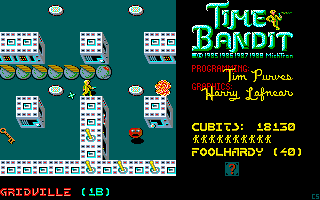
Navigation demands constant vigilance. You spend half your time weaving between monster fire and the other half searching for color-coded keys to unlock doors blocking the path to the exit. The top-down viewport lets you plan your routes early, but fast-spawning creatures keep tension high while you line up shots down tight corridors.
When an arcade shooter meets a rigid text parser
The element that splits modern players right down the middle is the interactive text parser. Interspersed between frantic dodging and shooting are interactive objects, computer terminals, and non-player characters. Bumping into a console on the wrecked spaceship Excalibur pauses the arcade action and opens a text prompt demanding keyboard input.
To repair damaged spaceship systems or complete optional side quests for rare artifacts, you have to type specific instructions. This hybrid mechanic brings character to the universe, but the text parser is notoriously strict. If you do not type the exact phrasing expected by the game, it simply returns no response, leaving you guessing while the main objective stalls.
This contrast between twitch reflexes and static text input creates a unique rhythm. You might spent three minutes blasting through alien spawners, only to spend five minutes fighting a stubby command line to fix a reactor door. It is a bold design choice that occasionally hits a wall of frustrating trial-and-error typing.
Arcade homages and split-screen duel mode
Beyond its solo campaign, the game includes a dedicated two-player split-screen Duel Mode. Two players can take the field simultaneously on a single monitor, working together to survive hostile levels or actively competing against one another for key drops and high scores. Split-screen cooperative play gave the action a genuine couch-multiplayer dynamic rarely seen in PC shooters of the decade.
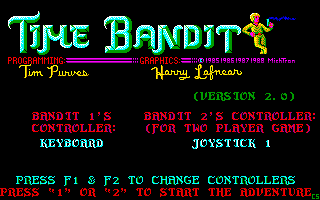
The developers leaned heavily into their love for classic arcade games. Beside the clear nods to Tutankham and Pac-Man, you will spot level tricks borrowed straight from Bomberman. In 2010, co-creator Harry Lafnear published The Timelord's Handbook, an official hint manual detailing secret mechanics and behind-the-scenes history. Years later, the original creators placed the game under a Creative Commons license, preserving its history for digital enthusiasts.
That open-source gesture ensures players can explore every secret level without digging through obscure second-hand software auctions. The community documentation makes deciphering the obscure parser prompts far more manageable for first-time runners.
Why you should try this classic arcade hybrid
Time Bandit is a strange experiment that forces high-speed shooting into the same room as text-based puzzle solving. The fast rocket action, clever level repetition mechanics, and split-screen multiplayer hold up well if you enjoy classic maze survival. The rigid parser prompts and strict phrase requirements get annoying fast, but the sheer variety across all sixteen timegates offsets the occasional wall of text.
If you want to experience this unique mix of genres yourself, you can play Time Bandit online right now. You can jump straight into the timegates and fire up Time Bandit free in your browser with zero installation hassle.
How Time Bandit is played — the keys the game listens to, grouped by what they do.
- Movement
- Action
- Interface
Highlighted keys are mapped — hover or tap one to see what it does.
Key mapping for MS-DOS specific function keys (such as save game keys) is omitted due to unavailable DOS-specific reference cards in cited research. Startup requires typing a copy protection passphrase from the manual.
Players' controls
Touch and gamepad controls
The on-screen keyboard and gamepad mapping the browser player uses on a phone, a tablet or a controller, as opposed to the real keys above. $PRO members make their own in the player and share them here; anyone can pick one to play with.
Make your own touch controlsPRO
- 1Open the editorSign in below, then pick what to make. The game starts with the editor open over it.
- 2Place your keysAdd keys and drag them where your thumbs rest, or map a controller's buttons. Test plays the game with them; Save keeps them, and you play with them from then on.
- 3Share themShare them right after saving in the game, or name and share them here. Players vote, and the best become this game's controls for everyone.
Go PROSee how it worksSign in+20 XP for sharing · +50 XP if yours become the game's own
- The game's own controlsKeyboardGamepadWhat every player starts with.In use
2 screenshots
From the archive
No gameplay video yet
No gameplay video for Time Bandit yet. Sign in to add one.
No reviews yet
Tell the community what you think of Time Bandit. Reviews are public and tied to your username.
No archived manuals for Time Bandit yet
No manuals archived for this title yet. Sign in to upload the first scan.
Cheat codes, console commands and memory pokes for Time Bandit — each one verified and attributed.
Sign in to submitNo cheats yet for this title
Know a working cheat, poke or trainer? Add it with the button above. Moderators check every entry before it goes live.
No archived soundtrack for Time Bandit yet
No soundtrack archived for this title yet. Sign in to upload the first rip.
No save states for Time Bandit yet
No save states for this title yet. Sign in to share one.
Discussions
Sign in to post- Threads0
- Total posts0
- Online now6
Community · Time Bandit
Who's contributing, and what's new
- Reviews0
- Threads0
- Uploadsapproved0
- Contributors0
Recent activity
Nothing here yet
Reviews, discussion threads and approved uploads appear here as members add them.